


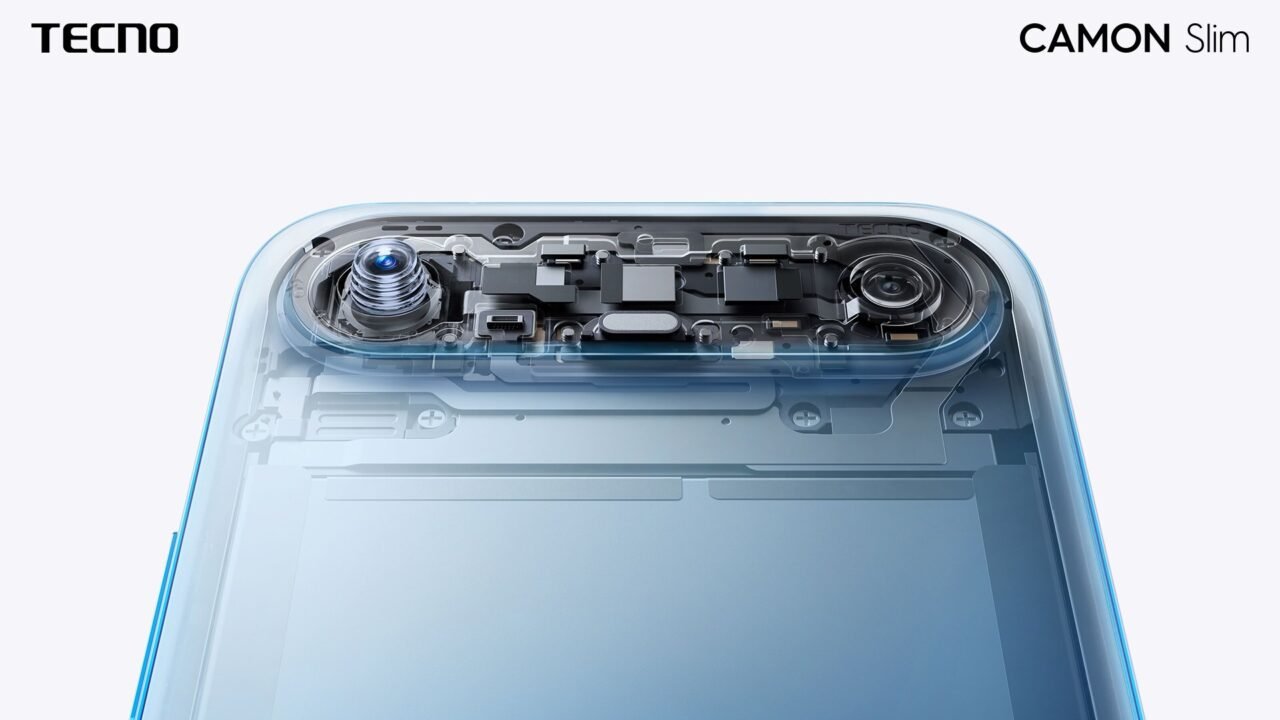
TECNO announced the CAMON Slim on 22 June 2026. It is 6.39mm thick, has a 6.78-inch 1224×2720 144Hz AMOLED screen, a MediaTek Helio G200 Ultimate chip, a 50MP Sony LYTIA 600 main camera, 60W wired charging, and both IP68 and IP69 ratings. It is a 4G phone. No 5G. It costs about USD 350.
Battery capacity depends on the source. TECNO’s own announcement says 6,000mAh and adds that “battery capacity varies by markets”. GSMArena’s spec page lists 5,600mAh. TECNO does not say what the cell is made of.
TECNO called the phone an “Ultra-Slim Art Piece in Hand” at launch. Its five finishes include a photochromic New Mondrian that changes colour in sunlight and a Van Gogh Blue based on The Starry Night, plus 354 mini LEDs on the back across 55 patterns.
Everyone else was already pulling back
Samsung launched the Galaxy S25 Edge in May 2025 at 5.8mm and USD 1,099, with a 3,900mAh battery. It sold 1.31 million units by August 2025, against 12.18 million for the Galaxy S25 Ultra. Samsung stopped making the Edge in October 2025 and, as we reported, cancelled the S26 Edge.

Apple’s iPhone Air followed in September 2025 at 5.6mm and USD 999, with a 3,149mAh battery. We covered it then as Apple’s answer to the Edge. Luxshare stopped assembling it at the end of October 2025, and Foxconn pulled down almost every line in mid-November.
Apple has not left the category. The iPhone Air is still on sale. Bloomberg’s Mark Gurman reported in June 2026 that a second generation, in advanced testing under the code name V62, is on track for spring 2027 with a second rear camera, a bigger battery and vapour chamber cooling. Apple seemingly cut its losses and skipped a September 2026 refresh.
There was also the Honor Magic8 Pro Air, a 6.1mm phone with a 5,500mAh battery and a telephoto camera. It launched in China in January 2026. AndroidHeadlines reported in May 2026 that it reached roughly 50,000 activations. The figure comes from one supply-chain leaker. Honor has not published sales.
Xiaomi, Oppo and vivo shelved theirs. When Android Authority’s Adamya Sharma asked readers in November 2025 whether they would buy a huge battery or a thin phone, 88.4% of roughly 8,500 votes went to the battery.
TECNO manages both
Samsung and Apple asked people to pay flagship money and accept a smaller battery. Buyers said no.
TECNO did not make that trade. At either 5,600mAh or 6,000mAh, the CAMON Slim has at least 1,700mAh more than the Galaxy S25 Edge did, in a body just 0.59mm thicker.
But there’s a price rise
At a results briefing on 27 March 2026, Transsion management told investors that sales below USD 100 would fall, the USD 100 to USD 200 band would rise, and products above USD 200 would grow considerably. We wrote about this earlier this month.
Transsion’s net profit for 2025 fell 53.43% to RMB 2.584 billion on revenue of RMB 65.62 billion, its first annual profit drop of more than half since listing in 2019. Memory made up close to 60% of the bill of materials on a phone retailing under USD 400 in the first quarter of 2026, roughly twice its share two quarters earlier.
Omdia’s numbers show the effect in Africa. Smartphone shipments across the continent fell 7% year on year to 17.8 million in the second quarter of 2026, the first annual drop in three years. Transsion accounted for 8.3 million of them, down 14%. It held 47% share only because Xiaomi fell 30% and Oppo fell 25%. Samsung grew 15%. Sub-USD 100 shipments dropped 34%, and that band shrank from 45% of the market in the third quarter of 2025 to 30%. The average selling price across Africa reached USD 202, up USD 41 in a year. Nigeria fell 11%, Kenya 15%, Egypt 26%.
“The combination of higher production costs and weaker consumer purchasing power is having an impact,” Manish Pravinkumar, principal analyst at Omdia, said this month.
The CAMON Slim is above that USD 200 average.
Whether the phone reaches Nigeria and Kenya at all, and at what price, is still open. So is whether Transsion can raise prices and still hold 47% of the continent, which Omdia’s next report on Africa will answer.








Join the discussion