
Samsung is now the biggest smartphone brand in Africa. Figures from TechInsights, a market research firm, published in South Korea on 2nd November put Samsung first by revenue between January and March 2026, then first by both revenue and units between April and June. Its unit sales grew 34.8% in that second quarter, while Africa’s smartphone market as a whole shrank 16.6%. Samsung says it’s the first time it has led the continent since it started selling there in 1995.
TechInsights expects Samsung to finish 2026 with 38.7% of the phones sold in Africa and 34.5% of the money spent on them. Its share of units was 22.4% in 2024 and 26.5% last year.
The question most readers will ask is whether more Africans now buy Samsung than TECNO, Infinix and itel, the three phone brands owned by the Chinese company Transsion. Samsung has passed each of those brands on its own. On the shipment counts that are public, though, it hasn’t yet passed the three of them combined.
Why the trackers don’t agree
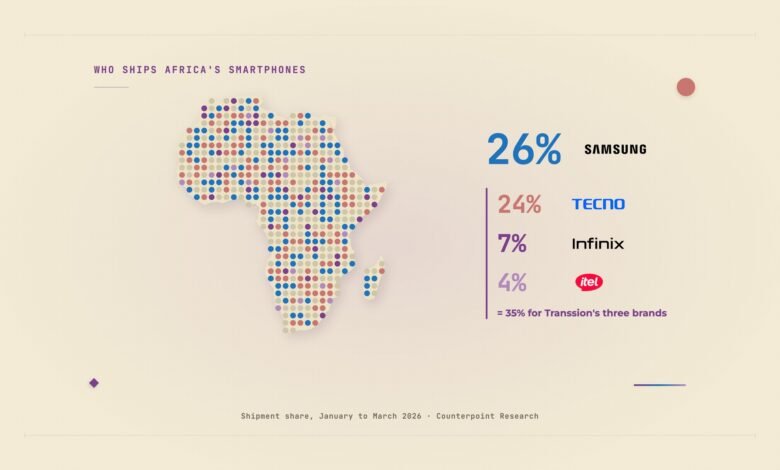
Counterpoint Research, another tracker, saw the brands swap places first. Its figures for January to March gave Samsung 26% of African shipments, up from 20% a year earlier, and TECNO 24%, down from 27%. Add Infinix’s 7% and itel’s 4% to TECNO’s share and Transsion held 35%.

Omdia counts Transsion as one company. In its April to June figures, Transsion shipped 8.3 million smartphones in Africa, 47% of the market, against Samsung’s 3.9 million and 22%. That’s more than twice as many phones. Still, Transsion’s shipments fell 14% and Samsung’s grew 15%, and a year earlier the split had been 51% to 18%.
Part of the difference is what each firm counts. Omdia and Counterpoint count shipments, the phones a maker sends out to distributors and shops. TechInsights counts phones sold. Its Africa figures also don’t say whether TECNO, Infinix and itel were counted as one company or as three.
How Samsung got here
Samsung’s main Galaxy A phones sell for about USD 200, or about KES 26,000, in a market where phones around USD 100, about KES 13,000, sell most (we’ve converted at KES 130 to the dollar and KES 19.44 to the yuan, the rates on 11th November 2026). Many buyers earn by the day or the week, which makes finding the full price at once hard. So Samsung sells to them on instalments. Through financing companies including Watu and M-KOPA, a buyer pays a small deposit, takes the phone home and clears the balance in daily or weekly mobile money payments. By Samsung’s own figures, those plans brought in 46% of its smartphone revenue in Africa this year. It also says sales of its Galaxy S and Galaxy Z flagships on the continent grew 20%.
The memory shortage helped too. Memory chips cost far more this year because their makers moved factory capacity to AI data centres, and memory takes a bigger share of what a cheap phone costs to build than a pricier one. Counterpoint says Samsung went into the shortage with plenty of stock while TECNO and other Chinese brands ran short. Omdia found that shipments of phones under USD 100 in Africa fell 34% between April and June, and that Transsion’s strong presence in that price band left it more exposed to the fall. Manish Pravinkumar, a principal analyst at Omdia, said vendors “can no longer profitably manufacture $75 smartphones”, which is about KES 9,800.
Transsion’s revenue fell 27%
Between July and September it got worse. Omdia counted Africa’s shipments down 39% in those three months, the steepest fall of any region. Transsion’s third-quarter report showed revenue down 27.45% to 14.85 billion yuan, about KES 289 billion, and profit from the phone business itself, with one-off gains taken out, down 47.72%. Transsion blamed higher supply chain costs and “reduced market capacity”, which means fewer people buying phones. As we explained earlier this month, the report doesn’t split revenue by region, so it can’t tell us how much of that fall happened in Africa.
What it means in Kenya
Kenya’s smartphone market shrank 15% between April and June on Omdia’s count. Omdia put it down to rising prices, especially for phones under USD 150, about KES 19,500, where most of the demand sits. Samsung launched the Galaxy A18 LTE here last month at KES 32,000, well above that band.
A daily plan makes a phone like that easier to start paying for, and it can cost a lot more in total. When M-KOPA started selling the Galaxy A10s in 2020, it asked for a KES 3,499 deposit and KES 60 a day for a year, KES 25,399 in all, for a phone that cost KES 12,889 upfront. Miss a payment and Samsung’s Knox software locked the phone. Those were 2020 terms for one phone. If you’re buying a Galaxy this way today, compare the total you’ll pay over the whole plan with the shop price before you sign.
The next test is Omdia’s Africa count for July to September, due in the coming weeks. It will show whether Samsung has closed the gap on Transsion’s three brands combined in a quarter when shipments across the continent fell by almost two in five.






Join the discussion