Panel makers in mainland China will account for 65.2% of the world’s automotive display shipments in the second half of 2026, according to Omdia’s latest automotive display forecast. That is up from 59.0% in the first half of this year and 56.6% across 2025. In 2019 the figure was 28.1%.
What an automotive display is
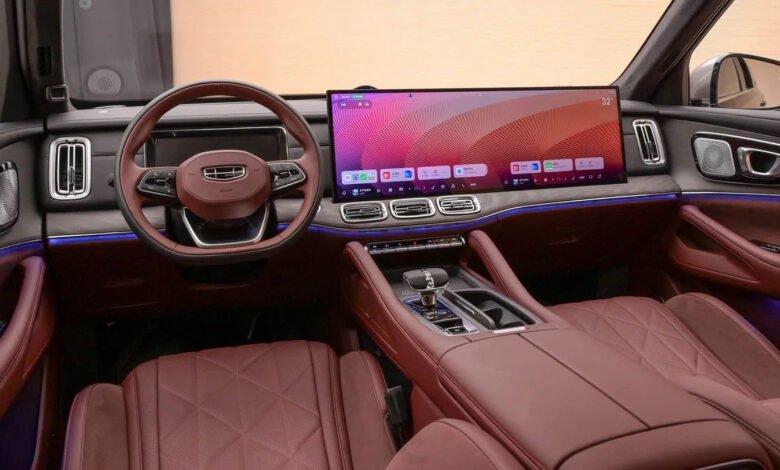
An automotive display is any screen fitted into a car at the factory. That is the instrument cluster behind the steering wheel, the central infotainment screen, and in newer cars a third screen in front of the passenger. Some models run all of them as one wide panel across the dashboard, or as several panels behind a single sheet of glass.
Geely’s Xingyue L Plus, which we covered yesterday, has 30 inches of screen split between the driver and the front passenger, plus a 17.3-inch display for the back seats. That is four panels in one mid-size family car, and every one of them has to be bought from a factory that makes them.
Most are LCDs, split between the cheaper a-Si and oxide types and the sharper, more expensive LTPS. A small and growing share are OLED, the same technology in high-end phones.
Why the Chinese share keeps climbing
Making mature LCD panels does not pay well. Panel makers outside China are responding by closing factories, selling them, or converting them to other products, and putting the money into higher-margin work instead. Every closure removes a production line that a carmaker could have used.
We are already down to just seven. That is how many automotive-grade a-Si and oxide LCD lines are left outside mainland China this year, and on the trajectory the closures set, three will be left by 2028. Most LTPS lines outside China run at about 30,000 substrates a month and were built before 2015, and no significant new capacity is planned outside China before 2028. OLED is the exception. Korean manufacturers have an established automotive OLED business, although Chinese Gen 6 capacity should be ready to serve cars by 2028 too.
Screens are not interchangeable parts
Before a display goes into a car it has to pass optical, mechanical, thermal and safety testing for that exact model. Once it passes, the supplier is fixed for the life of that vehicle programme, which usually runs several years. A panel is not a drop-in replacement just because another manufacturer sells one the same size. Changing supplier late means paying for the qualification work all over again.
So a carmaker that wants a second source has fewer places to look every year, and more of the places it can look are in China. What decides who gets to build a dashboard is turning into a question of who can still get qualified capacity, rather than who quotes the lowest price.
Carmakers fitted 232 million automotive display panels worldwide in 2024. BOE was the biggest supplier with 40.9 million units and 17.6% of the market. Tianma was second with 36.9 million and 15.9%. Both are Chinese.
What this means here
Kenya buys cars from Japan, Germany, India, China and elsewhere, mostly as used imports. The badge on the bonnet tells you less and less about where the parts inside came from. A Toyota, a Volkswagen and a BYD sold in 2027 can all carry screens from the same handful of Chinese factories.
We have been following the Chinese side of this from the vehicle end for a while, from the BYD Shark 6 landing here with NCBA financing and SBM Bank’s KES 1 billion fund behind a leased BYD fleet, to what it actually costs to import an electric car from China and Range Rover reaching the electric car years after China did. The displays are the same shift measured in components instead of finished cars.
If automotive LCD lines outside mainland China really do fall from seven to three by 2028, carmakers everywhere lose the option of buying their dashboards from anybody else. The forecast is revised every quarter, so we will know before the end of the year whether 65.2% is holding.









Join the discussion