
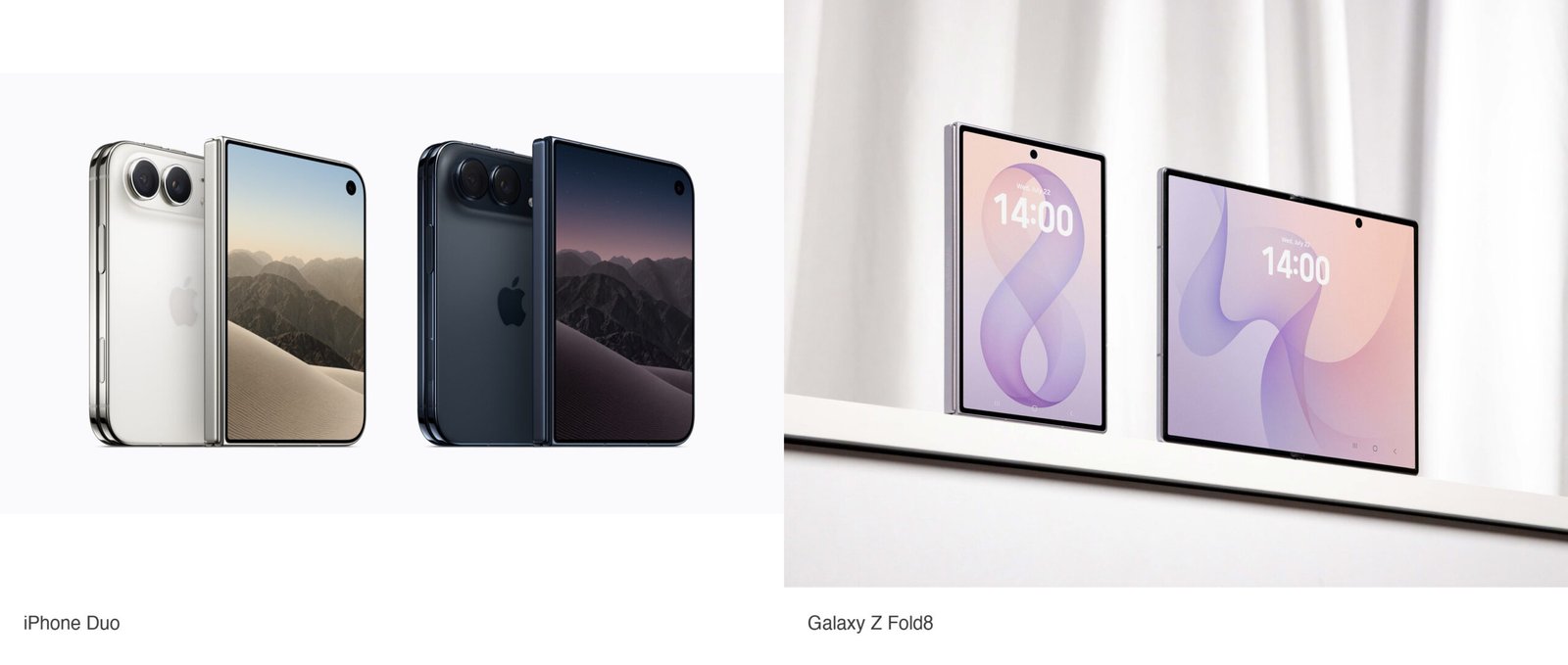
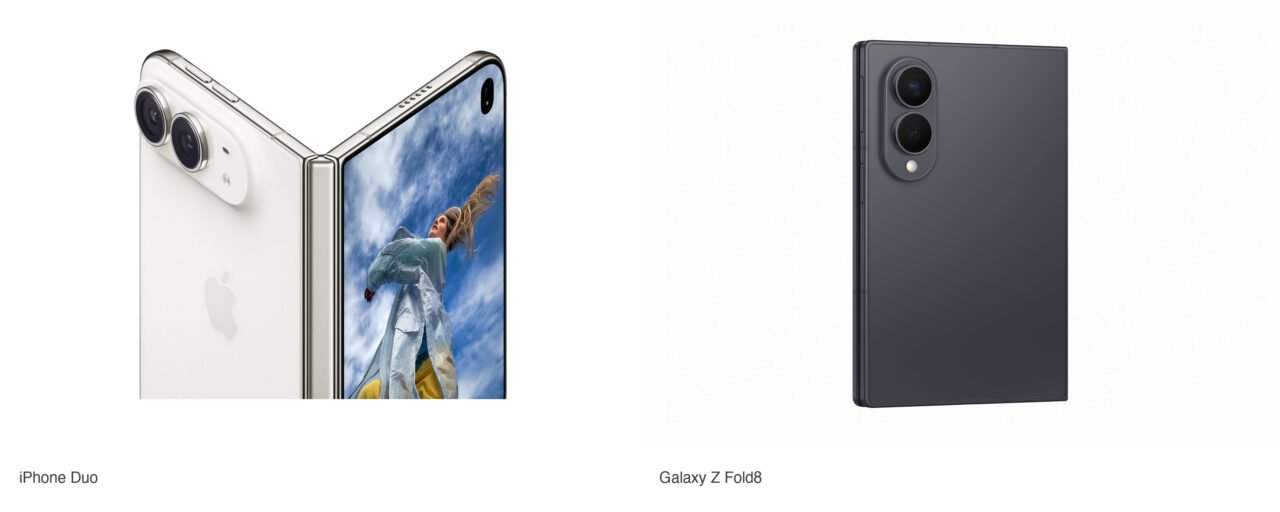
Apple announced the iPhone Duo yesterday. It starts at $1,999, about KES 259,000 before duty, with pre-orders from 16 October and sale from 23 October. Samsung launched the Galaxy Z Fold8 back in July at $1,899.99 and put it on sale on 7 August. In Kenya, Samsung Electronics East Africa sells the Fold8 from KES 243,900.
Both are the short, wide, book-style foldable Apple calls “similar in size to a passport”. Both open to a 7.6-inch inner screen and close onto a cover screen of about 5.4 inches. After that they are different in nearly everything else. We’ve already compared the Duo against the Xiaomi 18 Fold. But the Xiaomi device is China only. This is the comparison a Kenyan buyer can act on, because the Fold8 is already in shops here. And the Dio will be here in no time.
Form factor and build
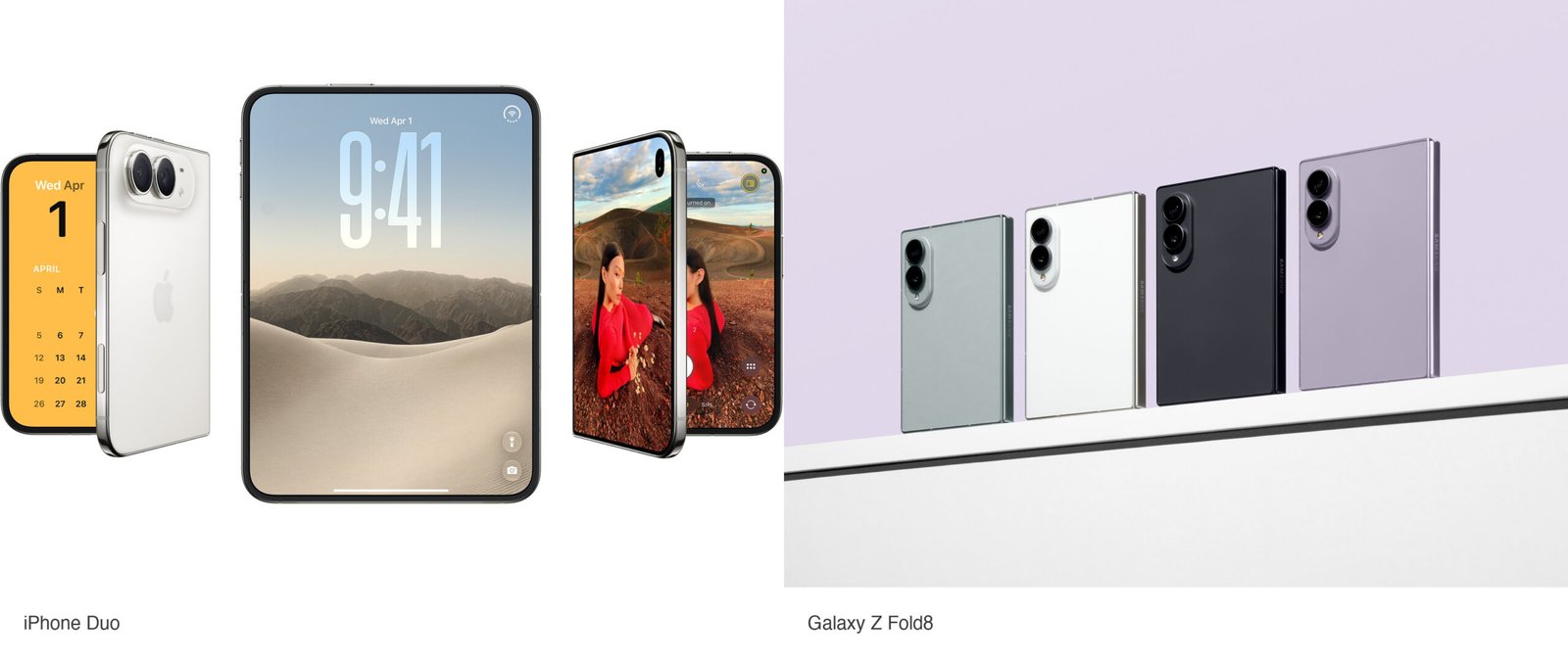
Closed, the iPhone Duo is 84.1mm wide, 117.8mm tall and 11.3mm thick. The Galaxy Z Fold8 is 81.9mm wide, 123.9mm tall and 9.7mm thick, so it still reads as a phone when shut. Open, the Duo measures 164.6mm across and 5.2mm thick; the Fold8 measures 161.4mm across and 4.5mm thick. NOTE: Samsung’s unfolded thickness leaves out the frame around the main screen, by its own footnote.
In terms of weight, the Duo weighs 254g, while the Fold8 weighs 201g. It is the lightest Fold Samsung has built, which makes Apple’s phone 26 percent heavier. Apple spent the extra grams on grade 5 titanium for the frame and a 3D-printed titanium hinge cover. Samsung on the other hand used Armor Aluminum.
The folding panels are built to different recipes. Apple lays a nano-textured polymer cover, up to 40 percent stiffer than the industry standard, over high-strength glass above and below the panel, with adhesives that let the layers glide past one another as the phone bends and a titanium plate underneath. Samsung’s answer is Flex Titanium, a titanium-alloy film over a reinforced plate, meant to spread the folding load instead of concentrating it at the crease.

The Screens
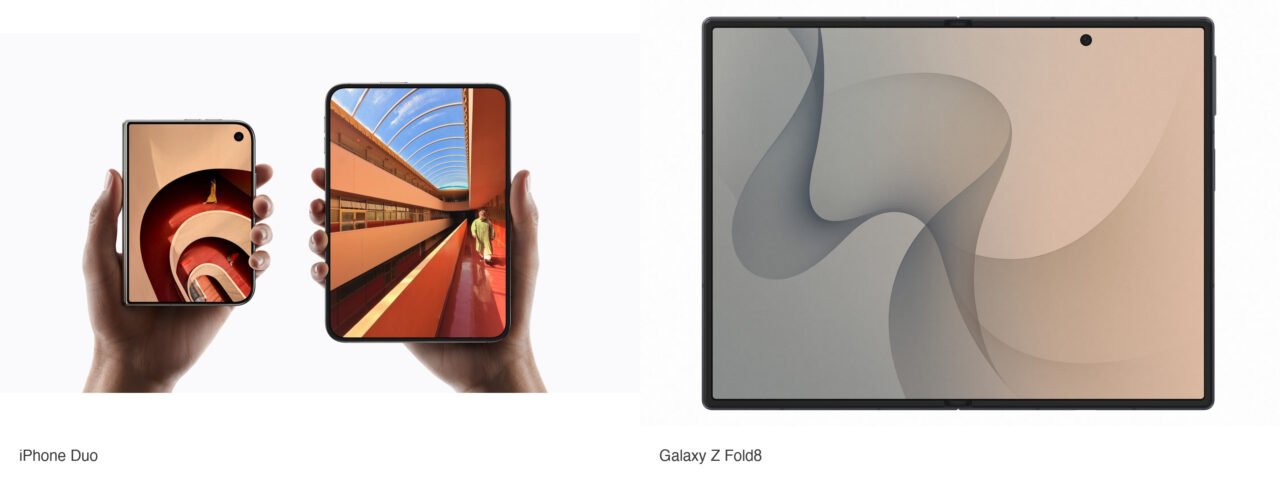
Apple’s inner display is 7.6 inches at 1878 by 2670 pixels, 430ppi. Samsung’s is 7.6 inches at 1848 by 2448, 403ppi. The outer screens are 5.4 inches at 460ppi on the Duo and 5.5 inches at 428ppi on the Fold8, and Samsung’s footnote puts that cover screen at 5.4 inches once the rounded corners are counted. The two are within a rounding error of each other.
In shape however, the phones differ.
Apple built both Duo’s inner and outer displays to the same proportions: 1.42:1 inside and 1.45:1 outside, a difference of 0.03. Open the phone and the layout stretches rather than rearranging itself. Samsung went the other way on purpose. The Fold8 cover screen is 10:16, a tall 1.58:1 built for scrolling feeds one-handed, and the inner screen is 4:3, a square 1.32:1 built for video and reading. That is a jump of 0.26, so an app has to redraw itself into a different shape every time you open the phone.
Both approaches have a cost. Samsung’s 4:3 panel wastes less space on 16:9 video than a tall foldable does, and turned sideways it reads like a paperback, which is what Fold8 owners like most about it, but some apps and games still do not scale cleanly to those proportions. Apple’s constant ratio makes the transition smoother, and it also means the outer screen is wider and shorter than any iPhone you have used, which changes how one-handed typing feels. And with the differences in shape on the Duo from left to right on the outer display, left handed people will feel left out a little.
Brightness is a draw on paper. Both claim 3,000 nits peak, though the Fold8 measures 1,525 nits at maximum in lab testing. To fight glare and better hide any potential creases, Apple uses the nano-texture matte finish it sells on MacBook Pro.
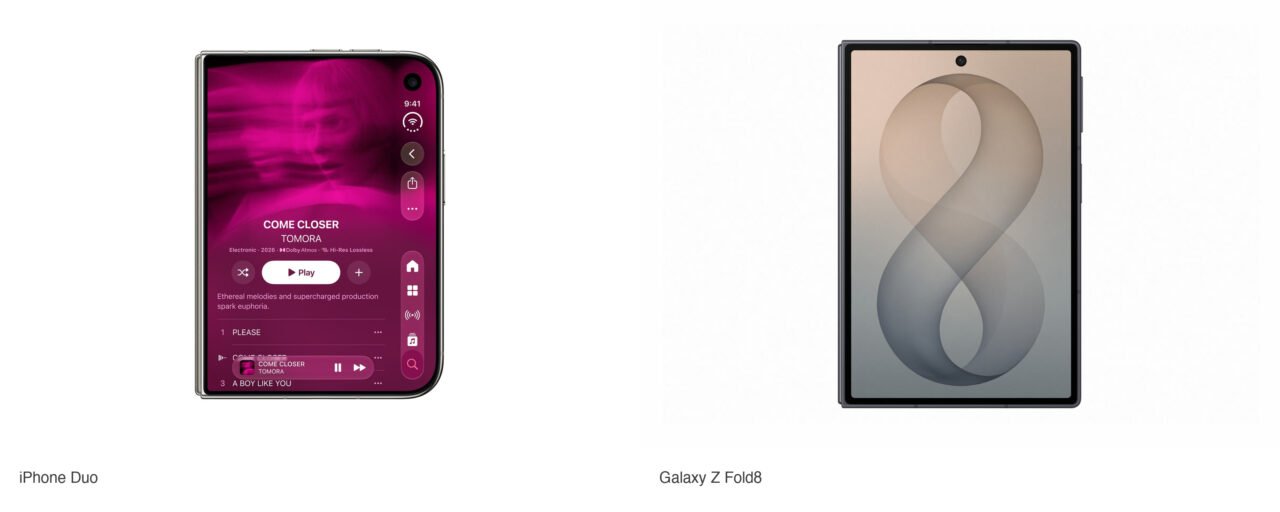
The last screen difference is a hole. The Fold8 has a 10MP punch-hole in the inner display and another in the cover screen, and the inner one is large and sits almost awkwardly. The Duo has a punch-hole on the outer screen only. On the inner screen, it use what Apple calls “FaceTime camera” which sits under the inner panel and disappears when it is not in use. That under-display camera is the weaker of the Duo’s two selfie cameras, but it buys back a screen with nothing in the middle of it.
Software
iOS 27 on the Duo moves Lock Screen controls, the Home Screen Dock and each app’s navigation to the side of the display. This makes it such that vertical space goes to content and the buttons sit under your thumb. The Dynamic Island turns 90 degrees and runs down the edge of both screens. Apple’s description of the behaviour is that “content reacts as it folds, reorients when turned to the side, and switches to the appropriate display when flipped over”.
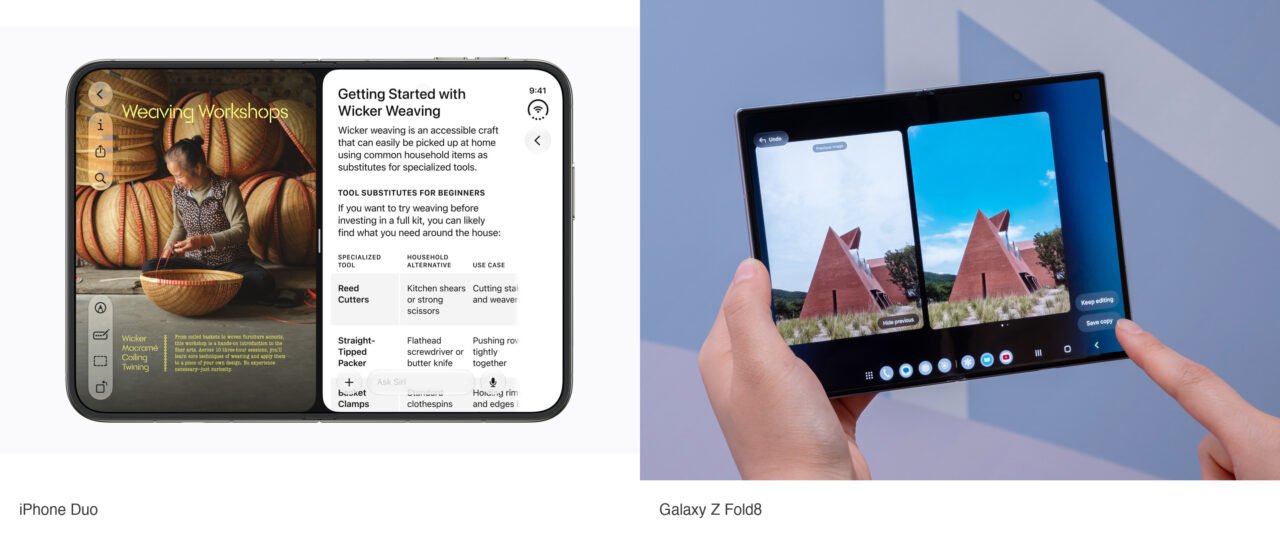
There’s also Split View, which is the first side-by-side multitasking on any iPhone, two apps or two windows of one app, can run smoothly and help with multitasking. You can even set apps in pairs, save and reopen them any time.
Apple also announced that the new Duo will support Apple Pencil with USB-C later this year on both inner and outer displays.
One UI 9 on Android 17 gives the Fold8 the more capable version of the same idea: three apps split on the inner screen with a fourth floating on top, and Samsung DeX allows for a windowed desktop experience. It is the best multitasking on any phone, and has been for several Fold generations. There’s also Gemini Intelligence which automates across more than 40 apps and services.
However, in terms of stylus support, Samsung has not brought back the S Pen: neither the Fold8 nor the Fold8 Ultra carries the digitizer layer that stylus input needs.
In terms of length of support, Samsung commits to seven years of Android version upgrades and security patches, which carries the Fold8 to 2033. Apple’s only written commitment since the iPhone 15, is a minimum of five years of security updates from the first supply date. In practice however, the company supports iPhones for six, seven, or more years.
Two more notes:
- Siri AI ships in beta with iOS 27 in English first, with French, Japanese, Korean, Portuguese and Spanish in October.
- The Fold8 ships with six months of Google AI Pro, including 5TB of storage, which Google prices at $19.99 a month.
Cameras
Neither phone has a telephoto lens. Both give you a main camera, an ultra-wide and a 2x crop the maker calls optical quality. That is the compromise both companies made to keep a folding phone thin, and it is the biggest reason the Xiaomi 18 Fold beats them both on paper.
The Duo carries a 48MP Fusion Main at f/1.6 with sensor-shift stabilisation and the same 48MP Fusion Ultra Wide as the iPhone 18 Pro, with macro. The Fold8 answers with a 50MP wide on a 1/1.56-inch sensor, physically larger than Apple’s, and a 50MP ultra-wide that autofocuses. Apple’s video pipeline is stronger, and nothing on the Fold8 matches Dolby Vision at 4K120, though Samsung adds an 8K mode Apple does not have.
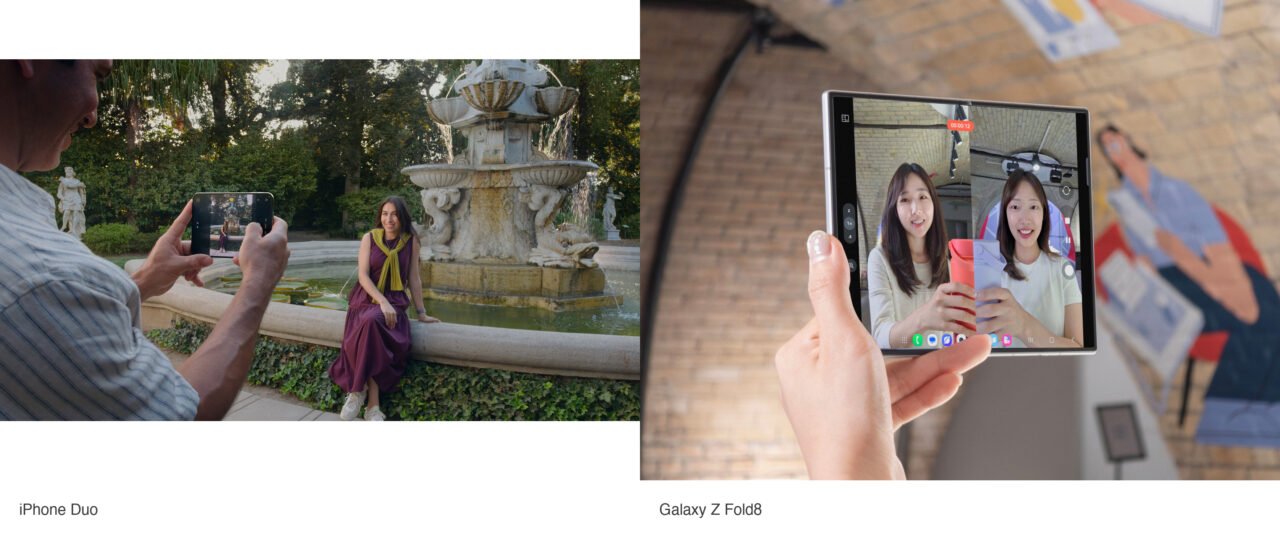
In terms of camera usage and design for the bigger inner screen, Apple has done more work. Duo Preview puts a live view on the outer display so your subject can see themselves, Smart Take fires the shutter when everyone is posing, and Kid Cue plays Peanuts animations to make a toddler look at the lens. Samsung also has something similar called Dual Recording where you get the cover-screen preview,
In terms of selfies, the iPhone Duo has a 12MP Center Stage camera outside that widens and rotates the frame automatically, and an under-display FaceTime camera recording 1080p, for which Apple publishes no megapixel count. The Fold8 has 10MP on both inner and outer creens.
Chips, memory and heat
Apple’s 2nm A20 Pro sits on a custom vapour chamber, in a chip package Apple says it borrowed from its M-series Macs. Apple rates it 35 percent better at sustained performance than the iPhone 17 Pro, with a CPU 20 percent faster than the A19 Pro and a GPU 40 percent faster.
Samsung’s 3nm Snapdragon 8 Elite Gen 5 for Galaxy turns in 2,197,874 on AnTuTu v10, flagship pace in a burst. Sustained, the Fold8 scores below other phones running the same chip, and it warms up under long sessions, which is what a 4.5mm body without a vapour chamber does. No independent Duo benchmarks exist yet.
Apple does not publish RAM so we’ll wait for that. Samsung does: 12GB on the 256GB and 512GB models, 16GB on the 1TB, on UFS 4.x storage. The Duo goes to 2TB; the Fold8 stops at 1TB.
Battery and charging
Apple also never mentions cell size for batteries, so we’ll wait on that too. Samsung hwoever ships the Fold8 with a 4,800mAh battery. This is the first Galaxy Z generation on silicon-carbon chemistry. Samsung claims more than 26 hours of video playback, while independent testing puts active use at 13 hours 59 minutes. Apple claims 31 of video on the inner display, 44 on the outer, and 24 hours of mixed use.
The Fold8 takes 45W wired and reaches 63 percent in about 30 minutes, plus 20W wireless. The Duo reaches 50 percent in about 20 minutes on a 60W adapter, and the same wirelessly in about 30 minutes.
Dust, water and repair
The Duo is rated IP68, tested to six metres for 30 minutes. The Fold8 is rated IP48, tested to 1.5 metres for 30 minutes.
The 6 in Apple’s rating means it’s dust-tight. The 4 in Samsung’s means protected against solid objects of 1mm and larger, and nothing finer. Sand, cement dust and the grit are all smaller than 1mm, and a hinge is exactly the gap they get into. Samsung tells Fold8 owners to keep dust and sand away from the hinge.
Apple is claiming a full dust seal on a folding phone. That’s crazy, and we wait to see tests when the phone arrives.
Both phones unlock by side-mounted fingerprint. Samsung adds face unlock on top of the fingerprint reader, but reliant on the camera.
Connectivity and the SIM question
Apple’s C2 modem does 5G on sub-6GHz, with mmWave in the United States only, and the N1 chip adds Wi-Fi 7, Bluetooth 6 and Thread. The Duo also carries satellite Emergency SOS, Messages, Find My and Roadside Assistance. The Fold8 matches it on Wi-Fi 7, Bluetooth and Ultra Wideband.
The iPhone Duo is eSIM only in every market on earth, with two active profiles and storage for more. The Galaxy Z Fold8 takes a physical nano-SIM plus two eSIM profiles, two of them active at a time.
The full table
| iPhone Duo | Galaxy Z Fold8 | |
|---|---|---|
| Announced | 9 September 2026 | 22 July 2026 |
| On sale | 23 October 2026, 70+ countries; 28 more on 30 October | 7 August 2026; Kenya through Samsung East Africa |
| Inner screen | 7.6-inch OLED, 1878 x 2670, 430ppi, ProMotion to 120Hz, nano-texture matte, 1.42:1 | 7.6-inch LTPO AMOLED, 1848 x 2448, 403ppi, 1-120Hz, anti-reflective, 4:3 |
| Outer screen | 5.4-inch OLED, 1398 x 2034, 460ppi, ProMotion to 120Hz, 1.45:1 | 5.5-inch LTPO AMOLED, 1248 x 1972, 428ppi, 1-120Hz, 10:16 |
| Peak brightness | 3,000 nits outdoor, 1,600 nits HDR, 1,000 nits typical | 3,000 nits claimed; 1,525 nits measured |
| Inner camera cut-out | Under-display camera | 10MP hole-punch |
| Open | 164.6 x 117.8 x 5.2mm | 161.4 x 123.9 x 4.5mm |
| Closed | 84.1 x 117.8 x 11.3mm | 81.9 x 123.9 x 9.7mm |
| Weight | 254g | 201g |
| Frame | Grade 5 titanium | Armor Aluminum |
| Glass | Ceramic Shield 2 front, Ceramic Shield back, nano-texture polymer inner | Gorilla Glass Ceramic 3 front, Gorilla Glass Victus 2 back |
| Folding structure | Polymer cover, glass above and below, titanium plate | Flex Titanium film and plate |
| Water and dust | IP68, 6m for 30 minutes, dust-tight | IP48, 1.5m for 30 minutes, dust larger than 1mm only |
| Chip | A20 Pro, 2nm, 6-core CPU, 7-core GPU, dual 16-core Neural Engine, vapour chamber | Snapdragon 8 Elite Gen 5 for Galaxy, 3nm, 8-core CPU to 4.74GHz, Adreno 840 |
| RAM | Not published | 12GB, or 16GB on the 1TB |
| Storage | 256GB, 512GB, 1TB, 2TB | 256GB, 512GB, 1TB (UFS 4.x) |
| Main camera | 48MP Fusion, f/1.6, 26mm, sensor-shift OIS | 50MP, f/1.8, 23mm, 1/1.56-inch, OIS |
| Telephoto | 12MP 2x crop at 52mm | 2x crop, no dedicated lens |
| Ultrawide | 48MP, 13mm, macro | 50MP, f/1.9, 120 degrees, autofocus |
| Outer selfie | 12MP Center Stage | 10MP, f/2.2 |
| Inner selfie | Under-display FaceTime, f/1.8, 1080p, resolution not published | 10MP, f/2.2 |
| Video | 4K at 120fps Dolby Vision | 8K at 30fps, 4K at up to 120fps |
| Two-screen camera tricks | Duo Preview, Smart Take, Kid Cue, Dual Capture, Duo FaceTime | Dual Recording, cover-screen preview, My FanCam |
| Battery | Not published; 31h video inner, 44h outer, 24h mixed | 4,800mAh typical silicon-carbon; 26h+ video |
| Wired charging | 50 percent in about 20 minutes with a 60W adapter | 45W, 63 percent in about 30 minutes |
| Wireless charging | MagSafe and Qi2 to 25W; 50 percent in about 30 minutes | 20W, plus 4.5W reverse |
| Unlock | Touch ID in side button; no Face ID | Side fingerprint plus face unlock |
| SIM | Dual eSIM only, no tray | Nano-SIM plus two eSIM, two active |
| Radios | C2 modem, 5G sub-6 and mmWave (US), N1 Wi-Fi 7, Bluetooth 6, Thread, UWB gen 2 | 5G, Wi-Fi 7 tri-band, Bluetooth 6.0, NFC, UWB |
| Satellite | Emergency SOS, Messages, Find My, Roadside Assistance | None listed |
| USB | USB-C, USB 3 at 10Gb/s | USB-C 3.2 |
| Stylus | Apple Pencil (USB-C), later in 2026, both screens | None |
| Software | iOS 27.1 at launch | One UI 9 on Android 17 |
| Update promise | Minimum 5 years of security updates | 7 years of OS and security updates |
| Multitasking | Split View, two apps or two windows, saved pairs | Three apps split plus a floating window, DeX |
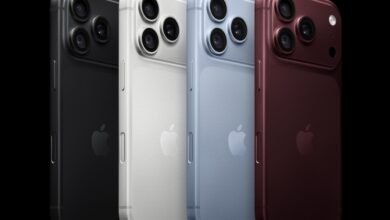
| Colours | Star white, night sky | Graphite, Cream, Lavender, Pistachio online only |
| In the box | Phone, USB-C cable | Phone, USB-C cable |
| Starting price | $1,999 (about KES 259,000) | KES 243,900 in Kenya; $1,899.99 in the US |
Buying either one in Kenya?
Apple’s US prices, before any tax, at KES 129.45 to the dollar on 10 September:
- 256GB: $1,999, about KES 259,000
- 512GB: $2,199, about KES 285,000
- 1TB: $2,599, about KES 336,000
- 2TB: $3,199, about KES 414,000
Samsung’s Kenyan prices, as sold:
- 12GB + 256GB: KES 243,900
- 12GB + 512GB: KES 270,000
- 16GB + 1TB: KES 322,200
What we’d pick
Buy the Galaxy Z Fold8 if you want the lighter phone, the better multitasking, seven years of updates, a SIM tray and a warranty you can claim in Nairobi.
Buy the iPhone Duo if you want the sealed hinge, the uninterrupted inner screen, the stylus and iOS magic.






Join the discussion