

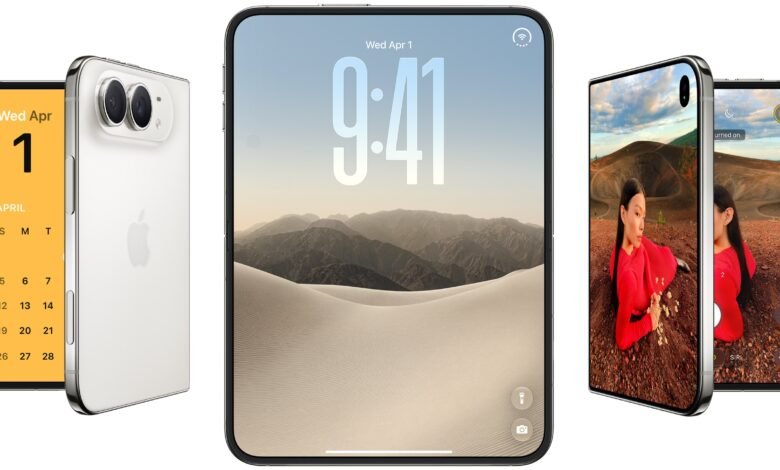
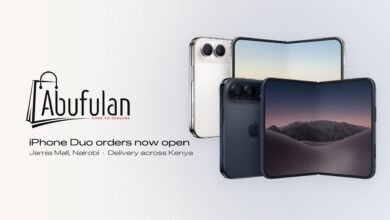
Apple announced the iPhone Duo on 9 September 2026 at $1,999 (about KES 259,000 before duty), and Xiaomi put the Xiaomi 18 Fold on sale in China on 10 September from CNY 10,999 (about KES 212,000). Both are the short, wide, book-style foldables that Xiaomi calls “mid-fold” and Apple calls “similar in size to a passport”. Both are 117.8mm tall. Both open to a screen shaped like a sheet of A4 paper.
Xiaomi has the “faster-looking” chip, a 200MP Leica camera, a 6,000mAh battery, a brighter screen and a lower price. Apple has the thinner bezels, a hidden inner camera, a titanium hinge, satellite messaging, and an operating system Apple rebuilt around two screens. We think the software customisation list matters more on a phone you’ll fold and unfold a hundred times a day. But let’s compare hardware first.
Form factor and build
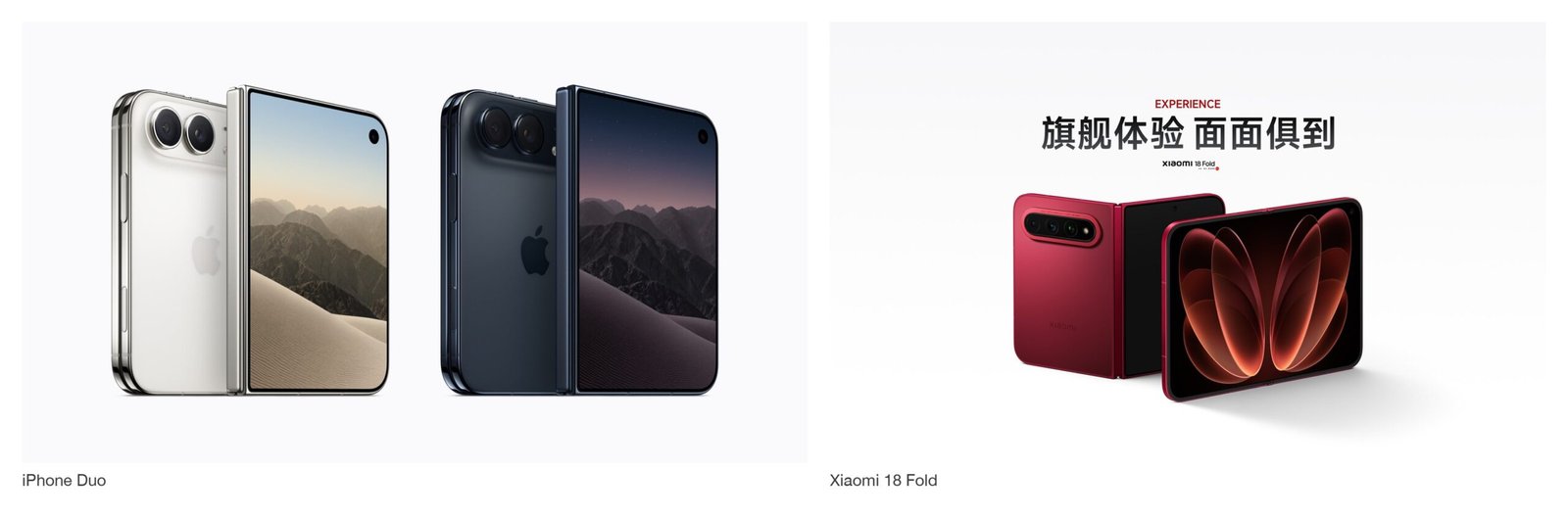
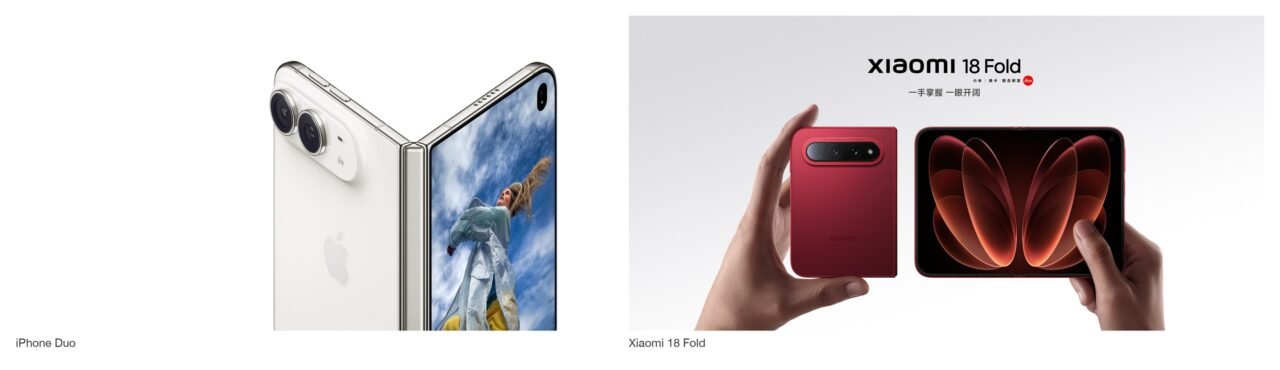
Open, the iPhone Duo is 164.6mm wide, 117.8mm tall and 5.2mm thick. The Xiaomi 18 Fold is 163.8mm by 117.8mm by 5.02mm. Closed, Apple’s phone is 84.1mm wide and 11.3mm thick, Xiaomi’s is 83.6mm and 10.68mm. So Xiaomi is fractionally thinner in both states, and the numbers are close enough that you would not tell them apart in a pocket.
The Duo weighs 254g and the 18 Fold 219g. The 35g gap comes from Apple’s choice of Grade 5 titanium for the frame and hinge cover against Xiaomi’s 7-series aluminium. Apple’s hinge has more than 100 components and a 3D-printed titanium cover. Xiaomi’s new Dragon Bone hinge is a three-link design that Xiaomi says went through 10,437 simulated drop angles and 492 design changes, and the phone carries a 1.2m drop rating that Apple does not match with a figure of its own.

Apple’s outer glass is Ceramic Shield 2, with Ceramic Shield on the back. Xiaomi uses its Dragon Crystal Glass 3.0 on both faces, with ion-implant strengthening on the cover screen. Inside, Apple layers a nano-textured polymer cover over the folding panel with glass above and below it and a titanium plate underneath. Xiaomi uses two layers of ultra-thin glass, 50 microns on top and 30 microns beneath, and says the average crease depth is 30 microns or less. Apple gives no crease number. Hands-on reports from the Steve Jobs Theater say you can see the crease at an angle but not feel it, which is the same thing reviewers said about the Xiaomi in Berlin.
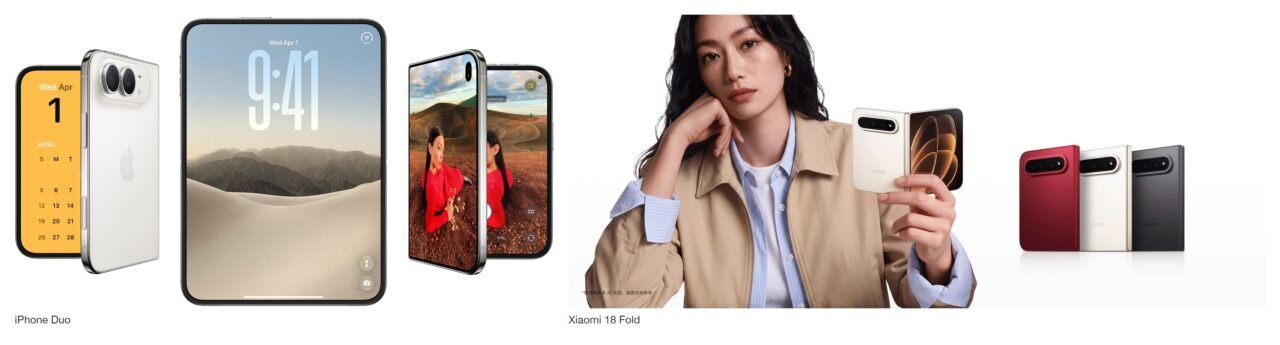
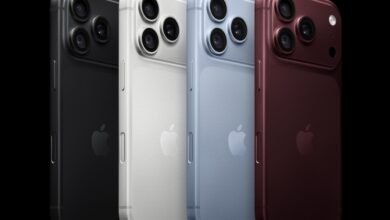
Colours: Apple sells Night Sky and Star White. Xiaomi sells Nishino Red, Warm Gold White and Black, plus a pink silicon nitride Ceramic Edition limited to 1,500 units.
The screens
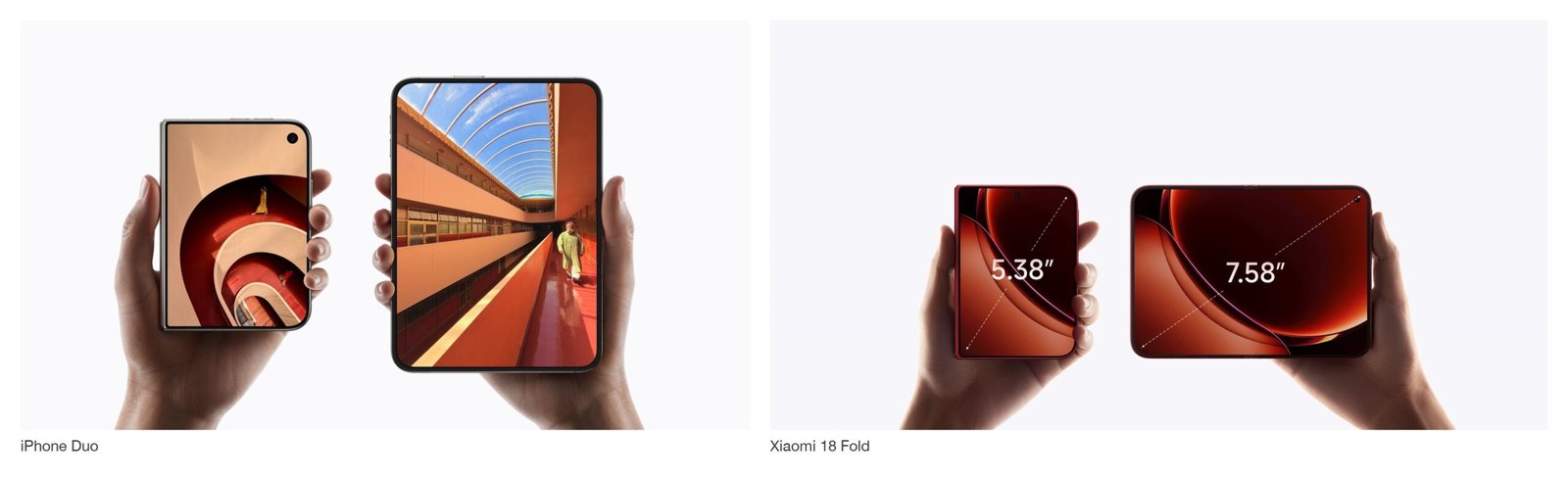
Apple’s inner display is 7.6 inches at 2670 by 1878 pixels, 430ppi. Xiaomi’s is 7.58 inches at 2364 by 1672, about 382ppi. The outer screens are 5.4 inches at 460ppi on the Duo and 5.38 inches at about 385ppi on the 18 Fold. Apple’s panels are sharper on paper, and the aspect ratios on both phones are within a rounding error of each other, so apps built for one shape scale cleanly on both.
Brightness goes the other way. Xiaomi claims 4,000 nits peak at 30 percent of the screen lit, on both panels, with a 1-120Hz LTPO refresh and a polariser-free inner panel under a low-reflection film. Apple claims 3,000 nits outdoors, 1,600 nits for HDR, 1,000 nits typical and ProMotion up to 120Hz on both, plus an Always-On mode. Apple’s answer to glare is a nano-texture matte finish on the inner screen, the same treatment it sells on MacBook Pro and Studio Display. Reviewers who handled it say the inner screen looks like paper. Xiaomi’s inner screen is glossy.
Bezels favour Apple. Xiaomi quotes a 1.23mm black border on the cover screen, and the phone has a hole-punch selfie camera on both screens. The Duo has a hole-punch on the outer screen and nothing on the inner one, because the FaceTime camera sits under the panel.
Software: the part Apple built from scratch
Both phones run software that was rewritten for a wide fold. Apple changed more of it.
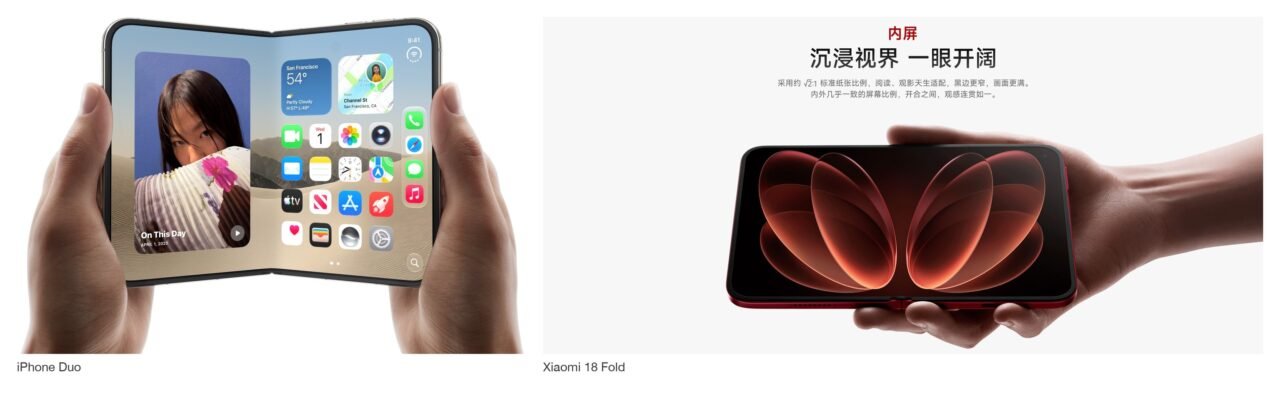
Xiaomi HyperOS 4, on Android 17, gives the 18 Fold a multitasking mode that runs up to six apps split on the inner screen plus a floating window on top. Three fingers swiped sideways switch windows, four fingers pinched open a task overview, and a grey bar between windows resizes them. Xiaomi also shipped a folder of “PC-class” apps, with WPS and CapCut adapted for the wide screen, and says more than 200 apps have fold-specific layouts. The headline AI trick, the Super XiaoAi Inspiration Ball you drag onto anything on screen to translate it, price-check it or navigate to it, is not on the phone at launch. Xiaomi’s own product page says it arrives by software update in late September and ships switched off.
iOS 27 on the Duo moves the Lock Screen controls, the Home Screen Dock and every app’s navigation to the side of the screen, so the vertical space is all content and the buttons land under your thumb. The Dynamic Island turns 90 degrees and runs down the edge of both displays. The status bar collapses into a circle in a corner. Open the phone and you get two Home Screen pages next to a scrolling Today View of widgets. Apple’s own words for what happens as you fold it: “content reacts as it folds, reorients when turned to the side, and switches to the appropriate display when flipped over”. Reviewers who opened one picked out the opening animation, which shows the outer screen’s content through to the inner screen as the phone unfolds, as the moment the device explained itself.
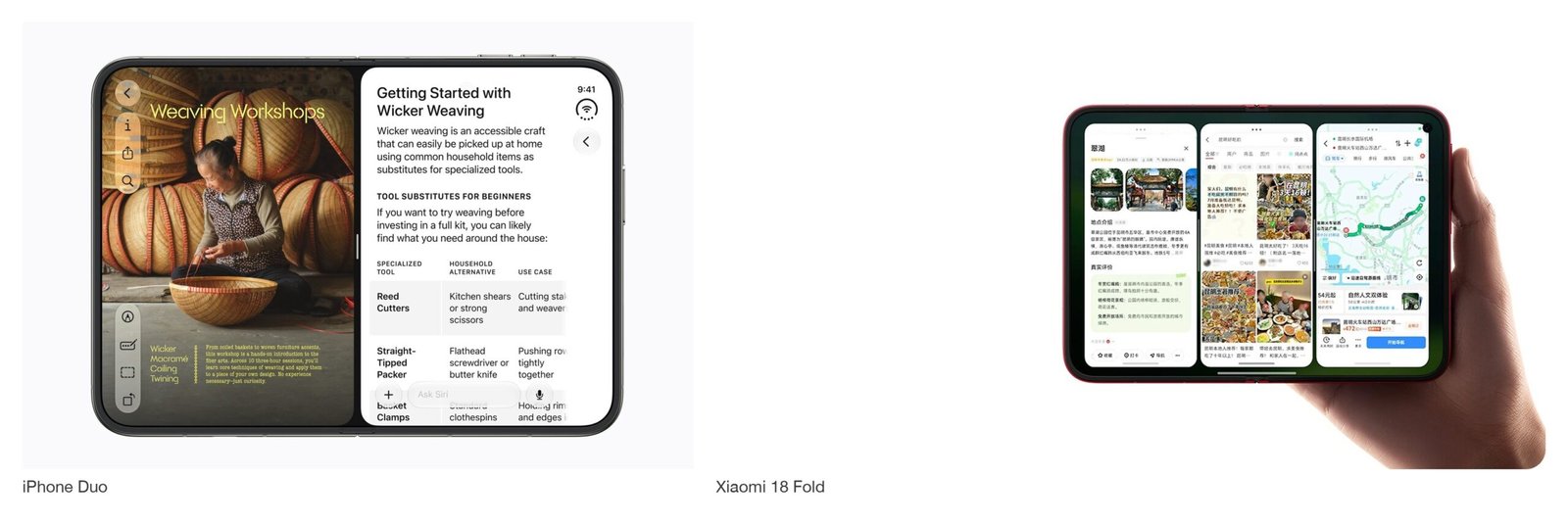
Split View is the first side-by-side multitasking on any iPhone. It runs two apps, or two windows of the same app, lets you save pairs of apps to reopen together, and drags Siri into one half while you read in the other. Two windows against Xiaomi’s six is a loss if you want a spreadsheet next to a video next to a chat. Two apps is also the number most people use on a 7.6-inch screen, and Apple’s two come with saved pairs, the side navigation and the fold-aware layout built into every app rather than added on top of them.
StandBy now works on either screen without a charger, so the folded phone standing half-open on a desk is a clock, a photo frame or a calendar. Apple Pencil with USB-C follows later this year for both displays. Xiaomi has no stylus support.
There is one more thing under the software heading that decides the purchase for a Kenyan buyer. The Xiaomi 18 Fold ships with the China version of HyperOS, which has no Google Play, no Google Maps and no Gmail app. You can sideload the APKs, but you’re on your own for updates. The Duo runs the same iOS as every other iPhone.
Cameras, and what two screens do for them
Xiaomi has the bigger camera bag. The 18 Fold carries a 200MP main camera at f/1.7 on a 1/1.56-inch sensor with optical stabilisation, a 50MP periscope telephoto at 80mm for 3.5x optical zoom and a 7x crop Xiaomi calls optical quality, and a 50MP ultrawide at 17mm. All three wear Leica Summilux branding. It records 8K at 24fps and slow motion at 960fps.
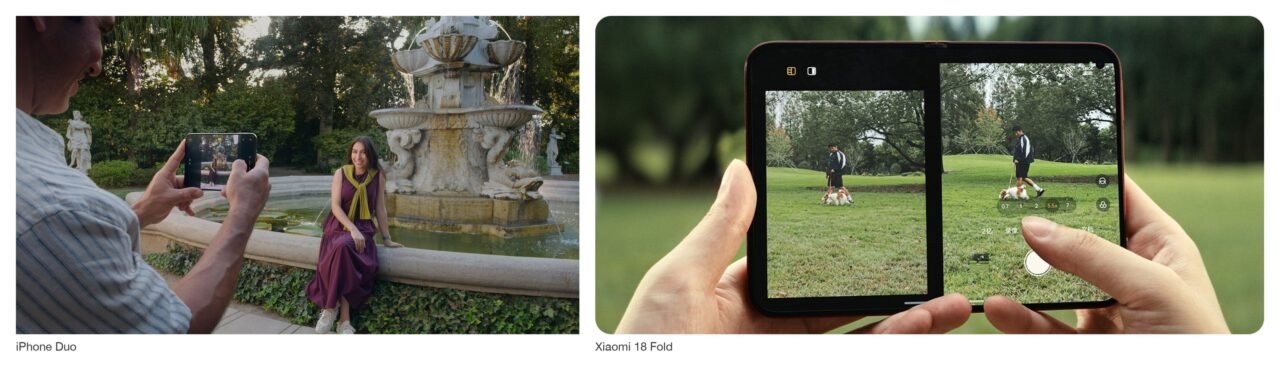
The Duo carries a 48MP Fusion Main at f/1.6 and the same 48MP Fusion Ultra Wide as the iPhone 18 Pro. There is no variable aperture and no telephoto. Its 2x is a 12MP crop from the main sensor. It records 4K at 120fps in Dolby Vision and shoots 24MP by default. On reach and resolution, Xiaomi wins by a distance.
Where Apple pulls level and then ahead is what the second screen does. Duo Preview puts a live view on the outer screen so the person you’re photographing can see themselves. Xiaomi has the same idea, and its outer screen also doubles as a 4:3 viewfinder when the phone is shut. Apple adds four more. Smart Take watches the frame and takes the picture when everyone is ready, so nobody is left behind the phone. Kid Cue plays Peanuts animations on the outer screen to make a toddler look at the lens. Dual Capture records the front and rear cameras at once, in FaceTime as well as the Camera app. And Duo FaceTime lets the friends sitting next to you join a call on the outer screen with the outer camera while you use the inner one.

The inner cameras differ more. Xiaomi puts a 16MP f/2.2 hole-punch on both screens. Apple puts a 12MP Center Stage camera on the outer screen and hides the FaceTime camera under the inner display, at f/1.8, recording 1080p video. Apple does not give it a megapixel count and reviewers say it’s not as good as the outer camera. It exists so the inner screen has no hole in it, and Chinese reviewers of the 18 Fold have already noted that reading apps run into the camera cut-out when the phone is open. On a phone whose entire pitch is the big uninterrupted screen, that is the trade Apple made correctly.
Chips and memory
Xiaomi’s XRING O3 is its own 3nm chip with 24 billion transistors, a 10-core CPU that runs every core as a performance core up to 4.35GHz, a 16-core GPU and a 4-core NPU rated at 200 TOPS. Xiaomi’s own AnTuTu score is 5.22 million. Apple’s A20 Pro is a 2nm chip with a 6-core CPU, two performance cores and four efficiency cores, a 7-core GPU and a dual 16-core Neural Engine, cooled by a vapour chamber. Apple rates it 35 percent better at sustained performance than the iPhone 17 Pro.
Apple does not publish RAM and never has. Xiaomi does: 12GB of LPDDR5X on the three cheaper models and 16GB of LPDDR6 from CXMT on the 1TB model, which we covered on 1 September as the first phone to ship the new memory standard. Storage tops out at 1TB on the Xiaomi and 2TB on the Duo.
Battery and charging
Xiaomi’s 6,000mAh silicon-carbon battery, rated at 5,875mAh, is bigger than the Huawei Pura X Max’s 5,300mAh and the Galaxy Z Fold 8’s 4,800mAh, at 20 percent silicon and 920Wh per litre. Xiaomi quotes 1.43 days of typical use on the inner screen. Apple does not give a capacity. It gives hours: up to 31 hours of video on the inner screen, 44 hours on the outer, and 24 hours of use per charge when you split time equally between them, from one battery in each half of the phone.
Charging is a clearer Xiaomi win. The 18 Fold takes 67W wired and 50W wireless, and the charger is in the box along with a case and a fitted screen protector. The Duo reaches 50 percent in about 20 minutes on a 60W adapter and 50 percent wirelessly in about 30 minutes, with MagSafe at 25W. The box has a cable.
Durability and water
Apple rates the Duo IP68, to six metres for 30 minutes. Xiaomi rates the 18 Fold IP58 and IP59: 1.5 metres for 30 minutes, plus high-pressure jets. The 5 in Xiaomi’s rating means it is dust resistant but not sealed, which is normal for a hinge. Apple is claiming full dust sealing on a folding phone.
Connectivity and the SIM question
The Duo has Apple’s C2 modem with 5G on sub-6GHz and, in the US, mmWave, Apple’s N1 chip for Wi-Fi 7, Bluetooth 6 and Thread, a second-generation Ultra Wideband chip, and satellite: Emergency SOS, Messages, Find My and Roadside Assistance. USB-C runs USB 3 at 10Gb/s with 4K DisplayPort out.
The 18 Fold has Wi-Fi 7 with multi-link, Bluetooth 6.0, UWB for car keys, NFC for Mi Pay and transit cards, an infrared blaster and USB 3.2 Gen 2 at 10Gbps. The standard model has no satellite messaging.
The SIM policies are opposites. The iPhone Duo is eSIM only in every market, with two active eSIMs and room for eight. The Xiaomi 18 Fold has two nano-SIM slots and no eSIM at all.
Unlocking is a side-mounted fingerprint reader on both. Apple calls it Touch ID and there is no Face ID on the Duo, the first new iPhone to unlock by fingerprint since the 2022 iPhone SE. Xiaomi adds 2D face unlock on top of the fingerprint.
The full table
| iPhone Duo | Xiaomi 18 Fold | |
|---|---|---|
| Announced | 9 September 2026 | 7 September 2026 |
| On sale | 23 October 2026, 70+ countries; 28 more on 30 October | 10 September 2026, China only |
| Inner screen | 7.6-inch OLED, 2670 x 1878, 430ppi, ProMotion up to 120Hz, nano-texture matte | 7.58-inch LTPO AMOLED, 2364 x 1672, about 382ppi, 1-120Hz, glossy, polariser-free |
| Outer screen | 5.4-inch OLED, 2034 x 1398, 460ppi, ProMotion up to 120Hz | 5.38-inch LTPO AMOLED, 1712 x 1168, about 385ppi, 1-120Hz, 1.23mm bezel |
| Peak brightness | 3,000 nits outdoor, 1,600 nits HDR, 1,000 nits typical | 4,000 nits at 30 percent APL, both screens |
| Inner camera cut-out | None, under-display camera | Hole-punch |
| Open | 164.6 x 117.8 x 5.2mm | 163.8 x 117.8 x 5.02mm |
| Closed | 84.1 x 117.8 x 11.3mm | 83.6 x 117.8 x 10.68mm |
| Weight | 254g | 219g |
| Frame | Grade 5 titanium | 7-series aluminium |
| Hinge | 100+ components, 3D-printed titanium cover | Dragon Bone three-link, 1.2m drop rating |
| Glass | Ceramic Shield 2 front, Ceramic Shield back, nano-texture polymer inner | Dragon Crystal Glass 3.0 front and back, dual-layer UTG inner (50 + 30 microns) |
| Crease | No figure given | 30 microns average or less |
| Water and dust | IP68, 6m for 30 minutes | IP58 and IP59, 1.5m for 30 minutes plus water jets |
| Chip | A20 Pro, 2nm, 6-core CPU, 7-core GPU, dual 16-core Neural Engine, vapour chamber | XRING O3, 3nm, 10-core CPU to 4.35GHz, 16-core GPU, 4-core NPU at 200 TOPS |
| RAM | Not published | 12GB LPDDR5X or 16GB LPDDR6 |
| Storage | 256GB, 512GB, 1TB, 2TB | 256GB, 512GB, 1TB (UFS 4.1) |
| Main camera | 48MP Fusion, f/1.6, 26mm, sensor-shift OIS | 200MP Leica, f/1.7, 23mm, 1/1.56-inch, OIS |
| Telephoto | 12MP 2x crop at 52mm | 50MP periscope, f/2.8, 80mm, 3.5x optical, 7x crop, OIS |
| Ultrawide | 48MP, f/2.2, 13mm, macro | 50MP, f/2.4, 17mm |
| Outer selfie | 12MP Center Stage, f/2.2 | 16MP, f/2.2, 90 degrees |
| Inner selfie | Under-display FaceTime camera, f/1.8, 1080p video, resolution not published | 16MP, f/2.2, 90 degrees |
| Video | 4K at 120fps Dolby Vision, Dual Capture at 4K30 | 8K at 24fps, 4K at 60fps, 1080p at 960fps |
| Two-screen camera tricks | Duo Preview, Smart Take, Kid Cue, Dual Capture, Duo FaceTime | Outer-screen preview, closed-mode 4:3 viewfinder, front-and-rear dual view |
| Battery | Not published; 31h video inner, 44h outer, 24h mixed | 6,000mAh typical (5,875mAh rated); 1.43 days DOU inner screen |
| Wired charging | 50 percent in about 20 minutes with a 60W adapter (sold separately) | 67W (charger in box) |
| Wireless charging | MagSafe up to 25W, Qi2; 50 percent in about 30 minutes | 50W |
| Unlock | Touch ID in side button, Apple Watch unlock; no Face ID | Side fingerprint plus face unlock |
| SIM | Dual eSIM only, stores 8+ | Dual nano-SIM only, no eSIM |
| Modem and radios | Apple C2, 5G sub-6 and mmWave (US), N1 Wi-Fi 7, Bluetooth 6, Thread, UWB gen 2 | 5G, Wi-Fi 7 with MLO, Bluetooth 6.0, UWB, NFC, infrared |
| Satellite | Emergency SOS, Messages, Find My, Roadside Assistance | None on the standard model |
| USB | USB-C, USB 3 at 10Gb/s, 4K DisplayPort out | USB-C, USB 3.2 Gen 2 at 10Gbps |
| Stylus | Apple Pencil (USB-C), later in 2026, both screens | None |
| Software | iOS 27.1 at launch | HyperOS 4 on Android 17, China ROM, no Google services |
| Multitasking | Split View, two apps or two windows, saved app pairs | Up to six apps split plus a floating window |
| Fold-specific interface | Side navigation, side Dock, vertical Dynamic Island, two-page Home Screen, fold-aware transitions, StandBy on either screen | A4-ratio app adaptation, 200+ adapted apps, PC-class app folder, Inspiration Ball by update in late September |
| Colours | Night Sky, Star White | Nishino Red, Warm Gold White, Black, Ceramic Edition pink (1,500 units) |
| In the box | Phone, USB-C cable | Phone, charger, cable, case, fitted screen protector |
| Starting price | $1,999 (about KES 259,000) | CNY 10,999 (about KES 212,000) |
The prices in full
Apple’s US prices, before any tax:
- 256GB: $1,999, about KES 259,000
- 512GB: $2,199, about KES 285,000
- 1TB: $2,599, about KES 336,000
- 2TB: $3,199, about KES 414,000
Xiaomi’s China prices:
- 12GB + 256GB: CNY 10,999, about KES 212,000
- 12GB + 512GB: CNY 11,999, about KES 231,000
- 16GB + 512GB: CNY 12,999, about KES 251,000
- 16GB + 1TB with LPDDR6: CNY 14,999, about KES 289,000
- Ceramic Edition 16GB + 1TB: CNY 15,999, about KES 309,000
The Duo’s 2TB model costs more than every Xiaomi 18 Fold, including the ceramic one. The base Duo costs about KES 47,000 more than the base 18 Fold, and that gap is wider than it looks because Xiaomi’s price includes Chinese sales tax while Apple’s excludes American sales tax.
Buying either one in Kenya
Apple does not sell in Kenya and no country in Africa has an Apple Store. Pre-orders open on 16 October and the phone reaches 70-plus countries on 23 October, including the UAE, India and China, which are the routes importers use. When the iPhone 17 series arrived here, Nairobi shops had prices within three days of the global date. Add shipping, duty, 16 percent VAT and the reseller margin to KES 259,000 and the base Duo lands past KES 300,000. There is also the eSIM problem we flagged at launch: Safaricom’s eSIM on iPhone has had documented phantom-SMS and USSD faults for two years, and the standard fix of going back to a physical SIM is impossible on a phone with no tray.
Xiaomi has never sold a foldable outside China, and the 18 Fold is China only. Xiaomi’s official stores in Kenya sell global models, and there is no global 18 Fold. Grey importers will bring it in at a markup, and the phone that arrives runs the China ROM with no Google services and no Xiaomi Kenya warranty. It does support the n41 and n78 bands Safaricom uses for 5G. If you’re the kind of buyer who can live with sideloaded Google apps, the hardware for the money is the better deal. If you’re not, the Xiaomi is a very good phone for someone else.
What we’d pick
Buy the Xiaomi 18 Fold for the camera, the battery, the charger in the box and the price. Buy the iPhone Duo for the software. The side navigation, the vertical Dynamic Island, the fold-aware animations, saved app pairs, Duo FaceTime and an inner screen with no hole in it are the things you’ll notice every time you open the phone, and Xiaomi hasn’t matched them.




Join the discussion