

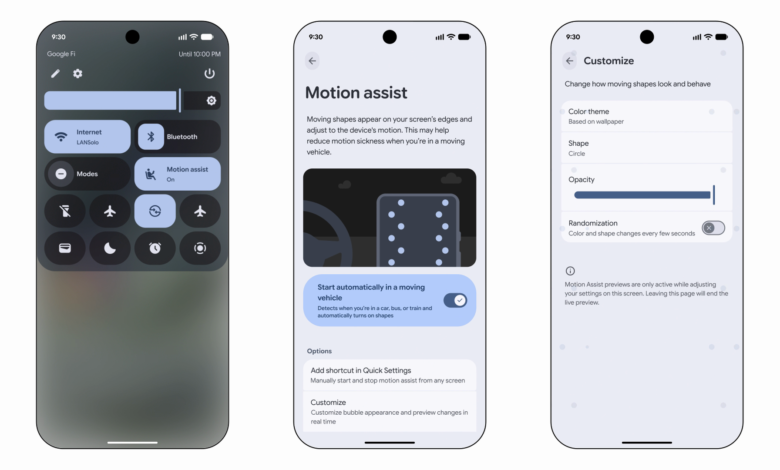
Motion Assist has started reaching phones beyond Pixel. Samsung Galaxy phones are the first group outside Pixel to get it.
Motion Assist is a motion sickness tool for people using a phone as a passenger. It puts small bubbles along the edges of the screen, and the phone’s motion sensors move them to match what the vehicle is doing. They slide when the car turns, when it speeds up, and when it brakes. Google’s support page calls them “small, subtle visual bubbles along your screen edges” and says the feature is for riding as a passenger, not for driving.
Why dots on a screen do anything
Motion sickness comes from a disagreement between two of your senses. Your inner ear has fluid-filled canals that sense acceleration and tilt, so in a matatu pulling out of a stage they report movement. Your eyes, fixed on a WhatsApp thread 30cm from your face, report a page that is perfectly still. The brain gets two accounts of the same moment, and nausea, sweating and a headache follow. A phone is the worst case, because a screen gives your eyes nothing that agrees with what your body is feeling. A window at least does.
That’s what the bubbles are for. They sit in your peripheral vision, the part of your sight you aren’t reading with, and they move the way your inner ear says the vehicle is moving.

Google hasn’t published any data on whether its own version works. The wider idea has better evidence behind it. A team at the University of Glasgow ran an on-the-road study on visual cues that track a vehicle’s acceleration rather than its speed, published in the September 2026 issue of Applied Ergonomics. The cues cut motion sickness as well as the older speed-matched approach did, and distracted passengers less from whatever else they were doing. That study used VR headsets rather than phones, so it backs the principle rather than Google’s version of it.
Apple got there first. Vehicle Motion Cues shipped in iOS 18 in 2024 and sits under Settings, Accessibility, Motion. Google’s version turned up inside Google Play services in November 2024, then called Motion Cues, and took nearly two years to ship. OPPO and vivo have had something similar on their own phones for a while.
What your phone needs
Android 17 or higher, per Google’s support page. The feature itself arrives inside Google Play services, version 26.33.32 or newer, so there’s no app to download and no system update to wait for once you’re on Android 17. If it doesn’t appear, restart the phone.
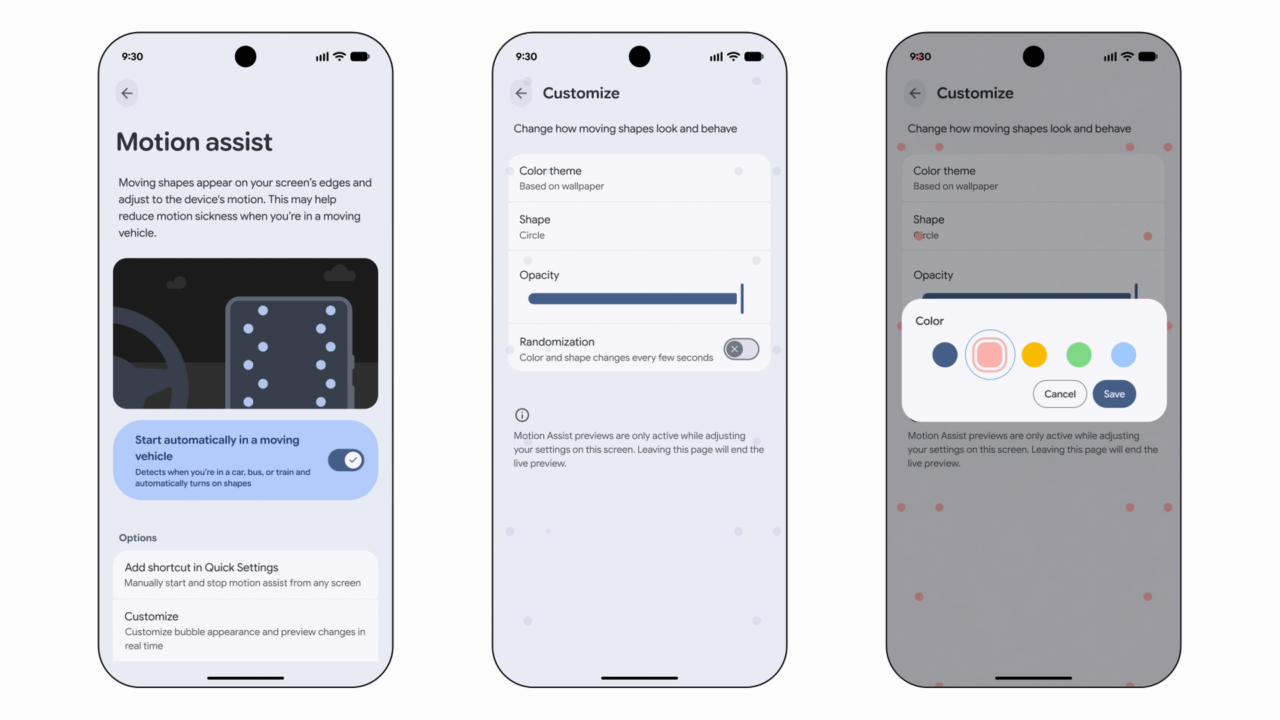
On Samsung that means One UI 9, which is Samsung’s version of Android 17. Go to Settings, tap Google, then All services, scroll to Personal and device safety and pick Motion Assist. On a Pixel the path is Settings, then your profile, then All services. Switch on the option that starts it automatically when the phone detects vehicle motion, or add a Quick Settings tile and run it by hand. Android shows a notification while the bubbles are on, and tapping it turns them off.
You can change the colour (dynamic, red, yellow, green or blue), the shape (circle, square, pentagon or diamond) and how transparent they are. There’s also a randomisation setting that rotates the colour and shape every few seconds.
Almost nobody in Kenya can use it yet
The Android 17 requirement is what decides this for most readers here. On the Google side, Pixel 6 and newer got stable Android 17 in June, and Nairobi shops import enough Pixels for that to matter a little.
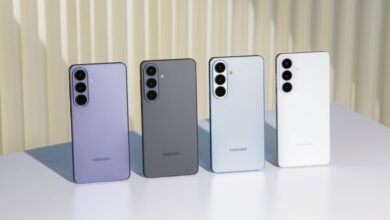
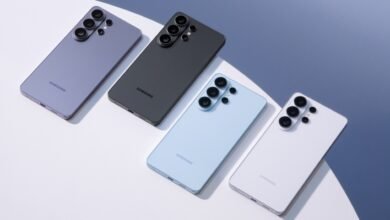
On the Samsung side the list is short. One UI 9 shipped first on the Galaxy Z Fold 8, the Z Fold 8 Ultra and the Z Flip 8 in July, and the Galaxy S26 FE came with it out of the box, on sale here since 4 September at KES 103,100. That’s four phones. The Galaxy S26 series, the S26 Ultra included, was still on beta builds in mid-September with no stable date from Samsung. Everything older sits further down the queue, and our One UI 9 tracker has where each model stands. A separate list covers the Galaxy phones for which One UI 9 is the last major update they’ll ever get.
So if you’re reading this on an S23 or an A55, Motion Assist is coming, months from now, with One UI 9. If you’re on one of the four Galaxy phones that already have Android 17, open the Google settings and switch it on before your next Mombasa road trip. The thing to watch is the stable One UI 9 rollout for the Galaxy S26 series, which Samsung has said is coming soon but still hasn’t dated.




Join the discussion