


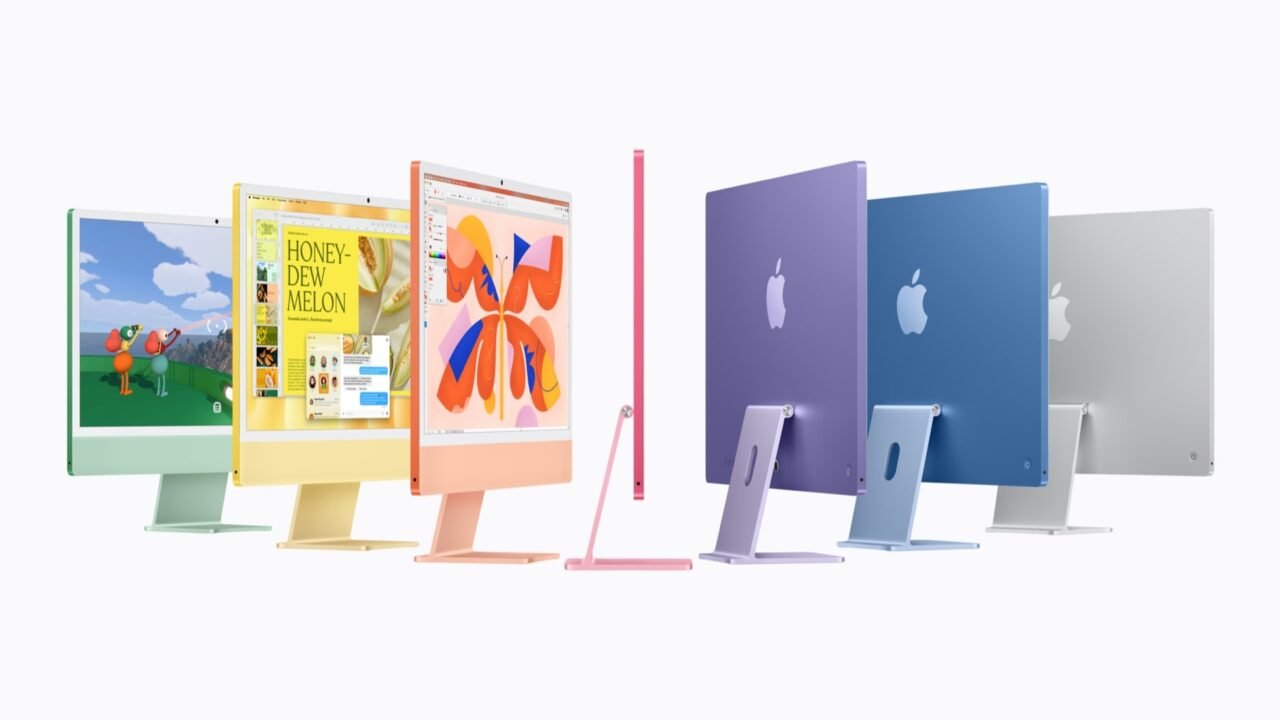
Both versions of Apple’s new M6 iMac start with 16GB of memory and 256GB of storage. The higher model has more processing cores and ports, and lets you order more memory or storage. You still pay extra for those larger capacities. The configuration also determines how many external screens you can connect.
Apple announced the refreshed all-in-one desktop, which combines the computer and screen in one unit, on 27th October 2026. Preorders are scheduled for 28th October 2026, with availability from 6th November 2026 in launch markets. Earlier this week, we advised prospective iMac buyers to wait for the announcement.
The entry model starts at USD 1,499, or about KES 195,000. The higher configuration starts at USD 1,699, or about KES 221,000.
What changes between the two M6 iMac models
The entry M6 has a 10-core CPU, the processor that handles general computing, and a 10-core GPU, which handles graphics. The higher model has 12 cores of each, along with different connection and upgrade options.

| Specification | 10-core model | 12-core model |
|---|---|---|
| CPU / GPU | 10 cores / 10 cores | 12 cores / 12 cores |
| Starting memory / storage | 16GB / 256GB | 16GB / 256GB |
| Memory options | 16GB or 24GB | 16GB, 24GB or 32GB |
| Internal storage options | 256GB, 512GB or 1TB | 256GB, 512GB, 1TB or 2TB |
| Thunderbolt 4-capable USB-C ports | Two | Four |
| External 6K screens at 60Hz | One | Up to two |
| Built-in screen | 24-inch 4.5K, 500 nits | 24-inch 4.5K, 500 nits |
| Nano-texture glass | Unavailable | Optional extra |
| Touch ID keyboard | Optional with Numeric Keypad | Included |
| 2.5Gb Ethernet | Optional | Listed as standard in specifications |
If you need wired networking on the cheaper iMac, get the seller to confirm that your order includes it.
Unified memory is the working space shared by the CPU and GPU, while solid-state drive (SSD) storage holds your apps and files. If you need 32GB of working memory or 2TB of internal storage, you’ll have to choose the higher model and pay for the relevant upgrade. The starting 12-core configuration still has 16GB and 256GB.
Ports and screens can decide which model to buy
Thunderbolt uses the USB-C connector to carry data and display signals. Both entry-model ports support Thunderbolt 4; the higher configuration gives you four. That leaves more connections available if you regularly plug in external drives and other accessories.
Having two Thunderbolt ports doesn’t mean the entry model can drive two external monitors. The entry model supports one external screen at up to 6K resolution and 60Hz, meaning 60 screen refreshes per second. The higher model supports up to two at those settings, or one external 8K screen at 60Hz, while keeping the built-in screen active. To connect two external monitors using the iMac’s built-in display support, you’ll need the higher configuration regardless of how much processing power your work uses.
The built-in display is shared: 4.5K resolution and 500 nits of brightness, marketed as 24 inches with an actual diagonal of 23.5 inches. Nano-texture is an optional glass treatment on the higher configuration. Apple says it reduces reflections and glare, which makes it useful beside a bright window. The resolution stays the same. The supplied keyboard differs too: Touch ID, Apple’s fingerprint authentication, is included with the higher model and optional on the entry model’s keyboard with Numeric Keypad. Both configurations have Wi-Fi 7 for wireless networking and Bluetooth 6 for connecting devices such as headphones.
In its tests, Apple claims up to 50% faster productivity performance in apps such as Excel and up to 100% faster graphics performance for tasks such as photo editing in Affinity, compared with M4. Its comparison footnote specifies a 10-core M4 iMac with 32GB of memory and a 2TB SSD. Those figures do not establish a starting-model-to-starting-model improvement, or measure the difference between the two M6 configurations. The launch announcement also gives no fixed number of years of software updates.
The step up between starting models is USD 200, or about KES 26,000. We’d choose by the screens and accessories on the desk, and the memory the work needs. If those require the higher model, budget for any memory, storage or nano-texture upgrade on top. If they fit within the entry model’s limits, weigh the extra ports and cores against that additional cost. Ask for quotes with the memory and storage you intend to buy, because both advertised starting prices are for 16GB/256GB machines.




Join the discussion