
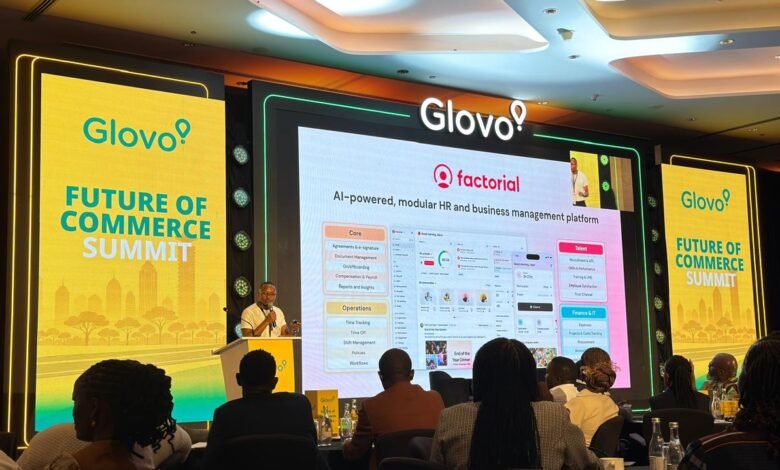
Factorial has partnered with Glovo Kenya at its inaugural Future of Commerce Summit in Nairobi, taking its workforce management software to an audience of retailers and other commerce businesses. The company says the partnership is part of its effort to expand across African markets.
Factorial makes business software for managing employees and administrative work, including payroll, the process of calculating and administering staff pay, alongside recruitment and performance reviews. Glovo is the delivery platform through which customers order food and other goods from local businesses. Their summit partnership brings the people running those businesses into the same conversation as a company selling tools to manage their staff.
For Kenyan employers, the announcement introduces Factorial’s pitch for using artificial intelligence in everyday administration. The statement, dated 3rd November 2026, does not announce a contract for Glovo to use Factorial internally, or an integration that gives Glovo’s merchants access to the software. There is also no special price or implementation timetable attached to the partnership.
“Our partnership with Glovo Kenya and our presence at the Future of Commerce Summit is a direct reflection of our long-term commitment to this market,” said Fredrick Githendu, Factorial’s partner manager, in the announcement.

What Factorial is bringing to the conversation
The product behind that pitch is Factorial One, an AI assistant built into Factorial’s business software. Factorial says One can use company information and existing access permissions to answer employees’ questions and help with routine work. That could mean finding a leave policy or producing a report from information already held in the system, so staff spend less time gathering it themselves.
Factorial’s Kenya product explanation also describes expense processing and recruitment screening. In its expense example, One reads receipts, prepares a claim and checks it against company policies. For recruitment, it can speak with candidates at a defined screening stage and prepare an evaluation for a person to review. These are Factorial’s descriptions of the product; we have not tested the software for this article.
Access to employee records is part of the purchasing decision. Factorial says One’s access follows the permissions already assigned to each employee. A business evaluating it should ask to see that working with its own approval process and data, including who can review an AI-generated evaluation and correct it.
Glovo Kenya’s country managing director, Caroline Mutuku, said in the summit announcement that the business had grown fourfold over four years, while staff increased from 33 to more than 100. The statement does not define the measure behind the fourfold growth figure or the scope of that staff count. It should not be read as a count of everyone earning through Glovo, including delivery riders.
Earlier this year, we tested Glovo’s shopping assistant in Nairobi, using Claude to find snacks within a budget. That was AI helping customers discover products. Factorial’s summit participation concerns the administrative work inside businesses selling and delivering them.
A route to prospective customers
For Factorial, the commercial opportunity is access to employers through Glovo’s business network. It is entering a market with existing competitors: SeamlessHR’s Kenyan service already markets payroll, recruitment and time management software to employers here.
Factorial also has funding behind its expansion. Its Series D investment announcement, dated 3rd June 2026, disclosed USD 150 million, or about KES 19.50 billion, at a valuation of USD 2.5 billion, or about KES 324.93 billion. General Catalyst led the round.
What would a Kenyan employer pay?
Factorial’s global pricing page advertises a starting price of USD 8 per user per month, or about KES 1,040. At that advertised starting rate, a business with 20 users would spend USD 160, or about KES 20,800, a month. This is an illustration using the global starting price, not a Kenyan quotation.
The pricing page includes employee records and payslip distribution in Factorial Core, the toolkit included with every plan, and asks customers to choose other tools for a tailored quote. Distributing a payslip means getting the document to an employee; it does not by itself establish that the package calculates Kenyan deductions or submits returns. A buyer should request a demonstration of those steps and an itemised price for payroll and One before budgeting from the starting figure.
The summit gives Factorial a way to introduce its software to prospective customers; the useful next step for a business is to establish which work the software can handle in its Kenyan operation, what remains with staff and what the full package costs.








Join the discussion