
AMACO Energy, a Greek energy company, wants to build a power plant on a barge near the Port of Mombasa. A barge is a flat-bottomed floating platform. This one would run on liquefied natural gas (LNG), which is natural gas chilled until it turns liquid so it can be shipped. AMACO calls the project HERCULES.
The plant would start at 250 megawatts (MW) and expand to as much as 1,000MW as demand grows. Its intended customers are AI data centres, heavy industry and port operations at Dongo Kundu, a 3,000-acre Special Economic Zone near the port that the government has set aside for industry.
That’s big. Kenya set a record national peak demand of 2,549MW on 15th July 2026. So at full size, this one plant could supply about two fifths of what the whole country uses at its busiest moment. AMACO puts the cost at a minimum of USD 700 million, or about KES 91 billion.
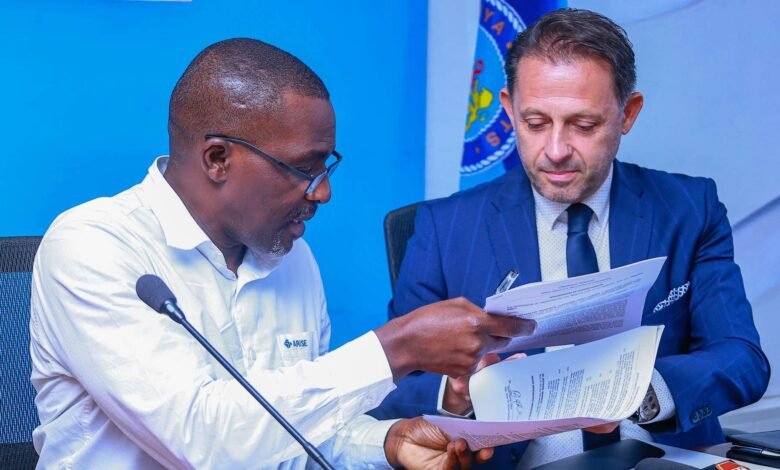
The agreement was signed on 6th November 2026 at the Kenya Ports Authority’s headquarters in Mombasa. The government’s own news agency headlined it “Govt signs Sh90B deal”, but the government didn’t sign it. The two signatories are AMACO and ARISE Integrated Industrial Platforms (ARISE IIP) Kenya, the company building the 500-acre Coast Integrated Industrial Park inside the zone.

What they signed is a memorandum of understanding (MoU), an agreement to work towards a deal. Under it, the two companies will carry out the technical, commercial, environmental, regulatory and financial assessments needed to move the project towards construction. Detailed engineering, regulatory approvals, financing and commercial agreements all still have to be done.
ARISE IIP is a private company, which Afreximbank, the African trade bank, calls its affiliate. The government’s main part so far is the land. The Kenya Ports Authority manages the zone, and in February 2025 it and the Special Economic Zones Authority leased Afreximbank 500 acres for the park.
Why a data centre would want its own power plant
A data centre is a building full of computers, called servers, that run the websites, cloud apps and AI tools you use. The servers run 24 hours a day and get hot, so they need heavy cooling as well as power. AI pushes both much higher. Theodore Theodoropoulos, AMACO’s chief executive, says an ordinary data centre may need tens of megawatts, while a large AI-focused one can use 100MW or more.
Kenya has already run into that problem. Back in May, we explained why Microsoft and G42’s USD 1 billion (about KES 130 billion) data centre at Olkaria in Naivasha stalled. Its first phase was 100MW, and it was meant to grow to 1,000MW, more than the grid could carry.
HERCULES is designed around that problem. The power plant sits next to the buildings that use it, so the data centres don’t have to wait for the grid to catch up. The plan is to sell electricity, cooling and related services to businesses inside the park. AMACO also says the gas could help with cooling. Turning LNG back into gas releases the cold it was stored with, so if that happens on site, the cold can go into cooling servers.
Mombasa has a second draw. Seven undersea internet cables come ashore there, and data centres like to sit close to the point where their traffic enters and leaves the country.
The first stage is meant to run without the national grid, so on its own it shouldn’t change a Kenya Power customer’s bill or supply. Theodoropoulos has said the 1,000MW stage could also serve Mombasa and the rest of the country, but AMACO hasn’t announced any deal to sell power to Kenya Power.
What’s still missing
No data centre operator has been named as a customer. A missing anchor customer was the other thing that held up Olkaria. Microsoft and G42 had asked the government to commit to paying for a set amount of computing capacity every year, and the government couldn’t commit at the level Microsoft wanted.
For scale, iColo’s campus at Miritini in Mombasa is planned to reach 13MW of IT load when it’s fully built. IT load is the power the computing equipment draws, before cooling. HERCULES’s first stage is about 19 times that IT load.
There’s also no gas yet. Kenya doesn’t produce natural gas, and it has no terminal for bringing LNG in. In March 2026, a Treasury document said the government was considering LNG import facilities, possibly a floating storage and regasification unit (FSRU). That’s a ship that stores LNG and turns it back into gas. AMACO hasn’t named a gas supplier.
In August and September, AMACO pitched HERCULES as a USD 1.5 billion (about KES 195 billion) project, and said that figure was the overall HERCULES project cost. In November, it’s at least USD 700 million for power, cooling and digital infrastructure. Neither company has explained the gap. We think the smaller figure covers less of the project.
Mombasa would be the first place HERCULES is deployed, so there’s no working one to look at. AMACO’s website says its specifications, capacities, sites and commercial terms aren’t published until a non-disclosure agreement is signed. AMACO says its link with GE Vernova, the American turbine maker, is a technology and turbine partnership, not a turbine order, investment or financing deal.
The government has its own gas plan for the same zone
AMACO isn’t the only one planning a gas plant here. In March 2026, the government started looking for advisers for its own LNG power plant at Dongo Kundu of up to 1,200MW. It’s planned in three steps, 300MW in 2026, 300MW in 2028 and 600MW in 2032, with Kenya Power as the likely buyer. In April, it was still choosing a transaction adviser, so we think the 2026 step has already slipped. As of April, it had no gas supply either.
The Treasury’s own progress report calls gas plants among the least cost ways to make power, and says this one will give the Mombasa zone cheaper power. The government’s long-term power plan disagrees. The Least Cost Power Development Plan 2024-2043 ranked nine candidate sources of base-load power, the power the country needs around the clock, by cost. A gas plant came last, at 27.7 US cents per unit (kWh, the same units your Kenya Power tokens are sold in), or about KES 36. Geothermal came in at 10 US cents (about KES 13). Solar was 8.5 cents (about KES 11), though it only produces while the sun is up. The plan notes that imported LNG costs more because it has to be liquefied, shipped and turned back into gas.
A gas plant also cuts against how Kenya makes most of its power today. About 90% of the electricity on Kenya’s national grid comes from renewable sources such as geothermal and hydro.
For now, HERCULES is two companies agreeing to study a power plant. We think the design does answer the grid problem that held up Olkaria, because a data centre that brings its own power doesn’t have to wait for the grid. It doesn’t answer the other one. There’s still no named customer, and at least at first, every unit it makes would come from imported gas, which the government’s long-term power plan ranks last of nine base-load options on cost.
First, watch for an application to the Energy and Petroleum Regulatory Authority (EPRA). Under section 117 of the Energy Act, anyone who generates or sells electricity needs an EPRA licence, apart from plants of up to 1MW for the owner’s own use. Then watch for a named data centre customer and a signed gas supply deal. AMACO plans to start building in the second quarter of 2027 and is targeting commercial operation in late 2028, so those are the dates to check it against.







Join the discussion