
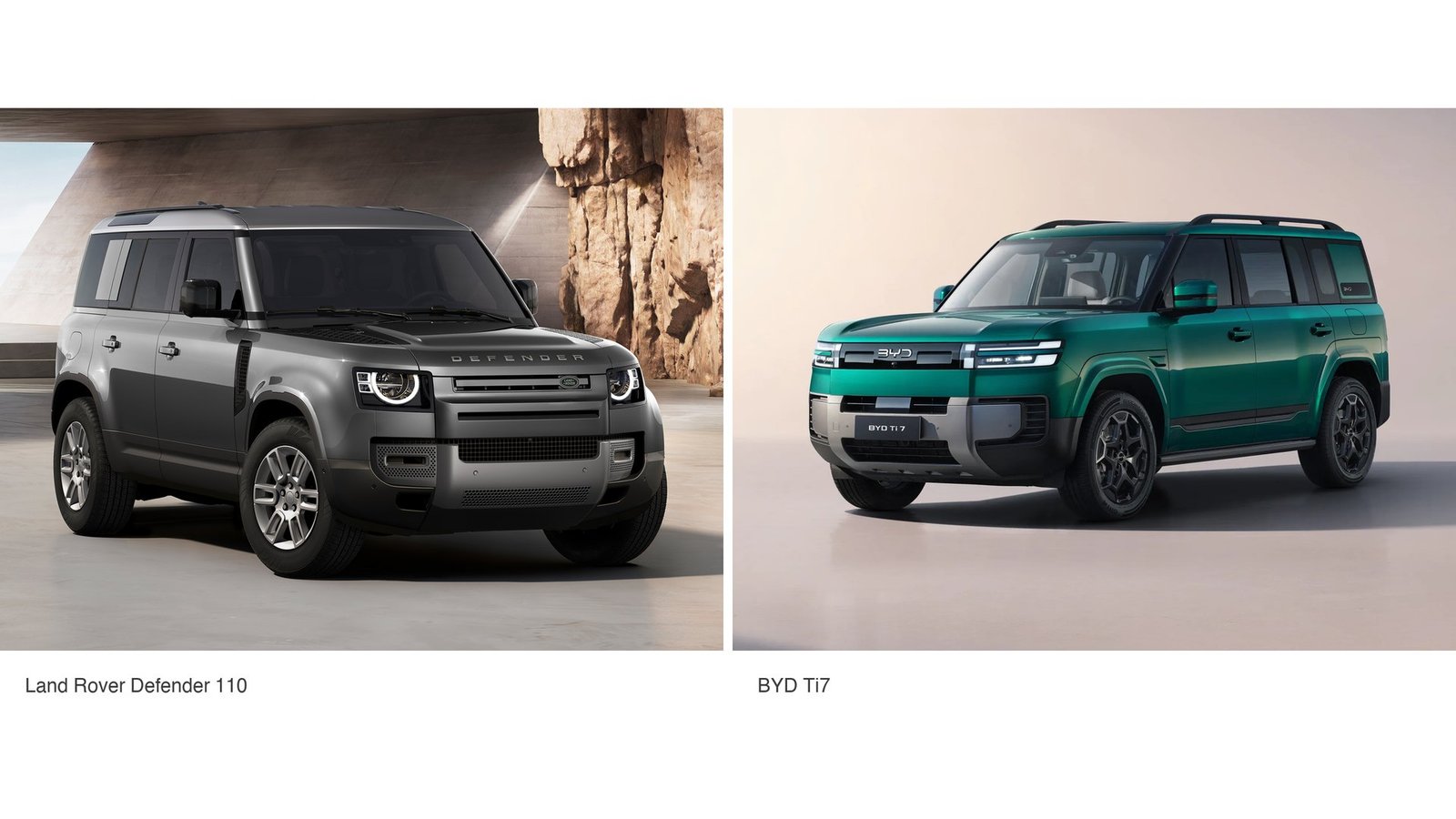
Bailiffs acting for Jaguar Land Rover (JLR), the British maker of the Range Rover and the Defender, seized digital records from Chinese carmaker BYD’s offices in Schiedam and Hoofddorp in the Netherlands in August. JLR’s case is that BYD’s Ti7, a seven-seat plug-in hybrid SUV that’s been called China’s answer to the Defender, infringes its intellectual property. A court in The Hague is expected to rule this week on procedural questions about that evidence and whether the case can go ahead.
The raid only became public on Sunday 8th November in a British newspaper report, and almost everything known about it comes from there. Both companies have declined to comment, and no court document on the case has been published.
So, did BYD copy the Defender? That’s what JLR will have to prove, and the case appears to be about more than how the Ti7 looks. JLR suspects BYD took apart a Defender to reverse-engineer some of its technology for use in the Ti7, though it hasn’t said which technology, or which patents, designs or other rights it believes were infringed.
What Dutch law allows, and what the court decides this week
Dutch law allows this kind of raid. Under Article 1019b of the Dutch Code of Civil Procedure, a judge can let a company that has made a plausible case of infringement seize evidence, including documents, before the main case starts. Where there’s a risk the evidence could be lost or hidden, the judge can allow it without hearing the other side first. That was JLR’s worry: it wanted the records secured before they could be destroyed.

BYD’s lawyers have called the seizure a “fishing expedition” and argue that too many files were taken. JLR’s side accuses BYD of obstructing the process. Seizing files and being allowed to use them in court are separate steps, so this week’s ruling won’t say whether BYD copied anything. It decides whether JLR gets to use what it took in August, and whether its case can move forward.
JLR has lost a fight over the Defender’s shape before
In August 2020, England’s High Court upheld a decision refusing JLR trade marks on the shape of the old Defender 90 and 110, in a fight with Ineos, which went on to build its own boxy 4×4, the Grenadier. The judge agreed that the shape didn’t depart enough from what other cars in the sector look like to be distinctive on its own.
We think that history is part of why this case appears to lean on reverse-engineering, the practice of taking a product apart to learn how it’s made, and not on looks alone. JLR has won a copying case in China before: in March 2019 a Beijing court found that the Landwind X7 copied five features of the Range Rover Evoque and ordered it off sale, after a case that ran for more than three years. JLR also works with Chinese carmakers: it formed a joint venture with Chery in 2012, and the two have agreed to bring back the Freelander name on new electrified models.
The car at the centre of it
The Ti7 is already on sale in China, where it launched on 9th September 2025 as the Fangchengbao Tai 7, Fangchengbao being one of BYD’s sub-brands, from about USD 26,900 or KES 3.5 million. In the UK it comes in one trim, the Excellence AWD, at £47,995 or about KES 8.3 million. It pairs a 1.5-litre turbocharged petrol engine with electric motors for 408PS, and BYD claims 0 to 62mph (100km/h) in 4.8 seconds. Its 35.6 kWh battery gives up to 74 miles, about 119km, on electricity alone. Showroom cars arrive this month, and customer deliveries start in January 2027.
The seven-seat Defender 110 starts at £68,465 or about KES 11.9 million in the UK. That makes the Ti7 about £20,470, or KES 3.6 million, cheaper for a similarly sized seven-seater, though the two have different powertrains and engineering underneath. Our KES figures use GBP 1 = KES 173.8 and USD 1 = KES 129.9, the rates on 9th November 2026.
That gap matters because of how much JLR now leans on the Defender. In the three months to 30th September 2026, JLR sold 29,500 Defenders to customers, up from 25,370 a year earlier. That’s more than a third of the 79,000 cars JLR retailed in the quarter, and Range Rover, Discovery and Jaguar retail sales all fell year on year. A seven-seater that looks the part for KES 3.6 million less is aimed straight at those buyers.
In Kenya, and what comes next
The Defender is sold here through Land Rover Kenya, and BYD sells seven models through CFAO Mobility, among them the Shark 6 plug-in hybrid pickup we covered at its Kenyan launch last year. The Ti7 isn’t on BYD Kenya’s model list, and BYD hasn’t said whether it’s coming. The nearest sign is South Africa, where BYD filed to trademark the Ti 7 name in April; BYD’s South African arm wouldn’t comment on the car.
When we looked at the Range Rover Electric in September, the problem for JLR was Chinese carmakers building big electric SUVs faster and cheaper. The Ti7 brings the same pressure to the Defender. Meanwhile BYD is still taking UK orders for the Ti7, with deliveries set for January. If the court lets JLR use the August files, JLR will rely on them to try to show that BYD copied the Defender.





Join the discussion