
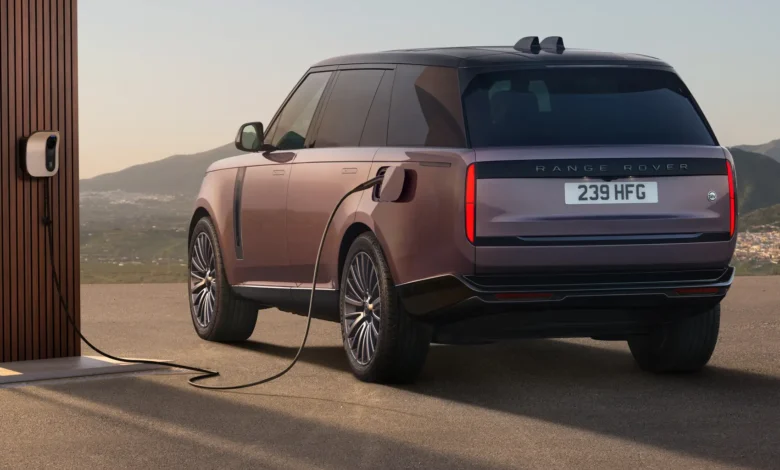
The automotive industry is undergoing a brutal, hardware-level architecture shift, and legacy automakers are finding out that prestige doesn’t guarantee a fast charging curve. JLR today finally opened the order books for the new Range Rover Electric. Marking the first battery-electric vehicle in the model’s 56-year history. It launches at £154,070 in the UK and $140,450 in the United States. For perspective, that is approximately KES 18.2 million , before any Kenyan import duty is applied.
At its core, the engineering is robust. The car features a massive 118.5 kWh usable battery constructed from 344 prismatic cells, powered by an 800-volt electrical system. Dual 260kW motors generate 550PS and 850Nm of torque. First deliveries from the Solihull plant begin in October, and the vehicle retains all its classic capabilities: wading up to 900mm and climbing 45-degree slopes using a single-pedal mode.
However, JLR rates the vehicle at up to 372 miles (599 km) on Europe’s WLTP cycle, and just 333 miles (536 km) on the much stricter American EPA cycle. For a battery of this sheer size, those numbers demand a deeper, critical analysis.
Five and a half years later
To understand the delay, we have to look at the timeline. JLR announced its Reimagine strategy in February 2021, boldly stating that the first all-electric Land Rover would launch in 2024, with a target of six models by 2030.

The initial waiting list, which opened in late 2023, attracted an impressive 62,000 names. But by 2025, JLR wrote to those people confirming the car would not arrive until 2026, pointing to softer global EV demand and a need for extended testing time. Compounding this delay was a severe cyberattack that began on 31 August 2025, halting JLR production worldwide for over a month and contributing to a staggering £559 million loss in the September quarter.
Giant battery, but little range
A 118.5 kWh pack is genuinely enormous. By comparison, a Tesla Model Y Long Range operates on a pack roughly 75 kWh in size. Squeezing just 333 EPA miles out of nearly 120 kWh translates to roughly 2.8 miles per kWh.
Let’s compare it with some electric SUVs
| Model | Battery | Range | Max charging | Price (USD / KES) |
|---|---|---|---|---|
| Range Rover Electric | 118.5 kWh | 536 km (EPA), 599 km (WLTP) | 350kW | $140,450 / KES 18.2m |
| Cadillac Escalade IQ | 205 kWh | 740 km (Cadillac estimate) | 350kW | $127,405 / KES 16.5m |
| Lucid Gravity Grand Touring | 123 kWh | 724 km (EPA) | 400kW | $94,900 / KES 12.3m |
| BMW iX5 | 144 kWh | 700 km (BMW in-house EPA estimate) | 460kW | $79,800 / KES 10.3m |
| Rivian R1S Dual Max | 140 kWh | 660 km (EPA) | 220kW | $90,990 / KES 11.8m |
| Lotus Eletre 600 | 108 kWh | 600 km (WLTP) | 350kW | $116,883 / KES 15.1m |
| Hongqi E-HS9 (2020) | 99 kWh | 465 km (WLTP) | 110kW | $66,515 / KES 8.6m |
| Luxeed R7 | not published | 855 km (CLTC) | 800V | ~$34,800 / KES 4.5m |
| Xiaomi YU7 | 96.3 kWh | 835 km (CLTC) | 5.2C, 10 to 80 per cent in 12 min | $37,735 / KES 4.9m |
| Aito M9 BEV | 120 kWh | 750 km (CLTC) | 800V | $71,421 / KES 9.2m |
| Li Auto i8 Max | 97.8 kWh | 720 km (CLTC) | 5C, 500 km in 10 min | $52,070 / KES 6.7m |
| Nio ES8 gen 3 | 102 kWh | 635 km (CLTC) | 600kW, 250 km in 5 min | $60,555 / KES 7.8m |
| Nio ES9 | 102 kWh | 620 km (CLTC) | 600kW | not confirmed |
| Onvo L90 | 85 kWh | 605 km (CLTC) | 900V | $39,566 / KES 5.1m |
While the range for each above SUV depends on use, and the CLTC standard overstates ranges, you can clearly see price versus battery size and range. Chinese vehicles are offering way more for way less, while charging way faster.
Big, heavy luxury cars should be the easiest segment to electrify. A Range Rover has always been heavy; this electric iteration weighs 2,885 kg, which is only 75 kg more than the plug-in hybrid because the platform was already accustomed to that mass. Electric motors offer precisely what off-roading demands: quiet operation, instantaneous torque, and granular power metering to each wheel at crawling speeds. Large SUVs also have the physical floor pan area to house massive cell arrays.
China happened
While JLR spent years testing and recovering from supply chain and cyber crises, Chinese manufacturers ruthlessly captured the segment. They have been building these cars for six years.
Hongqi released the full-size electric E-HS9 in China back in 2020, and started delivering it in Norway by January 2022 at about $67,000. Nio’s highly successful third-generation ES8, priced at 406,800 yuan (or 298,800 yuan if buyers rent the battery), dominated and led China’s full-size SUV market for three consecutive months leading up to February 2026.
The innovation isn’t just in volume; it’s in raw capability. Li Auto’s i8 utilises a 97.8 kWh battery to deliver a claimed 720 km starting from 321,800 yuan. BYD’s aggressive Yangwang U8L is explicitly aimed at Range Rover territory; it can turn on the spot and literally float for half an hour. Even the smartphone ecosystem is crossing over: on 7 September, Xiaomi’s Sky Nomad launches from around KES 5 million in China.
Are these apples-to-apples comparisons? Not entirely. Chinese range figures rely on the CLTC cycle, which is notably gentler than WLTP or EPA testing. Furthermore, several models like the Yangwang U8L and the Sky Nomad are range-extenders rather than pure battery EVs, meaning they carry petrol generators. In a strict like-for-like test, some would lose to the Range Rover. However, that misses the broader reality: the segment became saturated with highly capable alternatives while JLR was stuck in development.
Charging
The Range Rover Electric can charge from 10 to 80 per cent in 22 minutes on a 350kW charger, effectively adding 220 km of range in ten minutes. In 2023, those would be commendable specifications. Today, charging infrastructure and hardware have accelerated.
In March 2025, BYD unveiled its Super e-Platform, running 1,000V and 1,000A for a full megawatt of charging power, claiming 400 km in just five minutes. Zeekr’s 1.2MW charger has already peaked at 1,100kW, taking a car from 10 to 97 per cent in under nine minutes. Meanwhile, Nio allows drivers to swap a completely depleted battery for a full one in roughly three minutes.
It is true that achieving these speeds requires access to specialised Chinese chargers, and independent road testing has shown that BYD’s five-minute claims have not consistently held up in the real wold. But even with caveats, the direction of the technology is clear: European legacy charging speeds are being left behind.
Coming to a yard near you
The ripple effects of this technological arms race are hitting our shores directly. In 2025, China exported more than 2.5 million electric cars, practically double their 2024 numbers. BYD on its own exported 1.05 million vehicles.
We are seeing this market infiltration in real-time. BYD has been successfully selling the Dolphin, Seal, and Atto 3 in Kenya through Loxea since 2024. Furthermore, Jetour arrived in November 2025, bringing four new SUVs alongside a massive KES 1.4 billion local assembly plan. We have already thoroughly documented what happens to the final retail price of a Chinese EV once it clears Mombasa—the economic proposition is incredibly disruptive.
The Range Rover Electric will, without a doubt, be a very good Range Rover. With deliveries beginning in October, and subsequent plans for an electric Range Rover Sport and a Range Rover GT, JLR is finally on the board. But moving forward, the metrics that matter are the ones owners will experience daily: how close they actually get to that 333-mile range, and how long they have to sit at a public charger to put it back.









Join the discussion