

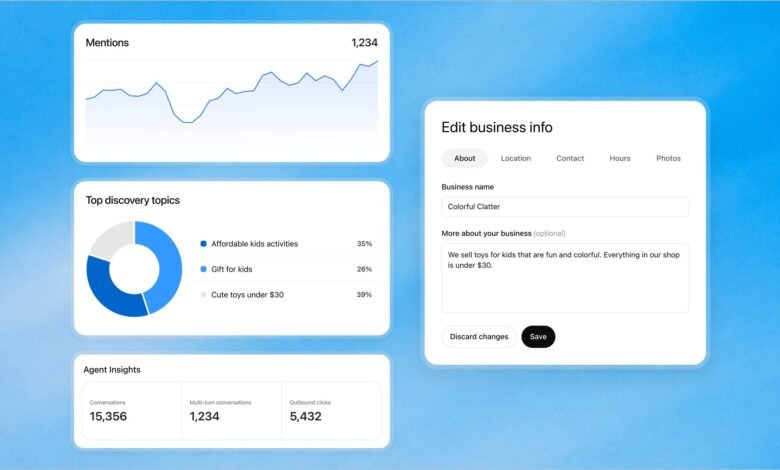
OpenAI has opened a way for businesses to take control of how they show up in ChatGPT. The beta, called Businesses in ChatGPT, went live on 10th November 2026. It lets a business claim its profile, correct its details, upload its products and prices, and see how often ChatGPT mentions it to the 1.2 billion people OpenAI says use the chatbot every week.
If you have searched for your own business on Google, this will sound familiar. A Google Business Profile is the listing with your hours, phone number and reviews that appears on Search and Maps, and owners claim it so that what people see is correct. OpenAI is building the same thing for a world where people ask a chatbot “which laptop bag should I buy?” instead of typing keywords. So the question for any business owner is whether they can claim theirs, and what they get when they do.
How claiming works
Everything runs through Business Hub, a new section in the ChatGPT sidebar. You search for your business by name, pick the listing that matches and prove you’re connected to it. OpenAI’s setup guide lists four ways to do that: a code sent to the business phone number, a code sent to the business email, a TXT record added to your website’s DNS settings (the part of your domain setup that tells the internet where your site lives), or logging in to your Shopify store.
That only gets your claim approved. To publish changes, connect a product feed or see any numbers, you also have to pass identity checks run by Persona, an ID verification company, which can ask for a government-issued ID, business registration documents and proof that you’re allowed to represent the business. Pass that and your profile gets a blue verified tick. After that you can update your website, description, category, logo and delivery and return policies, and upload a product feed, which is a file listing what you sell with current prices and stock.
The numbers are the part most owners will want. Business Hub shows mentions, website clicks and “discovery topics” over the past 28 days. A mention for an online business counts only when ChatGPT references its website; the brand name alone doesn’t count. Discovery topics are the common themes in conversations where your site came up. You don’t see anyone’s actual questions or chats, and OpenAI only shows a figure once enough conversations have built up, so a blank figure doesn’t necessarily mean zero.
So if ChatGPT already recommends your shop, you can now see roughly how often, and correct the profile when it gets your prices or hours wrong.
The agent is the US-only part
A Business Agent is a chatbot a business sets up inside ChatGPT, fed with its own product details and policies. When your business comes up in an answer, a customer can tap through to your profile and start a separate conversation with your agent, labelled as such, to compare products or ask “can I return an item I bought on sale?”
Agents are limited to eligible online shops and online service businesses in the US with a website. Businesses can also pay to promote their agent and use it as the landing point for ChatGPT Ads, the sponsored placements OpenAI announced in January.
OpenAI’s Business Agents policy sets the rules. The agent must say it’s an AI representing the business, not pose as a human or an independent adviser. It can’t pressure people or invent false urgency, can’t ask for unnecessary or high-risk personal information such as government IDs, health details or financial credentials, and can’t submit a purchase or booking on the customer’s behalf without explicit permission through a feature OpenAI has approved.
Google got there first. It launched its own Business Agent on Search on 11th January 2026, also for US retailers, with Lowe’s, Reebok and Poshmark among the first.
What it means for Kenyan businesses
OpenAI says any eligible business located where ChatGPT is available can claim its profile, and ChatGPT works in Kenya. The setup guide adds a condition: the verification method has to be supported where you are, and availability “depends on the business’s location and type”. OpenAI doesn’t publish a list of countries where that verification works.
The guide is clearer on one group. Physical stores and restaurants can currently claim only an existing US listing, so a Nairobi restaurant or a phone shop on Moi Avenue can’t claim its profile yet. We think a Kenyan online shop or online service with its own website has the best chance of getting through. It still can’t build an agent.
Kenyan businesses can, however, already buy ChatGPT Ads themselves. OpenAI expanded its ads to 89 countries on 21st October 2026, and its Ads Manager availability page lists Kenya as open for self-service. The ads show only to people on the Free plan and the cheaper Go plan, which we covered when it came to Kenya last year.
What OpenAI doesn’t say
The announcement gives no price for Business Agents, and it doesn’t say whether claiming a profile or uploading a product feed makes ChatGPT recommend you more often; the setup guide says only that a feed doesn’t guarantee recommendations. ChatGPT can also keep using other sources when it answers questions about your business, and OpenAI’s profile policy says it doesn’t check every detail a business submits. And OpenAI support won’t delete or hide a published profile at an owner’s request.
Claiming doesn’t change whether a profile appears either. So if ChatGPT already has a listing for your business, it stays whether you claim it or not, and claiming is how you correct it. When Glovo plugged its app into ChatGPT in July, the bet was that shopping would start inside chatbots. Business Hub is OpenAI making that bet official, and it ties the profile tools to its ad business from day one. For a Kenyan business with a website, it’s worth checking whether you can claim your listing now and what ChatGPT says about you. Paying for anything can wait until OpenAI shows whether a claimed profile changes how often you get recommended.




Join the discussion