

Samsung is working on a phone whose screen slides out to change shape, from 16:9 when it’s closed to a taller 21:9 when it’s open. That’s the claim Ice Universe, a long-running Samsung tipster, posted on X on 11th November 2026. Samsung hasn’t announced the phone, and nothing it has published uses those two numbers.
The numbers describe a screen’s shape, its height against its width. Most phones today, the Galaxy S26 Ultra included, sit at about 19.5:9. So a 16:9 screen of the same width is about 18% shorter than what you’re probably holding, which is the shape phones like the 2016 Galaxy S7 had. Open it to 21:9 and it’s about 8% taller than that 19.5:9 screen. The width doesn’t change, so the screen grows by about 31% in length. You’d carry a stubbier phone and pull out a slightly taller one.
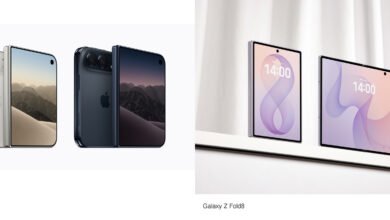
The tipster’s reasoning: “Some people prefer a wider screen, while others like a taller form factor.” Samsung already splits its foldables along that line. The Galaxy Z Fold8 we covered in July is shorter and wider than any Fold before it, while the Fold8 Ultra kept the tall body and has a 21:9 cover screen. In August, Huawei put the wide screen on an ordinary slab phone, the Pura X View.
What Samsung’s patent shows
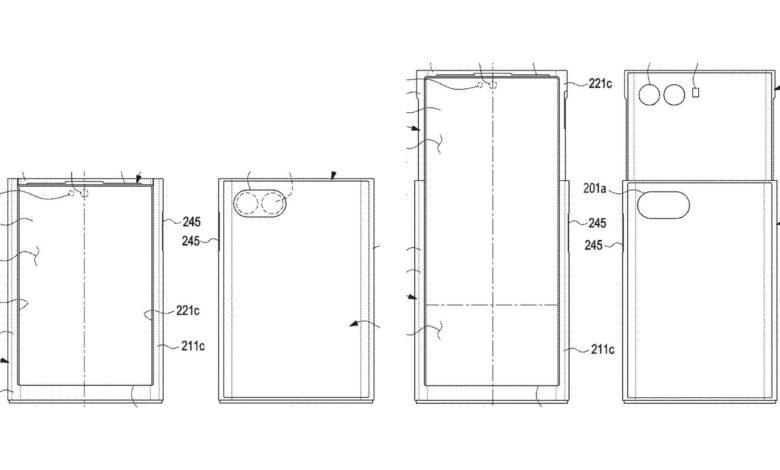
Samsung’s patent application US 2026/0333595, published by the US Patent and Trademark Office on 22nd October 2026, describes a phone in two parts. The top part slides up out of the bottom one, and part of the flexible screen stays curled up inside the body until you need it. A motor turns a gear along a toothed rail to push the top part out, and you’d set it off with a physical button or an on-screen one. The application says the screen’s proportions change as it slides, but it gives no ratios, and it’s an application, not a granted patent.

What Samsung wants to protect is a way of keeping that screen flat. Where the panel bends inside the phone, it pushes outward and can deform. So Samsung backs the screen with a row of thin support bars and runs them through guide rails with angled grooves, which pull the bars back in. That’s what would stop the curled part from bulging.
The two images in the tipster’s post match the patent’s drawings almost line for line, down to the cameras that look out through a window in the back when the phone is closed. Their screens don’t match the numbers in the post, though: we measured them at about 12:9 closed and 23:9 open. We think they were drawn from the patent.
Samsung has also built the idea before. At MWC 2026 in March, Samsung Display, the group’s screen-making arm, showed a “Mobile Slidable” prototype that went from a 5.1-inch 16:9 screen to a 6.7-inch 22:9 one. It was marked as under development, and its slide wasn’t motorised.
Why the battery is the hard part
The tipster raised this in the same post. The sliding mechanism takes up room the battery would otherwise use, because the motor, gear, rails and curled-up screen all have to fit inside. The patent even lists the battery among the parts the sliding half may hold. A bigger screen also uses more power when it’s open, which is why the post asks whether the phone would deliver enough battery life with the screen fully extended.
Timing is less clear. In June, a Samsung official said the company is targeting the first half of 2028 for its first rollable phone. Samsung hasn’t confirmed that date, or that the rollable and this sliding phone are the same device.
Put together, there’s a tipster’s two numbers, a patent that explains the mechanism and a prototype that already did something close. We think that’s enough to say Samsung is working on a sliding phone, though nothing yet says it will ship, or when. If it does, check the battery capacity first, because that’s where the tipster expects Samsung to give something up.






Join the discussion