
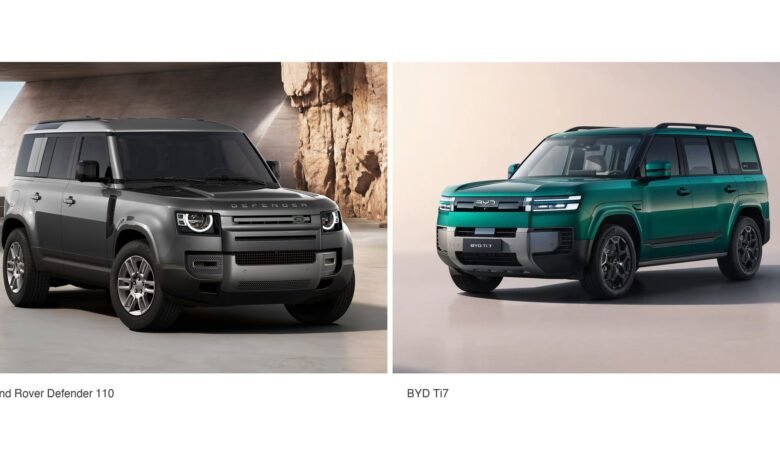
A court in The Hague ruled yesterday that BYD’s Ti7 SUV infringes Jaguar Land Rover (JLR)’s registered EU design for the Land Rover Defender. The carmaker is now banned from from importing, making, offering, selling, storing or delivering the Ti7 anywhere in the European Union. It is the first ruling on whether the car infringes, in a fight that began with a raid on BYD’s Dutch offices in August. The ruling arrives nine days after the same court ordered JLR to destroy the files it seized in that raid.
BYD’s European companies have a week from being served with the judgment to comply. After that, each breach costs EUR 100,000 (about KES 14.3 million) for every day or part of a day, or EUR 25,000 (about KES 3.6 million) per infringement if JLR prefers, up to a total of EUR 10 million, or about KES 1.43 billion. The order is provisional, pending a full trial.
The Ti7 is a seven-seat plug-in hybrid SUV: a 1.5-litre turbocharged petrol engine works with electric motors and a battery you can charge from the wall. As we reported earlier this month, Britain gets one version, the Excellence AWD, at £47,995 or about KES 8.2 million, which is £20,470 (about KES 3.5 million) less than the cheapest seven-seat Defender 110. Its upright, boxy shape drew Defender comparisons as soon as UK orders opened in July.
What the court decided
JLR’s case rests on a registered EU design, a legal protection for the way a product looks. One registration covers every EU country and can be renewed in five-year terms for up to 25 years. JLR registered the Defender’s design in 2018, a year before the current model went on sale in September 2019. A registered design is infringed by any product that gives an informed user, someone who knows the category well, no different overall impression, and unlike with an unregistered design, the owner doesn’t have to prove it was copied. That is why the court ruled that the Ti7 infringes the Defender’s design, and made no finding that BYD copied it.

The judge listed six elements the Ti7 shares with the registered design: bulging shoulders with rounded corners, the signature panel on the rear pillar, wheel-arch cut-outs with rounded corners, a continuous band of glass around the cabin, the proportions and the overall silhouette. BYD pointed to its different headlights, grille, bumpers, bonnet, windows and wheel arches. The court said those differences weren’t striking enough to change the overall impression, and concluded: “De Ti7 wekt daarmee geen andere algemene indruk dan het Uniemodel” (the Ti7 therefore gives no different overall impression than the EU design).
BYD told the court it has no concrete plans to sell the Ti7 in the EU. The judge banned it anyway, because the order exists to keep the car off a market it hasn’t yet entered. BYD Hungary, a subsidiary of BYD Europe, is to run a BYD car factory in Szeged that aims to start production from the end of 2026, and the judge considered that the Ti7 could be built there if it came to the EU. The ban’s bar on production rules that out for now.
JLR also wanted the car stopped in Britain. The court said it has no jurisdiction over BYD’s UK company, and it rejected the claim against BYD’s Dutch companies over British design rights because JLR hadn’t shown they were involved in offering the Ti7 there. Anyone who has ordered a Ti7 in the UK should still get it from January. The judge also turned down JLR’s requests for a public correction and for BYD’s documents on the car’s trade, since the ban already covers what JLR was worried about in the EU.
What happens next
The judgment came out of a kort geding, the Dutch fast-track procedure for urgent cases. JLR has six months to start main proceedings, a full trial on the merits, and if it doesn’t, the ban can lose its force. BYD says it will appeal. The company called the Ti7 “the result of BYD’s own independent design work”, said it “infringes none of JLR’s rights”, and promised to “pursue every legal avenue to demonstrate that this decision is incorrect.” JLR said it protects its intellectual property and takes legal action when necessary, and that it won’t comment further while proceedings continue.
The ban costs BYD no sales today. However, it raises the cost of bringing the Ti7 to Europe. Unless BYD overturns the finding on appeal or at trial, an EU version would need a body that leaves a different overall impression, and the court has already said that different headlights, a different grille and different bumpers aren’t enough.






Join the discussion