

For years, setting up Telegram on a new device has been a relatively painless process. Enter your number, receive a verification code via SMS or through an already logged-in device, and you’re in. But that familiar flow is now changing, and Kenyan users are among those getting caught in a confusing and increasingly controversial new system that asks them to pay just to receive a login code.
Telegram is now forcing users to purchase a temporary Premium subscription just to receive the standard SMS verification code required for logging into a new device.
One Kenyan user, attempting to set up the app on a new iPhone, was unexpectedly hit with a demand for payment, citing high carrier costs. This move is part of a wider, highly controversial policy that has left both new and long-time users frustrated and locked out of their accounts.
The user, who already had Telegram active on a Windows laptop, expected the verification code to be sent via the in-app chat, as has been standard for years. Instead, the process became a maze of new steps. He was first asked to provide an email address, which resulted in a code being sent to their inbox.
After successfully verifying the email, he was immediately presented with a payment screen. The image below shows a prompt for a subscription, which essentially forces them to pay to cover what Telegram claims is a high SMS fee levied by local carriers like Safaricom.
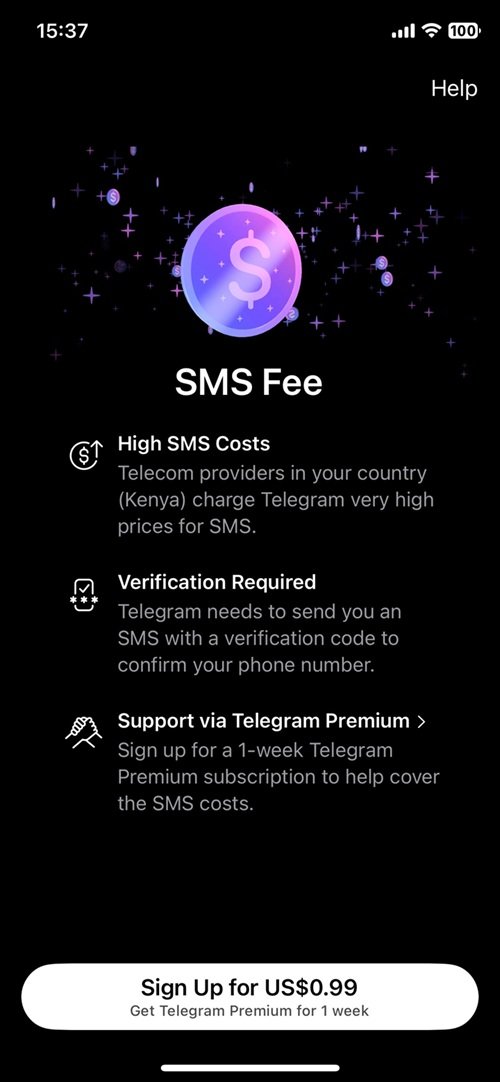
“I wonder how much Safaricom is charging them (Telegram) to warrant this change in their terms, because this was never the case before,” the user noted. The core issue, according to Telegram’s position echoed in forums, is that the entire fee is passed on to the carrier to cover the cost of the single verification SMS.
A growing African trend and global headaches
The issue is not isolated to Kenya. Reports from online forums, including the Telegram subreddit, indicate that users in Uganda, South Africa, and other sub-Saharan countries are experiencing the same frustrating paywall.
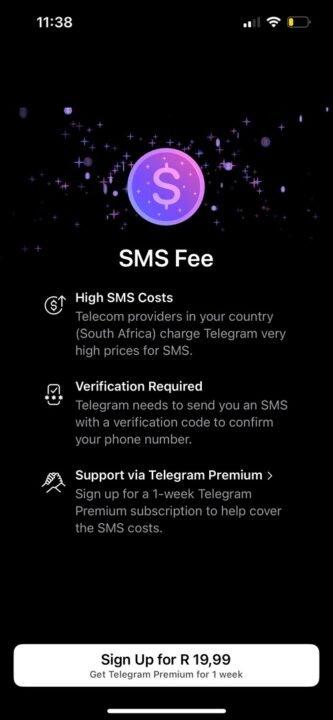
The problem, however, appears to be a global strategy by Telegram to offset rising SMS costs, especially in regions where carriers charge third-party services high rates for sending One-Time Passwords (OTPs). This situation is closely tied to Telegram’s controversial Peer-to-Peer Login Program (P2PL), which was announced last year. P2PL allows users to volunteer their phone number as a relay to send up to 150 OTP SMS messages per month to other users, in exchange for a free Premium subscription.
Payment issues and privacy concerns
Beyond the immediate paywall, the login process appears to be fundamentally broken for many of those affected. Several users who did proceed to pay the requested fee reported that the payment failed to process the login, leaving them charged but still locked out of their accounts. One user described being charged successfully but seeing the same menu, and when they restarted the app, they were met with a “Sorry you cannot use this email” error.
The most baffling part for existing users is the forced SMS verification when the account is already logged into another device (like a desktop). Telegram has historically used its own in-app notification for verification codes in such scenarios. Also, users with Two-Factor Authentication (2FA) enabled with a password and email are still being forced down the SMS verification path, which defeats the purpose of having alternative, secure verification methods.
While Telegram attempts to shift blame onto mobile network operators like Safaricom for high SMS costs, the broader tech community is questioning the execution and necessity of this move. If Signal can afford SMS verification in ‘expensive’ countries, why can’t Telegram?
This decision disproportionately affects users in poorer countries, which are a massive and growing part of Telegram’s user base. Furthermore, the push towards the P2PL system is a privacy nightmare because it exposes the recipient’s phone number to the sender/volunteer’s phone number, completely undermining Telegram’s long-held privacy-first image.
Workaround (for now)
For those facing this paywall, the only reported workaround is currently platform-dependent and risky. On Android, installing an older version of the Telegram app (specifically v.11.7.3) has been reported to bypass the issue for some, though its effectiveness is diminishing. But since older app versions are not accessible via the Apple App Store, iPhone users are left with very few options other than attempting to use the web browser version of Telegram or waiting out a “cooldown period” after repeated attempts.
It seems Telegram’s shift to curb its operational expenses is coming at the direct cost of user experience, convenience, and privacy, particularly in the critical growth markets of the global south.
Have you encountered this Telegram SMS verification fee in Kenya or elsewhere? Share your experience in the comments below.





Portugal as well
Just happened to me, and I’m in the USA!
Happened to me in Trinidad also
Happened to me with a Romanian phone number.
Happens in Germany, too, with Telekom.