

The latest Q1 FY 2025/26 sector report from the Communications Authority offers a telling snapshot of how Kenyans now communicate, and the shift toward data-based platforms is unmistakable. While domestic mobile voice traffic climbed to 29.93 billion minutes, representing steady quarterly growth, SMS traffic declined once again, falling to 14.66 billion messages from 15.24 billion.
This –3.8% quarterly dip in SMS volumes continues a multi-year trend driven by widespread smartphone adoption, which we detailed in our article on mobile phone devices and broadband. With smartphones now at 85.2% penetration, Kenyans increasingly rely on WhatsApp, Telegram, Messenger, and other internet-based channels instead of traditional SMS. Of course, telcos don’t like this since it takes away their SMS revenue, which perhaps explains why Safaricom and co. killed RCS support in Google Messages.
Key figures:
- MoU trend: Up from 126.5 minutes/month between April and June 2025 (Q4) to 127.5 minutes/month between July and September 2025 (Q1).
- SMS trend: Down from 66.3 to 62.4 SMS/month.
- Roaming: Kenyans abroad are using more data. Outbound roaming data volume increased significantly to 128 million MBs (+3.4%).
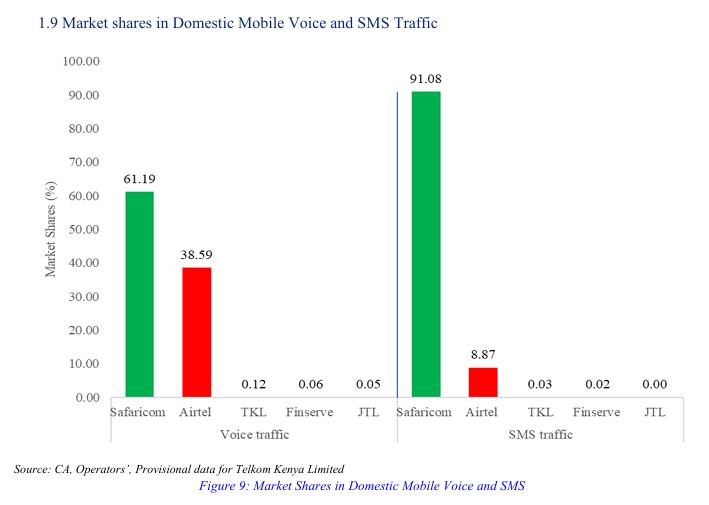
On-net voice traffic rose 2.2%, and off-net traffic jumped 5%, suggesting increased cross-network calling. Although Safaricom remains the dominant contributor with 18.3 billion voice minutes, this is a drop from last quarter’s 18.5 billion voice minutes. On the other hand, Airtel followed with 11.6 billion minutes, up from 10.6 billion minutes in April-June 2025. This shows that more and more Kenyans are joining Airtel and actually using their voice services over Safaricom’s.
Interestingly, average call durations shifted slightly. On-net calls averaged 1.8 minutes, down from 1.9 minutes last quarter, while off-net calls held steady at 1.3 minutes. Airtel subscribers recorded the longest average on-net call duration at 2.8 minutes, far ahead of Safaricom’s 1.6 minutes. This could indicate Airtel’s stronger perception around value for money on voice tariffs.
On the SMS front, Safaricom handled 13.35 billion of Kenya’s total 14.66 billion messages, underscoring its continued dominance even in a declining service category. Airtel managed 1.3 billion, with Telkom, Finserve, and JTL serving the remaining sliver of the market.
The Authority also reported on usage patterns at the subscription level. Minutes of use per subscription ticked up to 127.5 minutes per month, while SMS per subscription dropped to 62.4, down from 66.3. This supports broader findings in our separate analysis of mobile subscriptions and mobile money growth, where heavy smartphone uptake and broadband availability appear to be reshaping how Kenyans interact.
As data-centric platforms continue to evolve, especially with the rise of 5G, voice and SMS will likely maintain their relevance but gradually decline in per-capita usage. For now, though, voice remains stable, and SMS is quietly but steadily slipping into the background.