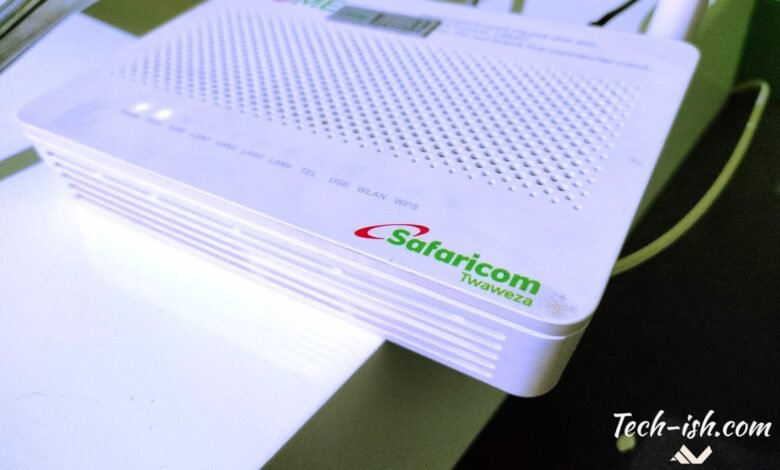

For years, Home Fibre in Kenya has operated on a rigid, monthly subscription model. You pay your KES 2,999 (or more), and you get your month of connectivity. But Safaricom is gearing up to fundamentally change how Kenyans consume fixed internet, borrowing a page from its mobile data success story: flexibility.
In a recent address discussing the company’s future roadmap, Safaricom CEO Dr. Peter Ndegwa revealed that the telco is preparing to roll out flexible payment schedules for fixed broadband. Soon, customers will be able to pay for fibre connectivity on an hourly, daily, or weekly basis, moving away from the strict monthly cycle that currently defines the market.
The ‘sachetization’ of Home Internet
The headline feature of this strategic pivot is what Dr. Ndegwa refers to as “tokenization.” The goal is to democratize access to Wi-Fi by breaking down the cost barriers associated with monthly bulk payments.
“We’ll be able to introduce pay-as-you-go,” Dr. Ndegwa explained. “In the same way we have it in mobile, instead of having plans that are monthly plans, you can have daily, hourly, weekly, or monthly.”
This shift is designed to target a market segment that has previously been excluded from the “premium” fibre ecosystem. Until now, fibre rollouts have largely targeted higher socio-economic neighborhoods. By introducing tiered pricing and shorter validity periods, Safaricom intends to penetrate the “lower segment,” making home Wi-Fi accessible to households that may not have the liquidity for a full month’s subscription upfront but can afford smaller, bite-sized payments.
By the numbers: The 3 million gap
The motivation behind this shift is simple: market saturation in premium areas vs. massive untapped potential elsewhere.
According to Dr. Ndegwa, Safaricom currently serves just over 400,000 customers on fixed broadband. The total market in Kenya currently serves about 1.2 million connections. However, Safaricom’s internal data suggests the actual potential market stands at 4 million households and offices.
“There’s still another 3 million to be served,” Dr. Ndegwa noted. “This area can grow 50% every year for the next 5 years without exhausting the opportunity.”
AI and 5G to drive the rollout
Expanding to that extra 3 million isn’t just about changing the billing system; it’s about infrastructure and cost management. Safaricom plans to use a mix of traditional fiber infrastructure and 5G Fixed Wireless Access to reach these new customers.
Notably, Dr. Ndegwa highlighted the use of Artificial Intelligence (AI) to optimize costs. The company plans to utilize AI to deliver a “cost profile” that makes serving lower-income segments financially viable for the telco while keeping prices affordable for the consumer.
Beyond the living room: Enterprise and Government
While the consumer changes are the most headline-grabbing, Safaricom is also retooling its approach to business and the public sector.
For small businesses, the strategy is shifting toward an “all-in” connectivity model. Rather than just selling a pipe for internet, Safaricom wants to bundle secure fixed networks with ICT and IoT (Internet of Things) services. The end goal is to integrate these services so heavily that businesses aren’t buying “products” but rather “business value.”
For the public sector, Safaricom aims to remain the primary digitization partner for the government, specifically mentioning agriculture, healthcare, and financial services. A key focus here is Digital ID. Dr. Ndegwa expressed a vision where remote identification could eliminate the need for physical customer interactions, streamlining service delivery for both the public sector and Safaricom’s own ecosystem.
The ‘One App’ strategy
Tying this all together is the Super App. Whether it’s a customer buying a daily fibre token or a business managing its IoT fleet, Safaricom wants the interaction to happen within a unified digital ecosystem.
With the second half of the financial year (H2) marked as the timeline to “drive tokenization,” Kenyans can expect to see these flexible fibre plans hitting the market soon. If successful, this could spark the biggest shift in Kenyan internet consumption since the advent of 4G.