

The Communications Authority of Kenya (CA) has been making headlines recently, cracking the whip on 21 mobile phone brands that have failed to meet compliance standards. It’s a bold move, and honestly, a necessary one. In an era where data privacy is a myth and cybersecurity threats are a daily breakfast staple, we need a watchdog that bites. The CA’s role as the gatekeeper of what gadgets enter our borders is critical. Not just for regulation, but for the safety of every Kenyan consumer.
But here is the problem: While the CA is busy red-flagging non-compliant brands, their own house, specifically the phone type approval register, is in a state of absolute chaos.
I’ve spent hours combing through the latest dataset, and to call it lazy would be a kindness. For a government entity with full financial backing and a mandate to lead Kenya’s digital transformation, the state of this public register is embarrassing. It is a disorganized, inconsistent, out-of-date data dump that serves almost no one effectively.
Here is why the CA needs to stop treating this register like an afterthought and start treating it like the vital database it is.
1. The “update” that is already ancient
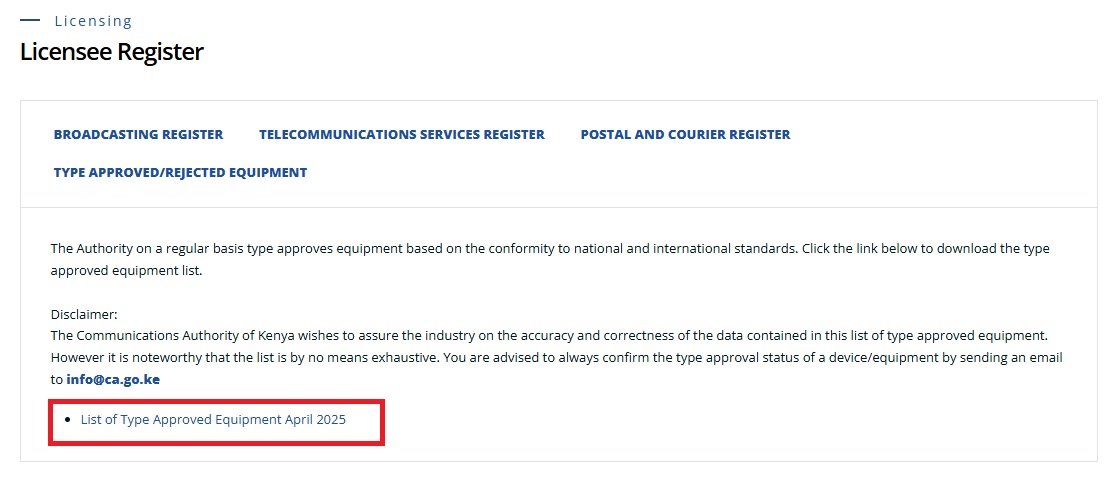
The CA’s website indicates the register was last updated for devices released by April 2025.
Let’s look at the calendar. It is February 2026.
In the fast-paced world of mobile tech, a 10-month gap is an eternity. We are sitting here waiting for the global launch of the Samsung Galaxy S26 series later this month. We know the Galaxy A27, A37, and A57 are in the pipeline. Xiaomi has already pulled the curtains off the Redmi Note 15 series. Yet, if you look at the CA’s “current” list, the Galaxy S25 and Redmi Note 14 are treated as the new kids on the block.
This isn’t just about being slow; it’s about the fundamental process. In markets like the US (FCC) or China (TENAA), the certification body is the source of leaks. Devices must be approved before they launch. The register should be a preview of what’s coming, not a history lesson of what we bought last year. If the CA is approving these devices for sale (which they must be, or the phones wouldn’t be in stores), why is the public-facing data lagging by nearly a year?
2. The alphabetical “data dump”
The current spreadsheet is organized alphabetically by brand. That might sound logical to a librarian in 1995, but for a tech register in 2026, it is useless.
There is no chronological sorting. A Nokia 3310 from the stone age sits comfortably near a Nokia G60 5G. An ancient Ericsson GH 688 (yes, really) shares space with an iPhone 16. And no, CA Kenya has no record of the iPhone 17 series on the phone type approval register.
This means that if I want to see which devices were approved in the last quarter to track market trends, I can’t. I have to scroll through thousands of rows of mixed-up eras. The CA needs to introduce Yearly and Monthly grouping. We should be able to filter by “Approved in 2025” or “January 2026.” It’s a simple spreadsheet function, yet it seems beyond the scope of our regulator.
3. The “guessing game” of naming conventions
This is where the laziness truly shines. I analyzed the raw data from the register, and the inconsistency in data entry is infuriating. There is no standard format for how devices are listed.
- The “model number” mystery: Some entries give you the full picture, like
APPLE iPHONE 13 MINI MODEL: A2628. Perfect. But then, just a few rows down, you getAPPLE A3106orAPPLE A3090. What is an “Apple A3106”? Is it an iPad? An iPhone? A Watch? The CA assumes we all have internal model numbers memorized. A consumer checking if their device is genuine shouldn’t have to Google the model number to find out what phone they actually own. - The “blanket approval” loophole: Then there are entries that are so vague they defeat the purpose of a register. Look at
KGTEL K SERIESorCORN MOBILE PHONE C SERIES. Which phones are these? Does this approve every phone that starts with the letter K? If a manufacturer releases a “K-Series” toaster that makes phone calls, is it approved? Specificity matters in security. - The Transsion confusion: Tecno and Infinix entries are a nightmare of alphanumeric soup. We see hundreds of lines like
TECNO KI7,TECNO KJ7,INFINIX X6836. OPPO is also a culprit (victim?) here as well. To the average Kenyan, these mean nothing. They know the Tecno Spark 40 or the Infinix Note 50. Why can’t the register consistently list the commercial name alongside the model number?- Bad Entry:
TECNO KI5q - Good Entry:
TECNO SPARK 10C (KI5q)(Note: The register actually has some good examples, likeSAFARICOM NEON KICKA 4 SMARTPHONE, MODEL VFD320, proving they know how to do it right, they just choose not to most of the time.)
- Bad Entry:
The CA must do better
We appreciate that the CA maintains this register. It is vital for transparency and helps us hold manufacturers accountable. But in its current state, it is a messy, outdated relic that is painful to use.
Here is the fix I’m proposing to the CA, just in case anyone over there is reading this:
- Standardize the input:
Brand|Commercial Name|Model Number|Date Approved. No exceptions. - Update proactively: If a phone is on the shelf in Moi Avenue, it should already be on the website.
- Sort chronologically: Let us see the history of approval, not just an A-Z list of everything since the 90s.
You have the government backing. You have the authority. Now, please, get some organization.