
Something unusual is happening on Kenyan phones.
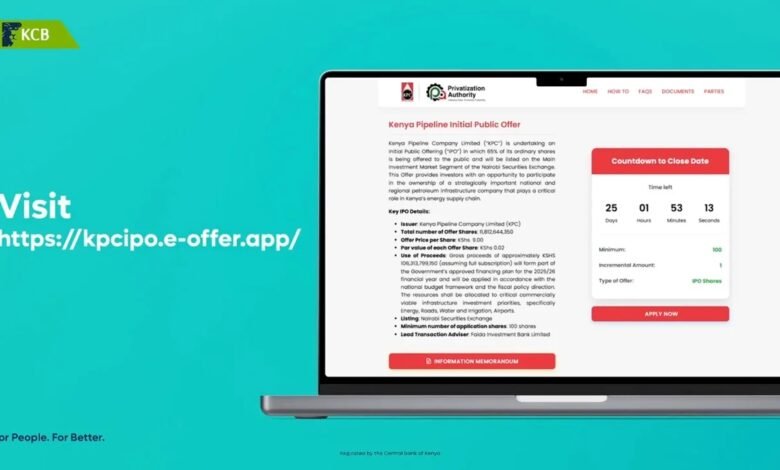
Over the past few days, I’ve received multiple SMS alerts urging me to participate in the Kenya Pipeline Company (KPC) IPO. Not from one entity. Not two. But from Co-operative Bank of Kenya, Safaricom, CDSC-Kenya, and Equity Bank.
On social media, Kenyans are reporting similar messages from KCB Bank Kenya, ABC Bank Kenya, and others.
In my lifetime as a Kenyan mobile user, I have never experienced a coordinated financial marketing push of this magnitude. Not during any public listings. Not even when the government genuinely needed retail participation to deepen the capital markets.
This feels different. And that difference is exactly why people are uneasy.
This unprecedented level of marketing blitz has spilled over onto social media, with Kenyans across platforms echoing similar experiences, naming KCB, ABC Bank, and a host of others as perpetrators of this digital “harassment.”
It’s clear as day: this isn’t organic. The government’s hand is unequivocally in the cookie jar, twisting the arms of these private entities to amplify its message. And for a government that has historically kept its distance from such aggressive corporate strong-arming, this sudden shift under the William Ruto administration raises more than a few eyebrows. It breeds suspicion.
Valuation vagaries
The plot thickens when you consider the conflicting valuations. While the Kenyan government proudly slaps a KES 9.00 per share price tag on KPC, Ugandan institutional analysts, notably Old Mutual and Crestel Capital, paint a drastically different picture. Their initiation note, released after the IPO opened, pegs KPC’s intrinsic value at a mere KES 4.61 per share. That’s a staggering 49% downside to the government’s asking price.
Let’s put that into perspective: the government’s valuation of KES 9.00 values KPC at a whopping KES 163.56 billion. Old Mutual, however, believes its true equity value is closer to KES 77.4 billion. This isn’t a minor disagreement; it’s a chasm that screams either gross overestimation or, more cynically, a deliberate inflation to meet some undisclosed target.
Other notable valuations include KES 9.00 by Faida Investment Bank (lead transaction advisor) and Dyer & Blair Investment Bank (lead sponsoring broker); KES 8.23 by Standard Investment Bank (SIB); KES 6.35 by NCBA Investment Bank; KES 3.70 by Sterling Capital; and an even lower valuation of between KES 3.28 by some Independent Online Analysts.
The second-largest listing in NSE history… on paper
The KPC IPO, at the government’s valuation, would mark the second-largest listing in the Nairobi Securities Exchange‘s history by value. Only Safaricom’s monumental KES 200.0 billion IPO in 2008 would eclipse it.
Here’s a quick look at the big players:
- 2008 – Safaricom: KES 200.0B
- 2026 – Kenya Pipeline: KES 163.6B (Government Valuation)
- 2008 – Co-op Bank: KES 33.2B
- 2006 – KenGen: KES 26.2B
- 2011 – Britam: KES 19.4B
- 1994 – Sameer: KES 6.6B
- 2007 – Kenya Re: KES 5.7B
- 1996 – KQ: KES 5.2B
- 2015 – Stanlib I-REIT: KES 3.6B
- 2006 – Eveready: KES 2.0B
The ambition is clear, but the underlying sentiment is anything but confident.
The subscription scramble: A panic play?
Earlier this week, with just four days left until the deadline, Business Daily reported a dismal 10% subscription rate for the KPC IPO. This paltry figure almost certainly explains the government’s frantic, almost desperate, marketing push. It’s a clear indication that the market isn’t buying what the government is selling, quite literally.
The aggressive SMS bombardment, the social media pressure, the sudden “reminders” from every bank and mobile provider (I haven’t received a single SMS from Airtel), it all smacks of panic. When a government has to resort to such heavy-handed tactics to sell off a public asset, it begs the question: what are they so afraid of? And why are they so insistent on pushing this through at a valuation that seems so out of sync with independent analysis?
A resonant red flag
For many Kenyans, this entire saga is deeply unsettling. The confluence of an aggressive marketing campaign, a contentious valuation, and the historical context of a government known for its opaque dealings creates a potent cocktail of suspicion. Is this a genuine opportunity for Kenyans, or is it another chapter in a long history of questionable state-backed ventures designed to benefit a select few?
The government’s heavy-handed approach isn’t inspiring confidence; it’s breeding distrust. And when it comes to entrusting our hard-earned money with a venture that seems to be screaming “red flag” from every corner, many Kenyans, myself included, are inclined to heed the warning. The KPC IPO, in its current state, feels less like an investment opportunity and more like a gamble with unusually high stakes and an even higher degree of suspicion.
What do you think? Have you been inundated with KPC IPO messages? Share your thoughts in the comments below!