
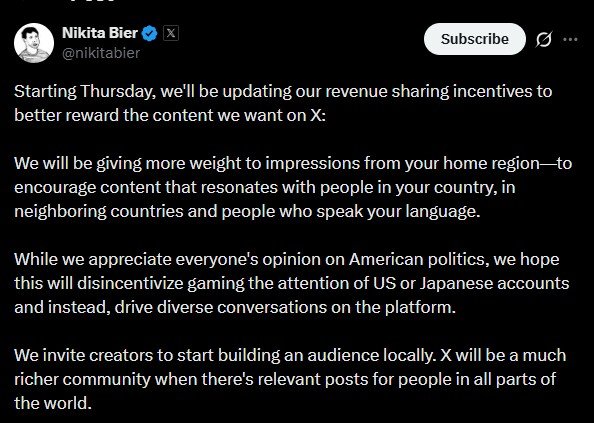
Nikita Bier, X’s Head of Product, dropped a policy bomb yesterday that had the entire platform buzzing, not in a good way. In a move set to roll out as early as this Thursday, X planned to tweak its ad revenue-sharing formula, where impressions from your home region (your country, neighbors, and same-language users) would suddenly carry a heavier weight in how much creators earn. Foreign eyeballs? They’d still count, but far less.
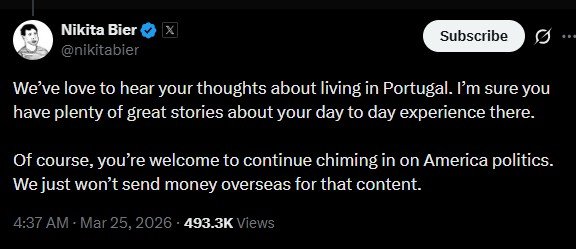
While you’re still welcome to continue chiming in on American politics or European football, X just won’t send money overseas for that content.
The backlash was instant and loud, especially from creators across Africa, India, and beyond who’ve built real audiences by weighing in on global topics. Hours later, Elon Musk stepped in with a single line that paused everything: “We will pause moving forward with this until further consideration.”

The rollout is now on ice. But the debate rages on, and as someone who’s tracked Kenya’s creator economy since X first opened payouts to us in 2023 even though I’m not a premium user, I couldn’t resist diving in.

See, I get why this change felt explosive. X was born as the ultimate global town square—borderless, chaotic, and full of voices from Nairobi to New York. This tweak threatened to put up invisible fences. Yet I also see the logic behind it.
So let’s break it down, fair and square: the merits, the massive demerits, and what this means for Kenyan creators like the ones I follow (and sometimes compete with) every day.
Finally, content that actually matters to us
X’s creator revenue program has always rewarded raw impressions. That sounded fair on paper. Post something viral, get paid no matter where the likes come from. In practice, it created a gold rush for impression farmers. A creator in Lagos or Nairobi could churn out hot takes on U.S. elections, Trump drama, or Taylor Swift beef, rack up millions of views from high-value American and European markets, and cash fat checks while ignoring local issues entirely.
Nikita Bier’s update aimed to flip that script. By weighting home-region impressions more, X wanted to reward relevant content. Think about it: a Kenyan politics thread that actually resonates with East African users would suddenly pay better than the same account farming U.S. outrage. Small, hyper-local creators who often get drowned out by bigger global accounts would finally have a fighting chance in their own feeds.
Here in Kenya, that resonates. I’ve watched talented local voices on tech, health, agriculture, and even county politics struggle because their reach gets diluted in a sea of international noise. This change could have forced creators to speak to their audience instead of over it. No more random Kenyan accounts dominating timelines with American election takes that most of us experience only through CNN. Instead, we’d get deeper dives into affordable housing in Mathare, the latest M-Pesa innovations, or why our football leagues deserve more shine. It shouldn’t just be about money. It should be about relevance.
As a Kenyan scrolling X daily, I’m tired of my feed feeling like an American echo chamber. This policy could have nudged us toward content that shapes our lives: local elections, tech policy affecting Safaricom, or health tips that actually work in our context. Global platforms have tried this before (YouTube’s ad rates vary by country, TikTok pushes local For You pages), and it often leads to healthier ecosystems. Plus, it cracks down on bad-faith actors who stir division abroad purely for profit. Win-win?
A global town square or gated community?
But here’s where it stings, and why the backlash hit so hard. X was never meant to be a collection of fenced-off national parks. It was the place where a football commentator in Nairobi could break down an EPL match and earn from UK fans who actually care. Or where a Kenyan tech reviewer could dissect the latest iPhone and get paid by gadget lovers worldwide. Tying payouts too tightly to geography risks punishing exactly the borderless creativity that made the platform special.
Take football commentary, the example that keeps coming up in Kenyan and Nigerian circles. Accounts in Lagos or Nairobi that live-tweet English Premier League games aren’t farming. They’re providing legit, passionate analysis to fans who engage because they love the content. Under the new weighting, UK impressions (the ones that actually pay well) would matter less. The same goes for tech creators covering global products, K-pop stans, fitness coaches, or even climate activists whose work crosses oceans. Why should a creator’s earnings get capped just because they live in a lower-value ad market?
I’ve seen this play out up close. Many Kenyan creators I know (some with 50k+ followers) built sustainable side incomes precisely because their content resonates globally. Politics isn’t the only example. Think travel vloggers, fashion influencers, fitness and wellness coaches, or even meme accounts that go viral across Africa and the diaspora. Limiting their payout to their home region feels arbitrary when the internet itself isn’t geo-fenced. It risks turning X into a patchwork of echo chambers instead of the messy, interconnected square it was founded to be.
And let’s talk economics. Ad rates in Kenya (and most of Africa and Asia) are a fraction of what they are in the U.S. or Europe. Even if local impressions get more weight, the actual dollars might shrink for creators who’ve relied on international reach. For small creators already scraping by, this isn’t empowerment. It’s a pay cut. Plus, genuine voices get lumped in with the farmers. Not every Kenyan talking U.S. politics is a grifter; some are informed observers whose takes add real value to the global conversation.
Why this hit home harder than most
As a Kenyan, I feel this tension personally. Our creator scene exploded post-2023 when X opened global payouts. Suddenly, voices from Nairobi were earning real dollars alongside their U.S. counterparts. But the flip side? Too many timelines filled with foreign rage-bait while local stories like the ongoing hustle around digital IDs, AI in agriculture, or the cost-of-living crisis got buried.
The proposed change could have been a game-changer for grassroots Kenyan creators: podcasters breaking down Huduma Namba debates, engineers demoing low-cost solar solutions, or comedians roasting local politics in Sheng. It might have finally given them the algorithmic love they deserve. Yet for the many who’ve built hybrid audiences with local roots and global appeal, it risked punishing success.
That’s why Elon’s quick pause feels smart. The backlash wasn’t just noise; it highlighted real pain points from creators who do create value across borders. X needs to thread the needle: reward local relevance without killing the platform’s global soul.
For now, nothing changes. Revenue sharing stays as-is while the team (presumably including Musk and Bier) reviews feedback. That’s the beauty of X. Iteration in public, even when it’s messy. Thursday’s rollout is off the table, but the conversation it sparked is far from over.
My bet? They’ll land on a smarter hybrid: maybe bonus weighting for local content without fully penalizing global engagement, or clearer guidelines that target actual farmers instead of blanket geo-rules. Whatever they decide, X’s creator economy is evolving.
I’ll be watching closely, both as a tech journalist and as someone who loves scrolling X for everything from local tech breakthroughs to the occasional EPL rant.
What do you think? Should X prioritize local relevance, or keep the global free-for-all? Drop your takes below. I’m all ears (and impressions).








Join the discussion