
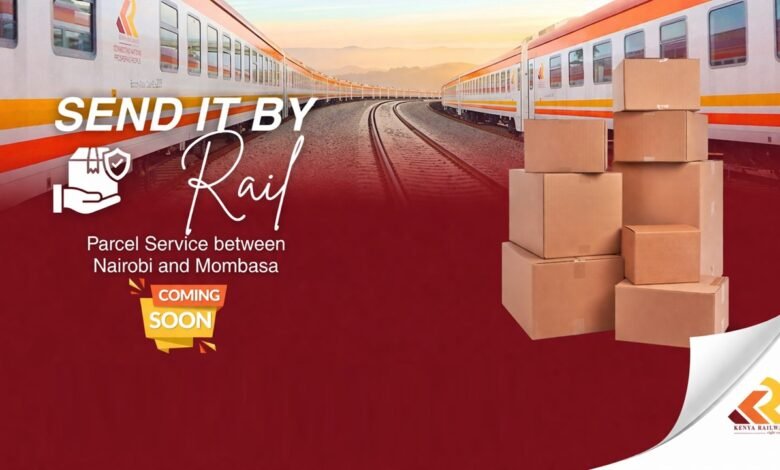

Kenya Railways says it is preparing to launch a new Parcel Service that will offer same-day delivery between Nairobi and Mombasa, a move that instantly makes sense for anyone who has ever watched a package crawl across Kenya by road and wondered whether time itself had been suspended.
In a teaser shared on social media, the corporation said:
“Coming soon, parcel delivery by rail. We’re excited to introduce the Parcel Service, offering same-day delivery between Nairobi and Mombasa, fast, safe, and right on track. Stay tuned.”
Kenya Railways already runs the Madaraka Express passenger service on the Nairobi-Mombasa corridor and also operates an SGR freight division, so this is not some wild leap into the unknown. It is, at least on paper, a logical extension of infrastructure that already exists.
And honestly, I like the idea.
The Nairobi-Mombasa rail corridor is one of the few transport links in the country where “same-day” can sound believable without needing prayer, patience, and several follow-up phone calls. Kenya Railways’ official passenger schedule shows daily services between the two termini, including an afternoon express train, while the broader route is commonly understood to cover the trip in roughly 4.5 to 5 hours depending on service pattern. That kind of speed gives rail a real shot at becoming a serious middle ground between road haulage and expensive private courier options.
For e-commerce merchants, small businesses, and ordinary people just trying to move goods between the capital and the coast without drama, the pitch is obvious. Rail-based parcel delivery could be faster than congested highways, more predictable than long-distance road transport, and potentially safer for goods that do not need a full truck but still need dependable movement. Kenya Railways also already frames its freight services around safety, efficiency, and regular scheduling, which makes the parcel move feel less like a side quest and more like the next box on the logistics roadmap.
But the more I think about it, the more one uncomfortable question keeps coming back: where is Posta Kenya in all this?
That, to me, is the real story.
Because if there is any state corporation that should have been all over a rail-linked parcel delivery partnership years ago, it is the Postal Corporation of Kenya. Posta is not some random bystander here. It already offers courier services, including same-day and next-day options in certain local markets, alongside domestic parcel and cargo services. On paper, this is very much its business. Its own site still presents courier, parcel, cargo, e-commerce, and pick-and-drop as part of its service mix.
So when Kenya Railways independently steps forward to announce same-day parcel delivery between Nairobi and Mombasa, it creates the impression of one government entity moving into a space another government entity should be defending, modernizing, and scaling. That is not a great look for Posta Kenya, especially at a time when private courier firms have already taken a commanding lead in domestic parcel handling.
And this is where I think the opportunity is being wasted a little.
Kenya Railways absolutely should launch this service. In fact, it should go harder.
Do parcels, yes. But do refrigerated units too, especially for perishables moving between major urban markets. Do proper last-mile delivery partnerships, whether with Posta, private logistics firms, or even app-based delivery networks. And if Kenya Railways wants to get really ambitious, it should start thinking beyond parcels into vehicle wagons.
I’m serious about that one. And so are other Kenyans.
Imagine importing a car through Mombasa and then shipping it inland by rail closer to its final destination instead of adding more pressure to road networks. Or flip it around: you are going on holiday to Mombasa or Kisumu, and instead of renting a car or suffering the usual transport compromises, you load your own car or bike onto the train and drive or ride it off at the other end. That is the kind of practical, consumer-facing rail innovation that makes people feel like public infrastructure is actually working for them for once, which would be a refreshing national plot twist.
The bigger problem, though, is that Posta Kenya keeps looking like an institution trying everything except the most obvious thing.
For years, the postal operator has been searching for relevance in a market that moved on fast. Private couriers have grown aggressive, digital commerce has changed what customers expect, and speed now matters almost as much as price. Posta still has the network, the public footprint, the legacy recognition, and in many places the trust. What it has lacked is urgency, sharp execution, and the kind of visible partnerships that could make it feel essential again.
A Kenya Railways-Posta Kenya partnership on this would have made immediate strategic sense. Kenya Railways would handle the trunk movement between Nairobi and Mombasa. Posta would do what a national postal operator is actually built to do: collection, distribution, branch access, and last-mile reach. That would have been the cleaner story. It would also have been the smarter state-capacity story. Instead, what we have for now is Kenya Railways walking into the conversation first while Posta risks looking like the relative who arrives late, underdressed, and somehow still wants credit for the event.
Maybe there is more coming. Maybe Kenya Railways is only teasing the rail leg while partnerships get finalized in the background. That would be the most sensible outcome. But based on what has been shared so far, Kenya Railways is owning the announcement and the momentum, while Posta Kenya once again feels absent from a logistics conversation it should be leading or at least co-leading.
Still, none of that takes away from the fact that the parcel service itself is a good idea.
If Kenya Railways gets the pricing right, makes booking simple, builds trust around handling and tracking, and plugs the last-mile gap properly, same-day rail parcels between Nairobi and Mombasa could become one of the more useful transport upgrades we have seen in a while. It would serve merchants, ease pressure on highways, and give the SGR another practical use case beyond passengers and conventional freight.
I just cannot shake the feeling that this should have been a revival story for Posta Kenya too.
Instead, it risks becoming another reminder that while Posta is still trying to rediscover itself, other players, including fellow state corporations, are moving directly into the future and taking the business with them.