

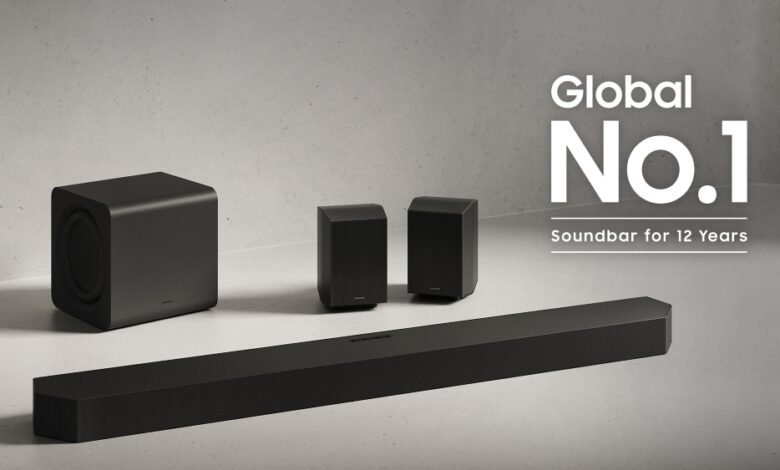
Samsung Electronics has held the global soundbar crown for twelve straight years, and the company is now banking on artificial intelligence to stretch the run further.
According to new Future Source Consulting data cited in Samsung’s own announcement, Samsung controlled 21.5% of global soundbar revenue and 19.7% of unit sales in 2025. The streak began in 2014. No rival has come close to matching that consistency in a category with hundreds of competing brands.
For the 2026 lineup, the pitch moves past speaker counts and channel arrangements. Samsung is selling intelligence. The new Q-Series soundbars introduce AI Room Calibration, which listens to a room’s dimensions and reflective surfaces, then adjusts output in real time.
That matters more than the marketing suggests. Many Kenyan living rooms punish audio gear. High ceilings, tiled floors, open-plan layouts and bare walls create echo and muddy dialogue. A soundbar that can measure those conditions and compensate is, in theory, better suited to local homes than one tuned for a carpeted American den.

The range leans heavily on Q-Symphony, Samsung’s trick of making a soundbar play alongside the TV’s built-in speakers rather than replacing them. For 2026, Q-Symphony scales to support up to five connected devices and analyses layout to distribute channels. Paired with SmartThings, users can hand audio off from a Galaxy phone to the soundbar as they walk through the door. This fits the “hyperconnectivity” story Samsung has been building around its 2026 Galaxy S26 ecosystem push in Kenya.
Design is the other sell. Samsung is pushing slimmer profiles, skin-tone finishes and wireless TV connections to cut cable clutter.
The local context matters. Samsung already sells flagship soundbars in Kenya, with the HW-Q990F retailing above KES 200,000 at local stores. That is a steep bar for most households. The 2026 range will likely include more affordable Q-Series and Music Studio Wi-Fi speakers, though Samsung East Africa has not yet confirmed Kenyan pricing or launch dates.
There is a fair competitive question too. LG, Sonos, Bose and Hisense have all sharpened their audio game. Samsung’s scale advantage is real, but intelligent features travel quickly between brands.
After twelve years on top, Samsung wants soundbars that listen to your room before they try to fill it.






Join the discussion