

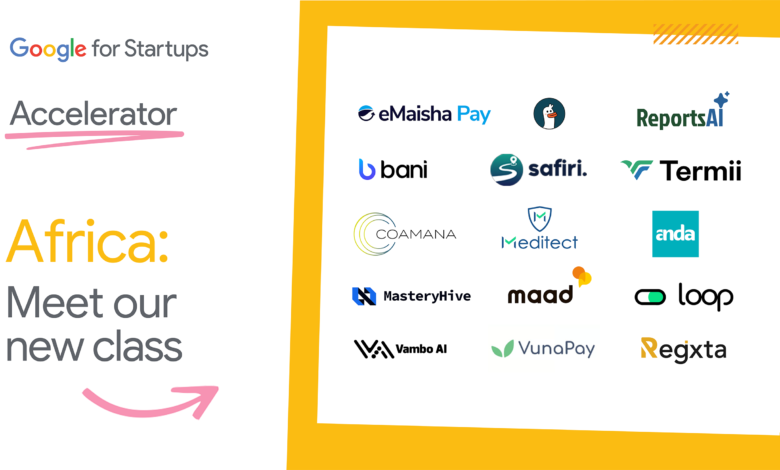
Google has unveiled the 15 startups joining the 10th cohort of its Google for Startups Accelerator Africa programme, and Kenya has its strongest showing yet. Coamana, Duck, ReportsAI, and VunaPay all secured spots in what is comfortably the most competitive class the programme has ever run.
The numbers tell the story. Roughly 2,600 startups applied. Only 15 were picked. That works out to an acceptance rate below 1%, narrower than the admission rate at most Ivy League universities. For context, Class 9 in 2025 drew about 1,500 applications, so applicant volume has jumped more than 70% in a single year. African founders building AI products clearly see Google’s programme as one of the most valuable non-dilutive opportunities on the continent.
What unites the chosen 15 is a focus on artificial intelligence applied to very specific African problems across fintech, agritech, health tech, mobility, and SaaS. The three-month hybrid programme runs from 13 April to 19 June 2026, offering mentorship, technical workshops focused on AI and machine learning, up to USD 350,000 in Google Cloud credits per startup, and access to Google’s investor network at the demo day.
Meet Kenya’s four picks
Coamana builds technology that helps governments and market associations digitise informal food markets. Through its Amana Market platform, the company targets traditional markets that handle the bulk of food trade across the continent but largely operate offline, with no real visibility into prices, volumes, or credit needs. Founded by Hafsah Jumare in 2018, Coamana operates across both Nigeria and Kenya and raised USD 500,000 from Village Capital in mid-2024. Google has tagged it as Kenya for this cohort, reflecting the company’s growing operational footprint locally.

Duck is a real-time data intelligence platform that pulls live sales and stock data from supermarket checkout systems, giving consumer brands instant visibility into what is selling, where, and when to restock. The startup, co-founded by Alex Mativo and Michelle Watiki, is a Techstars ’24 alumnus. Duck has been quietly building a retail data community in Nairobi, hosting an annual Retail Data Ecosystem Mixer that brings together banks, telcos, and FMCG players.
ReportsAI targets impact organisations such as NGOs, donors, and impact investors. Reporting and compliance pull significant team time away from actual delivery work. ReportsAI’s bet is that an AI-first platform can convert raw programme data into institutional knowledge and donor-ready reporting in a fraction of the time.
VunaPay builds fintech and data infrastructure for cooperatives, enabling instant payments for smallholder farmers who often wait weeks or months to be paid. Founded in 2023 by Judy Njogu-Mokaya, Koya Matsuno, and Ian Wambai, VunaPay has so far processed roughly KES 75 million in payments and onboarded thousands of farmers in coffee, dairy, and maize cooperatives. The startup won the Latitude59 Kenya pitch competition in 2024 and was a mentee on Safaricom’s Spark Accelerator.
Why the cohort matters for the founders
Beyond the headline of being Google-picked, the founders get something concrete. The cloud credits alone can buy meaningful runway for AI startups whose biggest cost line is GPU and inference infrastructure. The mentorship pairs each team with Google engineers tackling specific technical bottlenecks. And the Trusted Tester benefits give early access to Google’s newest AI tools, which can shave months off product timelines.
The fundraising signal matters too. According to the African Private Capital Association’s 2025 report, African startups raised USD 3.9 billion across 506 deals last year, with East Africa accounting for more than two thirds of regional deal value. Kenya, in particular, was Africa’s largest single market for venture capital in 2025. Google’s accelerator stamp tends to shorten the path to follow-on rounds.
What it says about Kenya’s startup pipeline
Four out of 15 is the strongest Kenyan showing in the programme’s history. Class 9 included only two Kenyan startups, Shamba Records and Apexloads. Doubling that this year is a useful proxy for both the depth of Kenya’s founder pipeline and the maturity of locally built AI products.
It is also notable that three of the four picks, Coamana, VunaPay, and Duck, work in some form of agricultural or retail infrastructure. The fourth, ReportsAI, targets the development sector. Together they look less like consumer apps chasing virality and more like the unglamorous, infrastructure-layer businesses that quietly hold economies together. That is arguably where the most defensible African tech companies of the next decade will be built.
Folarin Aiyegbusi, Head of Startup Ecosystem, Africa at Google, said the role of the programme is to give founders the technical infrastructure, mentorship, and global network to scale their solutions. Since launching in 2018, Google says the programme has supported 106 startups from 17 African countries that have collectively raised over USD 263 million and created more than 2,800 jobs.
The full Class 10 list is available on the Google Africa Blog.








Join the discussion