

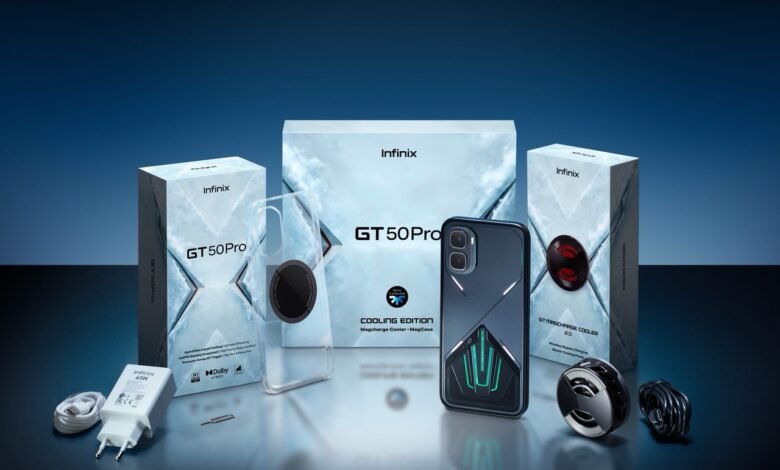
Infinix today pulled the wraps off the GT 50 Pro at a launch in Jakarta. The phone is the new flagship of its gaming-focused GT line, and it brings three big shifts over its predecessor: a redesigned liquid-cooling loop you can literally watch flowing through a glass window on the back, dual-pressure mechanical shoulder triggers that go well beyond the capacitive ones we have seen before, and MediaTek’s all-big-core Dimensity 8400 Ultimate chipset under the hood. The launch also formally introduces what Infinix is calling the “New GT Ecosystem” of gaming-tuned accessories.
If you remember the Infinix GT 30 Pro that landed in Kenya last September at KES 39,999, the GT 50 Pro is its more ambitious successor. Infinix has skipped the “GT 40” naming entirely. The pitch is no longer just “competitive mobile gaming on a budget”; it is closer to “flagship gaming hardware that still costs less than the iPhones and Galaxies of the world.”
That positioning matters here. Infinix has been quietly building a serious esports presence in Kenya. The GT 30 Pro powered last September’s PUBG Mobile Africa Cup Finals at Nairobi’s Charter Hall, the first time the continent’s PMAC tournament had ever been hosted in the country. The GT 50 Pro is meant to carry that competitive ambition forward.
The big idea: solving heat
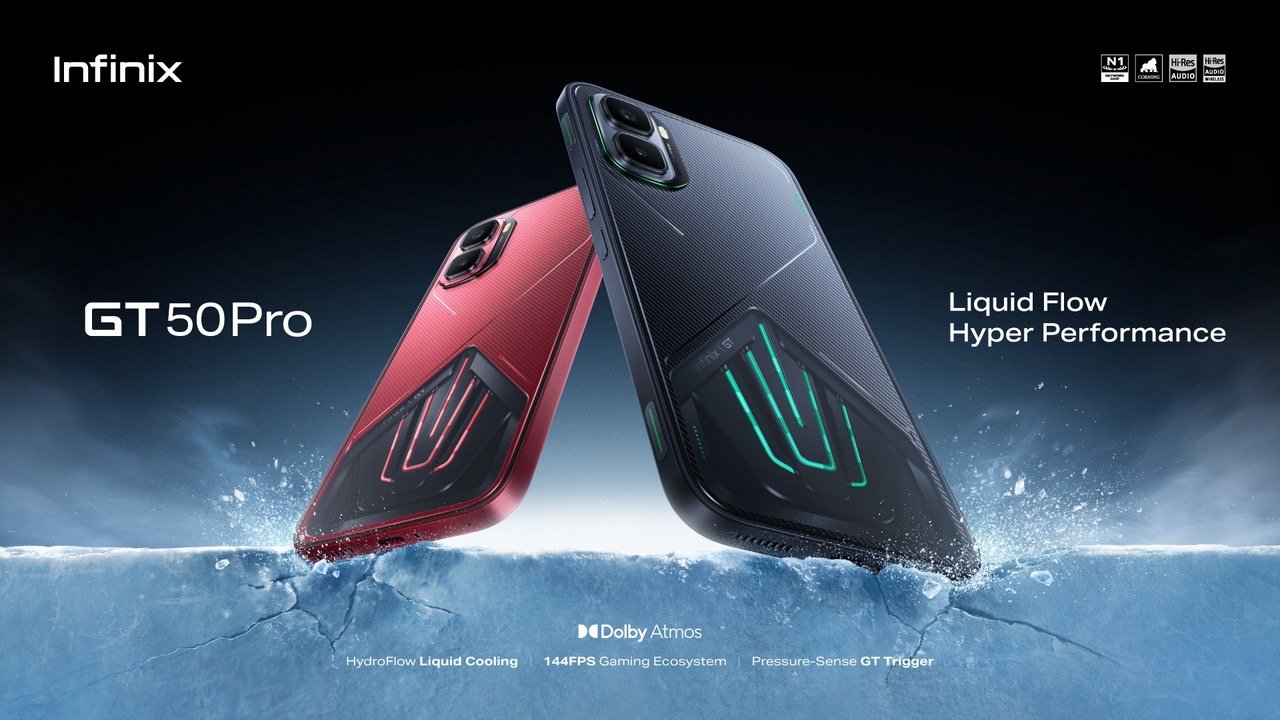
Heat is the defining problem of mobile gaming. Phones throttle their performance when temperatures climb, which means the silky frame rates you see in the first ten minutes of a match collapse halfway through round two. Infinix’s answer on the GT 50 Pro is what it calls HydroFlow Liquid Cooling Architecture.

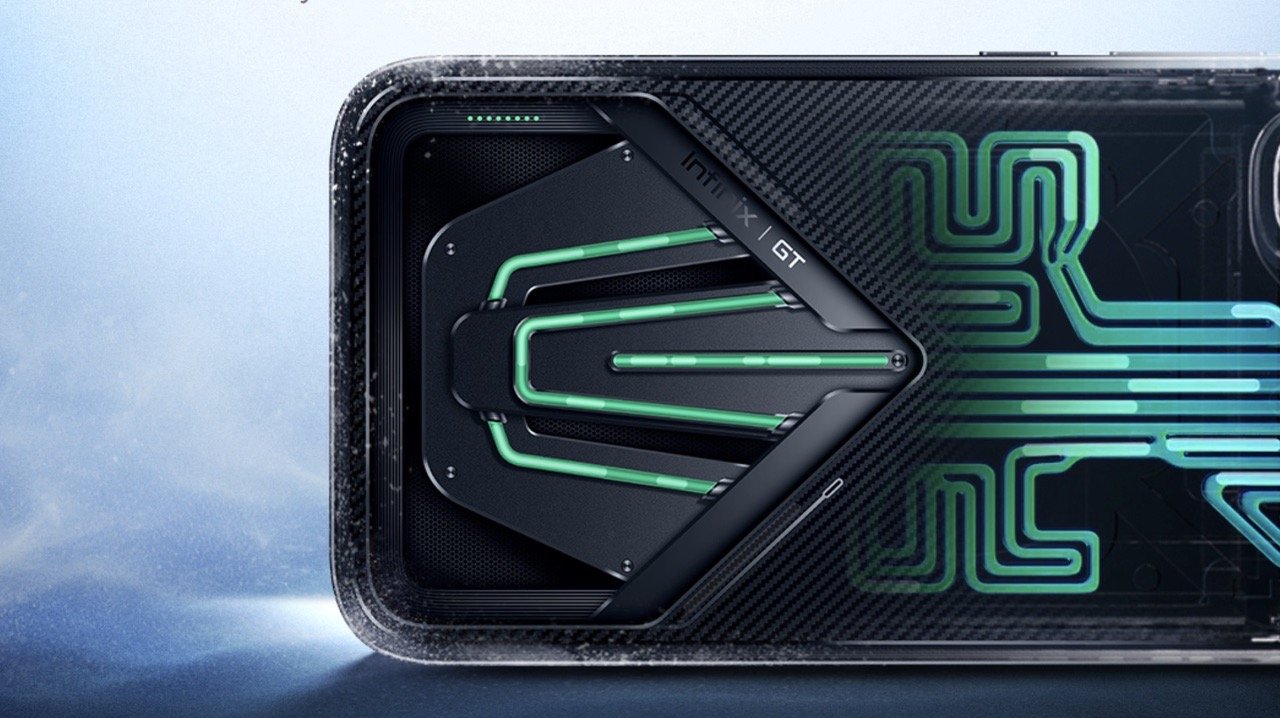
In plain English: there is now a tiny coolant loop inside the phone. A piezoelectric ceramic micro-pump (Infinix says it is the first of its kind on a phone) pushes coolant at 6.5 ml per minute through laser-etched channels that cover 100% of the device’s core heat sources. The vapour chamber sitting under those channels measures 6,437mm², which Infinix calls the largest ever fitted to this kind of device. Whether it actually keeps the phone from throttling under sustained load is the kind of thing only an extended review will confirm, but the engineering ambition is clear.
The whole loop is also visible. A transparent “Pipeline Window” panel on the back lets you watch the coolant move through the system in real time. It is gimmicky and we love it.

The triggers, and why they matter
The other headline change is the GT Trigger system. The GT 30 Pro had pressure-sensitive zones built into the side frame, but those were essentially capacitive shortcuts. The GT 50 Pro upgrades to a pair of true mechanical, dual-pressure shoulder buttons. Each one supports a light press, a heavy press, and a slide gesture.
Why does that matter? In shooters and battle royale titles, you can map separate actions to a half press and a full press. Light press to aim, heavy press to fire, for example. Each trigger supports up to 4 mapping points across 10 pressure levels, with latency held below 20 milliseconds and a rated lifespan of three million presses.
The triggers also work as a system-wide command centre. Sliding both buttons inward at once takes a screenshot, starts a screen recording, summons Infinix’s Folax AI assistant, or runs a memory cleanup. Inside the camera app, a single tap fires the shutter, a long press shoots burst, and the lower trigger handles a sliding zoom.
Design, display, and audio
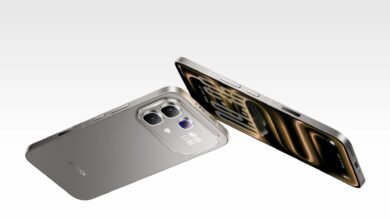
The body has been redesigned too. The GT 50 Pro drops the “Cyber Mecha” styling of the GT 30 Pro for a hypercar-inspired look, with a kevlar-textured finish and aerodynamic lines. The Pipeline Window dominates the back, ringed by four crosshair RGB strips Infinix is branding “Mechanical Light Waves.” There are 14 lighting scenarios and eight customisable colours, across three colourways: Black Abyss, Red Blaze, and Silver Glacier.
The screen is a 6.78-inch 1.5K AMOLED panel at 144Hz, hitting 4,500 nits peak brightness with full DCI-P3 colour coverage. Eye-strain mitigation is taken seriously: 2,304Hz PWM dimming and TÜV Rheinland low blue light certification. Gorilla Glass 7i sits on top. Audio gets Dolby Atmos profiles for movies, music, and gaming.
Performance, battery, and the optional Peltier cooler
Inside is MediaTek’s Dimensity 8400 Ultimate, a 4nm chip with an unusual all-big-core layout: eight Cortex-A725 cores, with the prime core hitting 3.25GHz. Most chips at this tier mix big and small cores; the 8400 Ultimate uses big ones throughout, which translates to noticeably stronger sustained multi-core performance. Infinix claims an AnTuTu score above 2.22 million on the GT 50 Pro, a 26% jump over the GT 30 Pro and well into upper-tier territory.
The Mali-G720 MC7 GPU pairs with MediaTek’s Frame Rate Converter (MFRC), which uses on-the-fly frame interpolation to smooth out games that cannot natively hit higher refresh rates. The phone is certified for native 144 FPS in six titles including Call of Duty: Mobile, Mobile Legends: Bang Bang, and Free Fire. Connectivity gets a lift from Infinix’s in-house N1 network chip, which the company says delivers 60% stronger signal performance.
The battery is a hefty 6,500mAh in most markets (Europe gets a 6,150mAh dual-cell version). It supports 45W wired, 30W wireless, and 10W reverse wired charging. There is also an optional GT Magcharge Cooler 2.0 that adds 12W of active Peltier cooling and, more interestingly, the industry’s first wireless bypass charging. Power is routed straight to the chipset rather than through the battery, keeping the battery cool during marathon sessions.
Cameras are functional rather than spectacular: 50MP main with OIS and EIS, 8MP ultrawide, and 13MP front. This is, after all, a gaming phone, not a Pixel.
Software and the New GT Ecosystem
The phone ships with XOS 16 on Android, and Infinix is now promising 3 years of major Android updates and 5 years of security patches. That is a meaningful jump from the GT 30 Pro’s 2-year OS commitment and brings Infinix closer to Samsung’s mid-range standard.
The launch also formally kicks off the New GT Ecosystem. The two confirmed accessories are the GTBUDS 5 (Dolby Atmos, sub-50ms latency, 50dB hybrid ANC) and the GTWATCH 5 Pro (independent GNSS, AI fitness tracking). A GT Game Controller with deep haptic integration was teased but not detailed.

Pricing and Kenya
Infinix has not yet confirmed Kenyan pricing. The GT 30 Pro and GT 20 Pro both landed here at KES 39,999, so a similar starting price for the base 12GB/256GB GT 50 Pro is the safest extrapolation, though the upgraded thermal and trigger hardware could push it slightly higher. The 512GB variant will almost certainly cost more. We will update this piece once Infinix Kenya confirms local availability.






Join the discussion