

Africa’s smartphone market still belongs to TRANSSION. That much remains undisputed.
According to Omdia’s latest Smartphone Market Pulse for Q1 2026, the Chinese smartphone giant, through TECNO, Infinix, and itel, retained a commanding 47% market share across Africa after shipping 9.3 million smartphones during the quarter.
To put that into perspective, Samsung, the second-largest smartphone vendor on the continent, shipped 4 million units for a 20% market share. Xiaomi followed with 1.8 million shipments and a 9% share, while HONOR climbed to 7% and OPPO settled at 6%. But while TRANSSION continues to dominate Africa’s volume game, the most interesting story in this report is arguably HONOR’s rise.
The company recorded a staggering 101% year-on-year growth in Africa during 1Q26, making it the region’s fastest-growing major smartphone brand. And honestly, this no longer looks like a temporary spike. HONOR’s momentum increasingly feels structural.

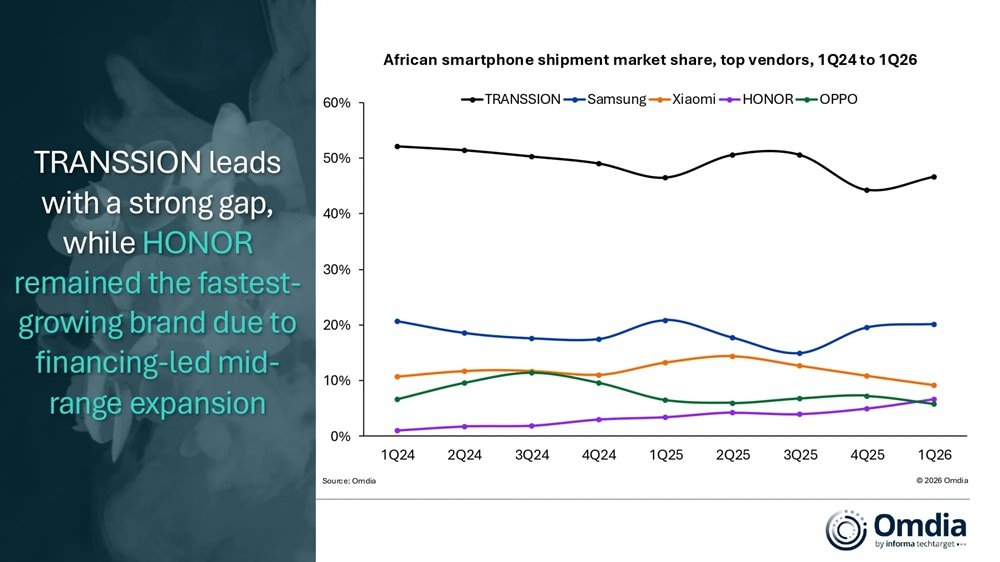
Omdia attributes much of the company’s growth to financing-led expansion in South Africa’s operator-driven mid-range market, but the wider trend goes beyond a single country. HONOR appears to be positioning itself exactly where Africa’s smartphone market is slowly shifting: affordable premium and upper mid-range devices financed over time rather than bought outright.
That strategy makes sense. As smartphone prices continue rising globally, fewer consumers can comfortably jump from entry-level devices straight into flagship territory. But many are still willing to stretch slightly higher if financing options make the monthly payments manageable. That middle ground is becoming one of the most important battlegrounds in Africa’s smartphone market.
Samsung understands this, too. Despite recording a slight 1% decline year-on-year, Samsung’s Galaxy A-series remains dominant in the crucial US$150–299 segment, scooping five spots in the global top 10 best-selling smartphones in Q1 2026, as per Counterpoint Research. And frankly, that lineup continues to be one of Samsung’s strongest weapons across African markets. The company’s long-term investments in localized distribution, especially in Egypt, also suggest Samsung is playing a longer strategic game rather than chasing short-term shipment spikes.
Xiaomi, meanwhile, had a far rougher quarter. The company’s shipments declined 28% year-on-year as memory supply constraints disrupted its aggressive entry-tier strategy. This is particularly significant because Xiaomi’s rapid rise in many developing markets has historically depended on delivering aggressive pricing in lower-end categories. Once margins tighten and component prices rise, that strategy becomes much harder to sustain.
OPPO also declined 7% amid restructuring efforts and weaker market conditions in Egypt. And by the look of things, HONOR is coming for OPPO’s position, perhaps even Xiaomi.
Then there’s TRANSSION itself. What continues to impress me about its dominance is how consistently underestimated the company still is outside Africa. Yet nobody understands this market better. TRANSSION built its position by focusing on practical realities rather than aspirational marketing. Better battery life. Louder speakers. Multiple SIM support. Aggressive offline distribution. Affordable pricing. Vast retail presence. Localized software experiences.
Those things matter far more in Africa than internet conversations about titanium frames and 8K video recording. This is why social media narratives around iPhone dominance often feel disconnected from actual market realities on the continent. According to Omdia’s shipment figures, Apple remains nowhere near Africa’s top-selling smartphone vendors. Visibility online simply doesn’t translate into shipment volume.
Africa’s smartphone market is still overwhelmingly driven by affordability and accessibility. And right now, TRANSSION continues to understand that reality better than almost everyone else. The bigger question heading into the second half of 2026 is whether HONOR can continue accelerating quickly enough to challenge OPPO and Xiaomi more aggressively.
Based on current momentum, that possibility no longer feels unrealistic. Especially if financing ecosystems continue expanding across major African markets.






Join the discussion