
Safaricom already lets users request for an eSIM through the current MySafaricom app, but the experience has never felt fully digital.
Under the “Account” section in MySafaricom, there is an eSIM option. But tapping through the option still pushes users toward visiting a Safaricom shop for registration. That makes the in-app option feel more like a signpost than a complete digital process.
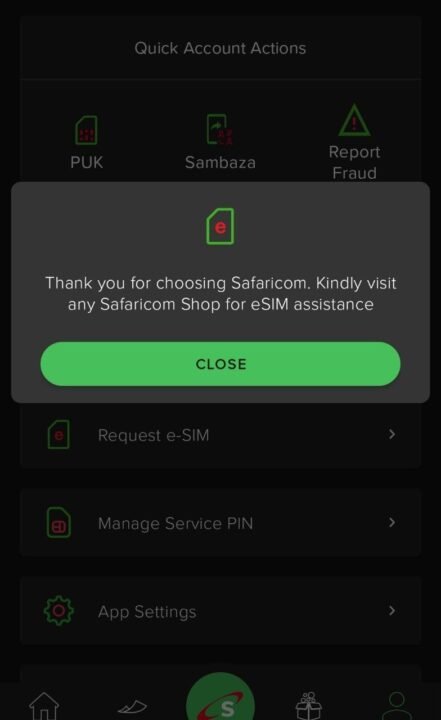
But a teardown of recent My OneApp build v5.1.6 suggests Safaricom may finally be preparing to make the eSIM process more complete inside the app.
The current MySafaricom APK already contains an esim module, so this is not a brand-new feature in the strictest sense. Safaricom has already had eSIM support wired into its app ecosystem. However, My OneApp appears to go further, with more detailed strings around requesting, activating, and receiving an eSIM.

Some of the strings found in My OneApp include “Get an eSim,” “Request eSim,” “About eSim Activation,” “Checking eSim status, Please wait ...,” and “eSIM Request Received.” The app also includes wording asking users to enter an email address where the eSIM will be sent.
Even more interesting, My OneApp includes pricing text that says the eSIM cost for a prepaid swap is KES 150, while postpaid swaps are free. There is also a line saying users can only request an eSIM for their own number.
That suggests Safaricom may be building a more complete self-service eSIM request flow inside My OneApp. If this goes live, it could reduce or even remove the need to visit a Safaricom shop just to get an eSIM, at least for some users.
This would be a welcome move. Airtel already makes eSIM requests relatively easy through the My Airtel app, and Safaricom has needed to catch up here. For a company pushing a unified digital app, asking users to start inside the app and then finish the process physically at a shop has always felt awkward.
Of course, this is still based on APK teardown findings. Code strings and resources do not guarantee that a feature will launch publicly. Safaricom could still hide the feature behind server-side controls, change the process before rollout or abandon parts of it altogether.
Still, the direction looks promising. My OneApp appears to be taking the eSIM feature beyond the basic MySafaricom implementation and toward a proper in-app request and activation flow.
If Safaricom gets this right, it could finally make eSIM access less painful for users who do not want to visit a shop for something that should, by definition, be digital.








Join the discussion