

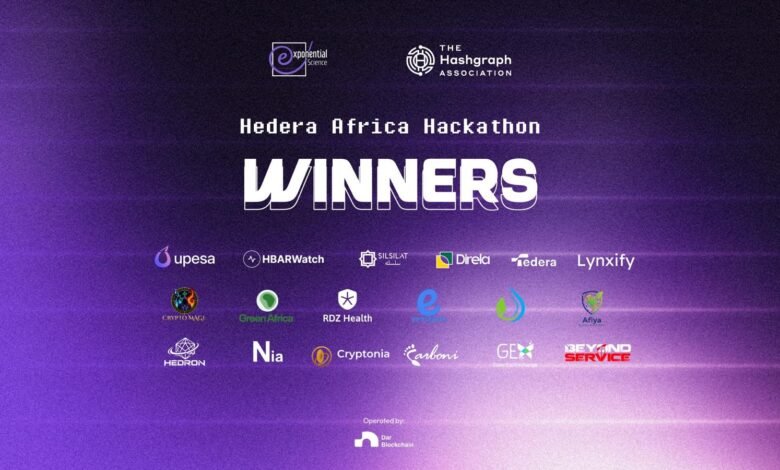
The 2025 Hedera Africa Hackathon has officially closed its books, and the numbers do something unusual for an African tech story: they understate themselves. More than 13,000 developers competed. Over 1,300 projects were submitted. Around 45,000 people were funnelled into the education and certification pipeline. The total prize pool was USD 1 million, roughly KES 129 million at current rates.
That makes it, by the organisers’ own claim, the largest Web3 hackathon ever held anywhere in the world. The previous global benchmarks, run by the likes of ETHGlobal and Solana, never crossed those participation numbers. Africa, often spoken about as a “frontier” market for crypto, just hosted the biggest single builder event the industry has seen.
If you’ve been following our coverage, you’ll remember we wrote about Abu Dhabi’s Hashgraph Ventures pledging another $1 million into the same ecosystem back in January. This is the missing piece of that story: the actual builders the money is chasing.
The Winners
The cross-track championship, which ranked the strongest projects regardless of category, looks like this:

- 1st place — GreenAfrica (Nigeria), $100,000: an environmental verification platform that lets organisations transparently track sustainability claims on-chain. Carbon accounting that you cannot quietly edit later.
- 2nd place — Carboni (Egypt), $70,000: infrastructure for issuing and trading verified renewable energy certificates. Think of it as the receipts layer for green power.
- 3rd place — Effisend X Africa (Mexico), $60,000: an AI-powered routing layer that connects African payment systems that were never designed to talk to each other. M-PESA does not natively speak to MoMo, which does not speak to bank rails. Effisend’s pitch is to be the translator.
- 4th place — Silsilat Finance (Malaysia), $40,000: cross-border settlement plumbing for emerging markets.
- 5th place — Beyond Service (Nigeria), $30,000: a mobile game with persistent digital identity and on-chain asset ownership.
Beyond the cross-track winners, four thematic tracks each crowned their own leaders. On-Chain Finance & Real-World Assets went to Silsilat Finance, with Direla (South Africa), Upesa (Nigeria), Tedera (Romania) and Nia (Madagascar) following. DLT for Operations was led by Carboni, with strong showings from RDZ Health (Zimbabwe), Afiya (Nigeria) and a USA-based green Power-to-X chain-of-trust project. Immersive Experiences went to Beyond Service. AI & DePIN was claimed by Effisend X Africa, with Nigeria’s GreenAfrica, Morocco’s Hedron and Côte d’Ivoire’s APIx all placing.
What’s actually being built
Three patterns emerge, and they tell you more about where Web3 is actually heading than any whitepaper.
Verification, not speculation. GreenAfrica and Carboni are both, at heart, “trust infrastructure.” The reason carbon credits are scandal-prone is that the same forest can be sold to three different buyers if no one can audit the registry. A distributed ledger fixes that by design. This is the most compelling argument for blockchain that does not involve token prices.
Connective tissue for fragmented systems. Effisend and Silsilat are both trying to glue together payment rails that should have been interoperable a decade ago and aren’t. In a continent where sending money from Lagos to Nairobi often costs more than sending it from Lagos to London, this is unsexy but enormous.
Healthcare records that can’t be silently edited. RDZ Health and Afiya are tackling medical records integrity. The use case is straightforward: in systems where a hospital can quietly change a patient’s chart, distributed ledgers offer an audit trail that survives political pressure.
The critical view: Hackathon submissions are not the same as functioning companies. A working demo built in three months is impressive. A regulated, audited service handling carbon credits or medical records is a multi-year journey. The honest question for every winner here is whether the team can survive the gap between prize money and real revenue.
The bigger move: an Investment Committee
The headline most outlets will miss is buried lower in the announcement. The Hashgraph Association is forming a new Investment Committee that will make multi-million-dollar commitments to strategic partnerships, with explicit emphasis on emerging markets.
This is the second major capital pool aimed at this exact builder pipeline in 2026. Combined with Hashgraph Ventures’ $1 million pledge in January and an earlier $1 million commitment from United Gulf Financial Services, the total non-prize capital chasing these developers is now well above $3 million (over KES 387 million).
Why this matters: most African hackathons end with a cheque, a photo, and silence. The winning team flies home, runs out of runway in six months, and the project quietly dies on GitHub. By building an investment vehicle that sits on top of the hackathon, Hedera is trying to fix the most chronic failure mode of African tech competitions.
Why Hedera, and why Kenya specifically
For readers new to the “Layer 1 wars,” a quick refresher. Hedera is not a blockchain in the traditional sense. It uses Hashgraph, a different consensus model based on a directed acyclic graph. Where a blockchain adds blocks one at a time in a strict line, Hashgraph lets nodes “gossip” information to each other in parallel and weave the history together. The pitch is faster transactions, predictable fees, and far lower energy use, which makes it more suitable for enterprise workloads than a network where fees spike whenever a meme coin trends.
The Kenyan angle is significant. The Nairobi Securities Exchange (NSE) is among the partners listed on this hackathon. That’s not a coincidence. The NSE joined the Hedera Council in October 2024 and last year launched a blockchain Innovation Lab with Hedera. The roadmap there is tokenised securities, digital assets and infrastructure for retail investors, which dovetails with Kenya’s broader fintech push that we’ve tracked through products like Ziidi Trader.
What this means in plain English: Kenya is not a hackathon stop. It’s a strategic node in a long-term plan to make Hedera the default plumbing layer for African capital markets.
The 2026 edition is already locked in
The Hashgraph Association confirmed the hackathon will return in 2026. Tracks, location and partners haven’t been announced. Given the partner roster from this round (Sygnum Bank, Orange Digital Centers, the NSE, Tunisia’s DAR Blockchain, Shamba Records and others), expect more financial-institution involvement next time, not less.
For African developers, the takeaway is uncomplicated: a Swiss non-profit, a Cayman-registered foundation, and a Gulf venture fund are now collectively the largest organised pipeline of Web3 capital aimed at this continent. Whether that produces actual unicorns or just a longer list of well-funded experiments will be the question worth watching for the next 18 months.
The coding phase is over. Due diligence has begun.





Join the discussion