

TECNO has announced a new set of abilities for EllaClaw, the mobile AI agent it is building for its phones. The updatedoes two things. First, EllaClaw can now look after the phone itself. Second, it can step inside other apps and carry out tasks on your behalf. TECNO showed this off on 24 June, and framed it as the next stage of a project it calls “Practical AI” for emerging markets, Kenya included.
Before going further, one thing to be clear about. You cannot download or use this today. EllaClaw is an “exploratory” closed beta. TECNO has not given a release date, a price, or a confirmed list of phones that will run it. What the company shared is a direction and a demo, not a finished product.
What an AI agent actually is
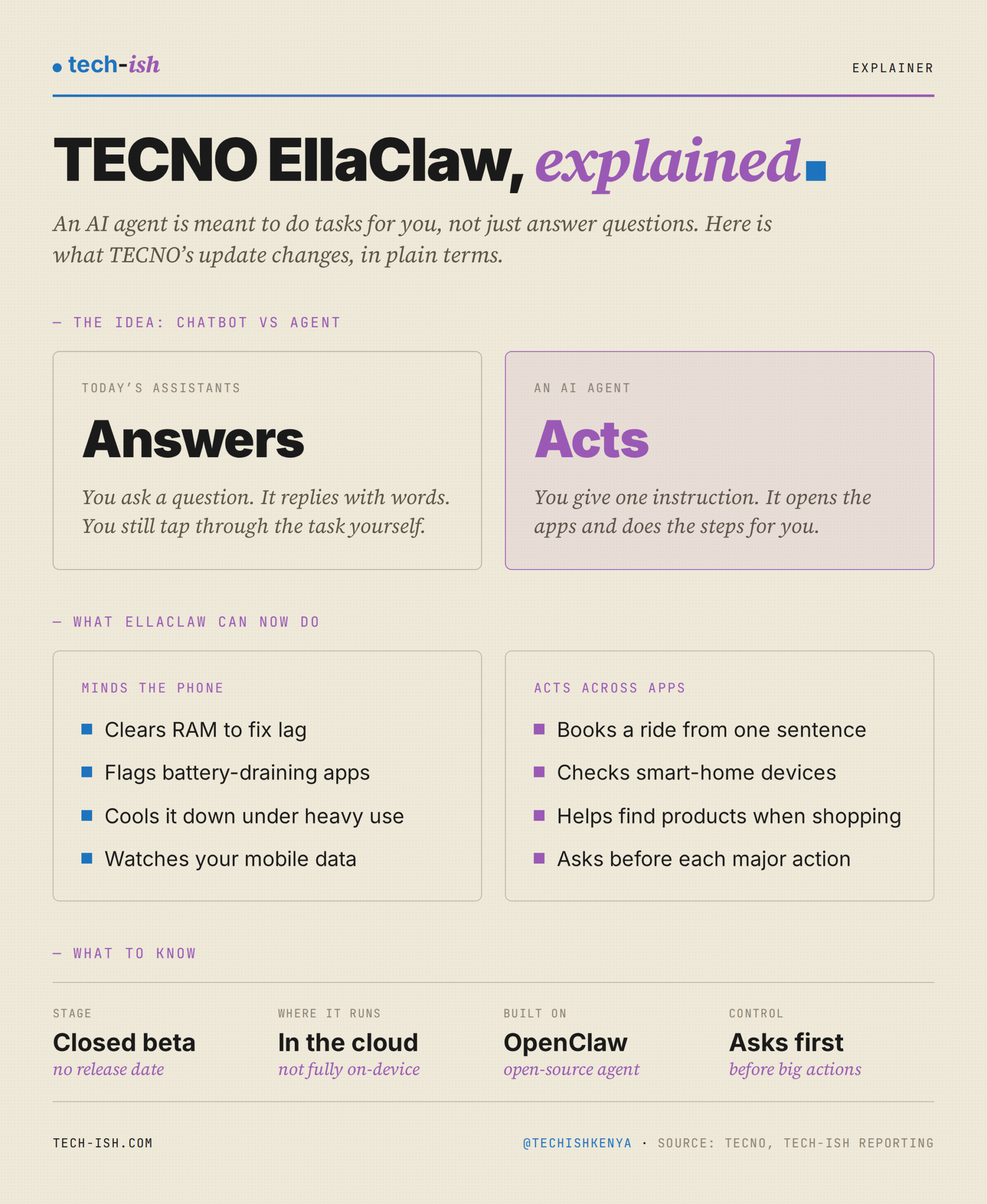
Most phone assistants you have used so far are chatbots. You ask a question and they reply with words. You still tap through the actual task yourself. An AI agent is meant to go a step further. You give one instruction in plain language, and the agent takes the steps and finishes the task across your phone. Ask it to book a ride, and instead of telling you how, it opens the app, sets up the trip, and asks you to confirm. That shift, from telling to doing, is what the industry means by “agentic AI”, and it has been the biggest theme in phone software this year.
The two new jobs
The first job is device upkeep. TECNO says EllaClaw now carries more than 40 “Smart Skills” for managing the phone. In plain terms, you can ask it to clear memory to fix lag, point out which apps are draining your battery, or cool the phone down when it heats up during heavy use such as gaming. A feature called Smart Data Guardian watches your mobile data against your usual habits and warns you before you run low. For anyone who buys data in small bundles, that one is aimed squarely at a real daily worry.

The second job is the bigger leap. With your permission, EllaClaw can now act inside third-party apps across categories like shopping, transport, food delivery and smart home. It does this in an unusual way. Rather than plugging into each app through hidden back-end connections, it reads what is on the screen and taps through the steps the way a person would. TECNO calls this GUI comprehension. The upside is that you can watch each step and stop it. The trade-off, which TECNO does not dwell on, is that reading screens is slower and easier to trip up than a direct connection.
What is under the hood
EllaClaw is TECNO’s existing Ella assistant joined to an open-source framework called OpenClaw. OpenClaw is a personal AI agent that became the fastest-growing open-source project on GitHub this year, built by Austrian developer Peter Steinberger before he joined OpenAI. We already explained how EllaClaw works and where OpenClaw came fromwhen the project first arrived in Kenya, so that is worth reading for the full background. The short version: TECNO took a tool that hobbyists normally run on their own computers and is trying to package it for ordinary phone users.
Why this matters in Kenya
The interesting part is not the feature list. It is the audience. Samsung and Google build their agent features for flagship phones that cost well over KES 100,000, and Samsung needed a top-end chip and three separate AI engines to make its version run smoothly. TECNO is aiming at budget and mid-range phones such as the CAMON 50 line, which starts at roughly KES 28,000. In markets where a phone is often a person’s only computer, an assistant that can run errands could matter more than another camera trick. The open question is whether cheaper hardware can run a background agent reliably, day after day. That part is unproven.
The honest catches
A few things deserve plain mention. When EllaClaw launched in March, the privacy pitch leaned on data staying on the phone. This update describes it as a cloud-based agent that works in the background, which means some of the processing happens on TECNO’s servers rather than on the device. What leaves the phone, and how that squares with both the privacy promise and the data-saving pitch, is worth asking TECNO directly.
There is also a security reason behind all the “it asks first” language. Agents that read your screen and act across apps are exactly where a class of attack called prompt injection can bite, where hidden instructions trick the agent into doing something you did not intend. OpenClaw has logged a long list of security advisories over its short life. TECNO’s confirmation-first design is the guard against that, not a marketing nicety.
For now, the thing to watch is simple. Does a beta sign-up open to Kenyans, does a release date appear, and when people can finally use it, does it work reliably on an affordable phone? Until then, EllaClaw is a promising direction with the hard parts still ahead.







Join the discussion