

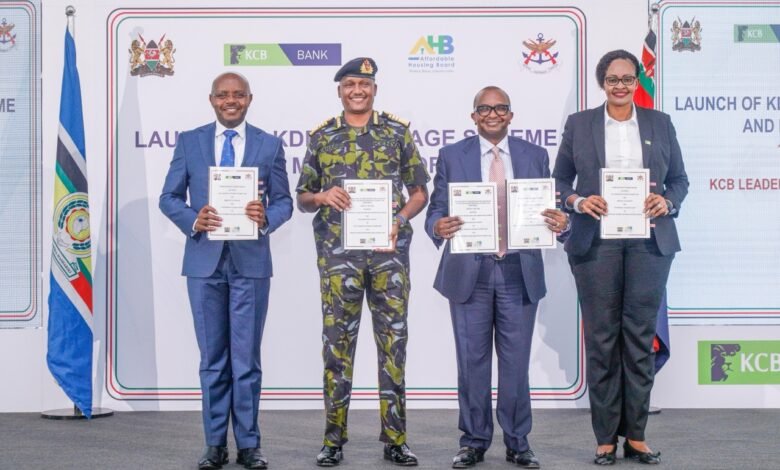
The Kenya Defence Forces (KDF) and KCB Bank Kenya have launched a mortgage scheme that lets serving military personnel borrow to buy or build homes at a fixed interest rate of 4% a year, repayable over as long as 20 years. The scheme was unveiled on 16 July 2026 at the KCB Leadership Centre in Karen, Nairobi. It brings more than 50,000 active KDF personnel under an existing government programme called the Civil Servants Housing Mortgage Scheme.
The arrangement was sealed through a memorandum of understanding signed by the Ministry of Defence, the State Department for Housing and Urban Development, the Affordable Housing Board and KCB. KCB will handle the day-to-day running of the scheme. That means assessing applications, advising officers, disbursing loans and running customer education. You can read the Ministry of Defence’s own account of the launch here.
What the scheme actually is
The Civil Servants Housing Mortgage Scheme is a government-backed facility that lends to public servants at concessional rates, well below what banks charge ordinary borrowers. Access within the military used to be narrow. Housing Principal Secretary Charles Hinga said the scheme was previously open mainly to senior officers, and that it now reaches eligible rank-and-file army personnel too. In plain terms, more junior soldiers can now use it, not just the top brass.
The 4% rate is the headline, and it helps to be clear about where it comes from. This is not KCB lending at 4% out of its own commercial book. The concession sits with the government scheme. KCB is the financing and administering partner. A soldier who qualifies gets a subsidised public-service mortgage that is arranged and serviced through the bank.

Why a 4% rate is a big deal
To see why the number matters, look at what a mortgage normally costs in Kenya. The Central Bank of Kenya’s 2024 Bank Supervision Report put the average mortgage interest rate at 14.9%. Rates eased a little through 2025 and into 2026 as the Central Bank cut its benchmark rate, but commercial home loans still sit firmly in double digits. A fixed 4% is far below anything on the open market. It is even below the roughly 9% to 10% charged on loans refinanced through the Kenya Mortgage Refinance Company, the state-backed body set up specifically to make mortgages cheaper.
The Kenyan mortgage market is also tiny. That same Central Bank report counted just 30,016 active mortgage accounts in the entire country in 2024, with total outstanding mortgage debt of KES 279.3 billion. Mortgage penetration is around 3% of GDP, among the lowest in Africa. Against that backdrop, bringing 50,000 potential borrowers from a single employer into a cheap scheme is a substantial move.
One caveat matters here. Onboarding is not the same as loans issued. Being brought into the scheme makes an officer eligible to apply. How many actually take up a mortgage will depend on their income, house prices and personal choice. So the 50,000 figure is a pool of eligible borrowers, not a count of homes financed.
What the money can be used for
The financing is fairly broad. Officers can buy a completed house, buy a residential plot, build from scratch, combine a plot purchase with construction, or finish a house already under way. They can also release equity from a property they already own, or move an existing mortgage from another bank into this scheme, which is known as a takeover. Muslim officers can use KCB’s Shariah-compliant window, Sahl Bank, so the facility does not lock anyone out on faith grounds.
The bigger housing picture
For years, Kenya’s affordable housing drive has focused on building more units, funded partly by the Housing Levy deducted from workers’ pay. Supply on its own does not fix the problem if buyers cannot afford to finance a purchase. This scheme works on the other side of that equation. It lowers the cost of borrowing for a large, salaried and stable group of workers. Housing-sector analysts have noted that it could become a template for other public servants, such as teachers, police officers, health workers and county staff. If that happens, employer-backed schemes could grow the mortgage market meaningfully.
It also fits a clear direction of travel at KCB. We recently covered KCB’s move to open mortgages to boda boda riders, content creators and other informal-sector earners at single-digit rates. The bank keeps widening who it will lend to for housing, leaning on employer schemes and behaviour-based pricing instead of the old payslip-only model. It is part of a broader push to grow its lending base, which we have tracked in coverage such as KCB’s planned stake in the payments firm Pesapal.
What to keep in mind
A few things are worth weighing before treating this as free money. The headline rate is not the only cost. Mortgages carry valuation fees, legal fees, stamp duty and mortgage insurance, so the true cost of borrowing is higher than 4%. Eligibility and the precise terms will follow the scheme’s own guidelines, so officers will need to confirm exactly what they qualify for. And because the scheme is tied to service, how it treats officers who leave or retire matters for anyone planning over a 20-year horizon.
For a serving soldier, the practical point is straightforward. A mortgage at 4% over 20 years is one of the cheapest home loans available to any salaried worker in Kenya today. If you are eligible, the sensible next step is to get the full terms in writing and run the numbers on a specific house before you sign anything.






Join the discussion