

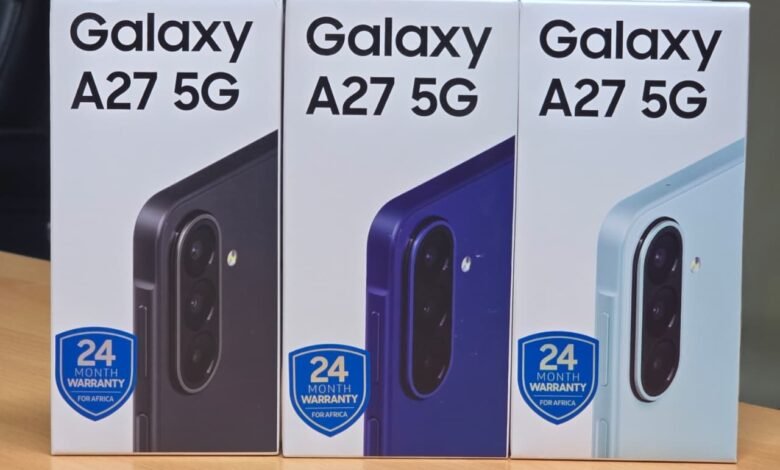
Samsung has officially launched the Galaxy A27 5G in Kenya, confirming local pricing for a phone that had already reached Kenyan shelves weeks earlier. The A27 is the newest device in Samsung’s Galaxy A series, the mid-range and budget line that makes up most of the phones Samsung actually sells in a market like Kenya.
Samsung’s recommended retail prices are KES 41,300 for the version with 4GB of RAM and 64GB of storage, and KES 52,500 for the version with 8GB of RAM and 256GB of storage. Those are the prices Samsung Kenya wants shops to charge. As we explain further down, retailers are already selling the phone for less.
What the A27 actually is
The Galaxy A27 5G replaces last year’s Galaxy A26 5G, which we covered when it arrived in Kenya. On paper the two phones are close relatives. Both use a 6.7-inch Super AMOLED screen running at a 120Hz refresh rate, which keeps scrolling and animations looking smooth. Both carry a 5,000mAh battery with 25W wired charging. Both promise up to six generations of Android upgrades and six years of security patches. That long support window remains one of the strongest reasons to buy a Samsung at this price, because it means the phone keeps getting new features and security fixes for far longer than most rivals from TECNO, Infinix or Xiaomi.
What is genuinely new
There are real upgrades. The biggest sits inside the phone. The A26 ran on Samsung’s own Exynos 1380 chip. The A27 switches to Qualcomm’s Snapdragon 6 Gen 3. Independent testers at GSMArena put the speed improvement at roughly 10 to 20 percent, which they describe as real but slight. In daily use, that should feel like slightly quicker app-switching rather than a dramatic jump.

The A27 also ships with newer software, Android 16 with Samsung’s One UI 8.5 interface, and it swaps the A26’s small teardrop notch for a centred punch-hole cutout that Samsung calls an upgraded Infinity-O display. The front camera moves from 13 megapixels to 12 megapixels. Fewer megapixels reads like a downgrade, but Samsung says the new sensor captures a wider range of brightness and richer colours for more natural selfies. That is a claim we cannot verify without testing the phone.
On the software side, Samsung is pushing what it brands “Awesome Intelligence,” its name for the AI tools it has been bringing down from its pricier flagship phones. Circle to Search, built with Google, lets you circle anything on your screen to look it up, and it can now recognise several items in one image at once. Object Eraser removes unwanted things from photos. Voice Transcription in the Voice Recorder app can now translate as it transcribes, across 22 languages. The phone also lets you choose between AI assistants, including Google Gemini and Perplexity.
Where it steps backwards
Some things moved the other way, and the press release does not mention them. The A26 carried an IP67 rating, meaning it could survive being dropped in up to a metre of water for half an hour. The A27 drops to IP64, which covers dust and light splashes but not full submersion. The ultra-wide camera also shrinks from 8 megapixels on the A26 to 5 megapixels here, as Newsweek noted in its launch coverage. The 50-megapixel main camera with optical image stabilisation carries over unchanged. And in Kenya, the cheapest A27 ships with just 4GB of RAM and 64GB of storage, a smaller starting configuration than the A26’s 6GB and 128GB base.
The price is where it gets complicated
When Samsung brought the A26, A36 and A56 to Kenya in 2025, which we reported at the time, the A26 started at around KES 30,000, the A36 at about KES 36,000 and the A56 at about KES 45,000. Against that ladder, the A27’s official starting price of KES 41,300 sits closer to where the old A36 and A56 launched than to the A26 it is meant to replace. The top A27 configuration at KES 52,500 is above what the A56, a more premium phone, cost at launch.
None of this is happening in isolation. In December we explained why phones across the board are getting more expensive in 2026, driven by a sharp rise in the cost of memory chips as manufacturers divert supply towards AI data centres. Samsung, the world’s largest memory maker, was raising its own chip prices by up to 60 percent late last year. One of the outcomes we flagged then was “shrinkflation,” where a newer budget phone quietly offers less than the model it replaces in order to hold a price point. An A27 that starts at 4GB of RAM and 64GB of storage, and costs more than the 6GB and 128GB A26 did, is close to a textbook example of that.
There is an important caveat. Recommended retail prices and street prices are rarely the same, and Samsung’s RRP tends to sit above what shops actually charge. Kenyan retailers are already listing the A27 between roughly KES 36,500 and KES 47,000 depending on the variant and store, well below Samsung’s official figures. When the phone first turned up in local shops in June, before Samsung Kenya had said anything about it, we pointed out that one retailer’s price put the A27 within about KES 2,000 of the higher-tier Galaxy A57. The official launch has not resolved that awkward overlap.
The Galaxy A27 5G is a competent, well-supported phone with a good screen, a faster chip than its predecessor and six years of updates behind it. What complicates it is where Samsung has placed it. You get newer hardware and newer software, but also weaker water resistance, a lower-resolution ultra-wide camera and, in Kenya, a smaller base configuration, at a recommended price that runs into phones a tier or two above it. If you are shopping in this range, compare the A27 directly against the Galaxy A37, A56 and A57, and check what shops are actually charging rather than the official RRP before you decide.





Join the discussion