

Two people can send the same 20,000 shillings to the same person on the same afternoon and pay wildly different amounts to do it. One taps a banking app and pays nothing. The other pays 100 shillings or more. Neither can usually tell you why, because the thing that decides the price is invisible: it sits inside the bank, in the payment networks it has chosen to plug into.
Kenya has more ways to move money than almost anywhere on earth. You can send cash from a phone to a market stall, pay a government bill without queuing, and split rent between four bank accounts in seconds. Yet most people can’t say what really separates one bank from another, because on the surface they all offer the same short list: an app, a card, a way to send money. The differences that count are underneath, in the networks a bank connects to and how much it charges you to use them.
SBM Bank Kenya has spent the past year rebuilding itself around those hidden parts, under a slogan it repeats often: Kenya’s preferred payments bank. That phrase describes a strategy rather than a type of licence, and the difference between the two is where any honest explanation of a modern payments bank has to begin.
“Payments bank” is a strategy, not a category
In some countries, “payments bank” is a formal, restricted licence. India’s Reserve Bank created the category in 2015 for institutions that can hold deposits and move money but cannot lend, with customer balances capped and most funds parked in government securities. Airtel and Paytm run banks like that. The trade-off is safety in exchange for a narrower business.

SBM Bank Kenya is not that. It is a full commercial bank, licensed by the Central Bank of Kenya, that takes deposits and lends at scale. In the first quarter of 2026 it held KES 89 billion in customer deposits and had KES 48.5 billion out on loan. So when SBM calls itself a payments bank, it isn’t claiming a special licence. It’s describing where it has chosen to compete: on being the account people use for everyday transactions, rather than the one they visit occasionally for a loan. CEO Bhartesh Shah put the logic plainly in the bank’s Q1 results: “When you win transactions, you win the relationship, and the economics follow.”
A modern payments bank is judged less by how many branches it has than by the networks it connects to and the friction it takes out. Those networks are often called payment rails, the shared pipes money travels through to get from one account to another. Here is the five-part checklist of what a modern one needs, and where SBM sits on each.
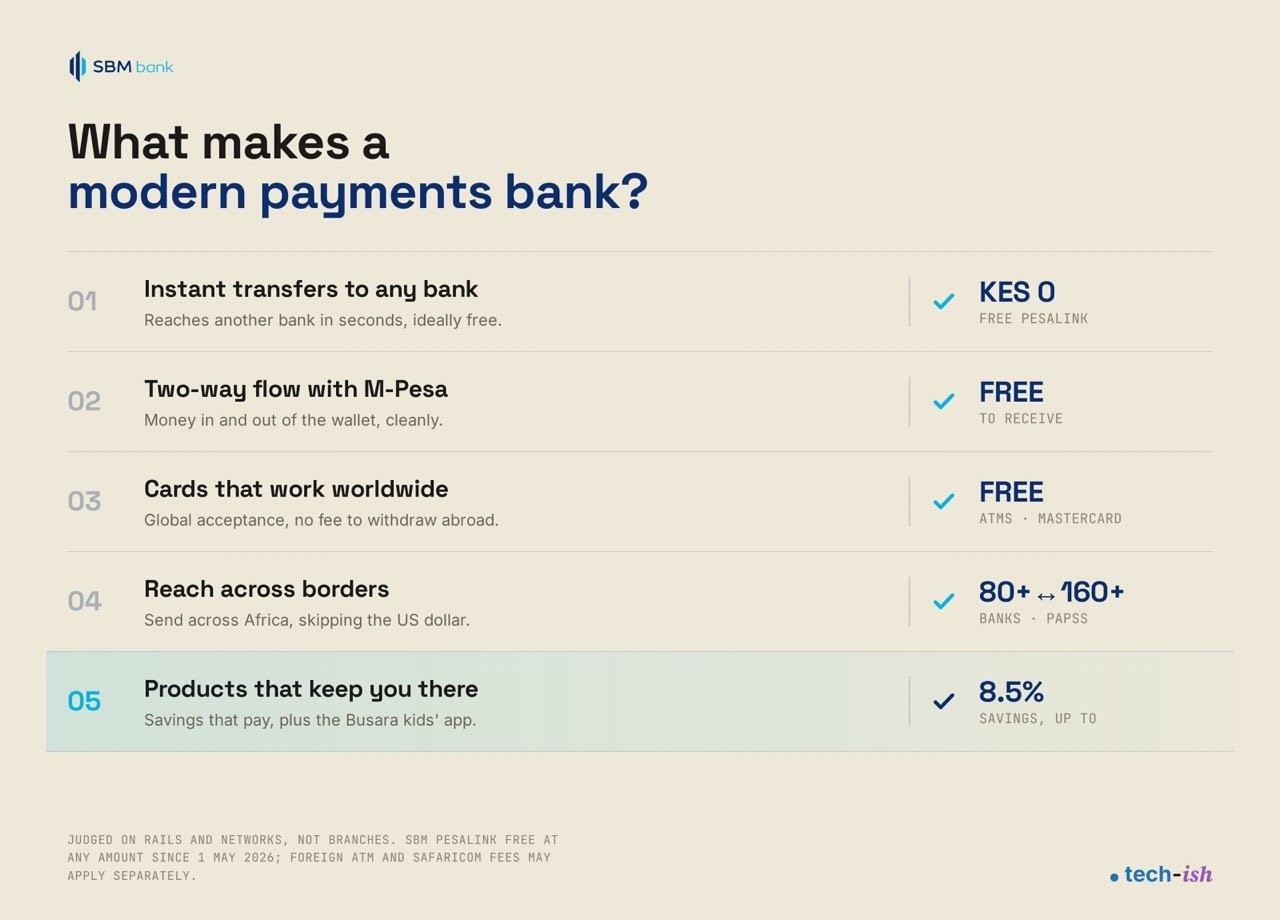
1. Instant transfers to any bank, ideally free
The foundation is being able to send money to an account at another bank and have it arrive at once. In Kenya that runs on PesaLink, a shared system launched in 2017 by the Kenya Bankers Association through its subsidiary IPSL. It moves money between different banks in seconds, 24 hours a day, holidays included. In 2024 it carried over KES 1.1 trillion across 8.2 million transactions.
For most of PesaLink’s life, banks charged tiered fees on it, sometimes up to KES 250 a transfer. That has collapsed. An industry campaign called “Tuma Direct na 20/-” pushed members to a flat KES 20, free below KES 1,000. SBM went further and dropped its PesaLink fees to zero at any amount from 1 May 2026. We explained the plumbing behind this shift, and why the fees were pricing choices rather than technology costs, in a companion piece on the tech behind faster, cheaper payments. On this first and most important test, SBM is at the leading edge.
2. Money that flows to and from M-Pesa without a fight
A bank account that can’t talk to M-Pesa is a walled garden in a country where mobile money is the default. More than half of Kenyan adults use it daily. A modern payments bank has to let money move both ways between the account and the mobile wallet, cleanly and cheaply.
SBM’s Mfukoni app moves money to and from M-Pesa directly, and the bank charges nothing to receive M-Pesa deposits into an account. (Safaricom’s own paybill fee on the wallet side of that journey is separate from what the bank charges.) That two-way link is the difference between an account you actually run your life through and one you top up occasionally.
3. Cards that work everywhere, without punishing you for leaving home
The card network is where “modern” gets tested against the rest of the world. In November 2025 SBM announced a move to Mastercard, migrating customers in phases to Mastercard-branded cards with tap-to-pay and digital wallet support. The practical payoff is global acceptance and, unusually, free ATM withdrawals, at SBM, Kenswitch and international Mastercard ATMs worldwide.
Withdrawing cash abroad without your own bank adding a fee is rare in Kenyan banking, where international ATM withdrawals commonly cost several hundred shillings each. The honest caveats: the foreign ATM’s operator may still charge its own surcharge at the machine, and currency conversion applies. But the bank’s slice of that cost is gone, which is the part the bank controls.
4. A reach beyond borders
The newest frontier is cross-border payments, historically the slowest and most expensive part of African banking. The World Bank has put the average cost of sending money within Africa at 7 to 8% of the amount, with settlement taking three to seven business days. The reason is the roundabout route the money takes: a payment from one African country to another is usually passed through a chain of middleman banks abroad and converted into US dollars along the way, with each step adding time and cost.
That is changing on rails SBM already sits on. In February 2026, PesaLink connected to the Pan-African Payment and Settlement System (PAPSS), an African Export-Import Bank initiative that lets money move between African countries instantly and settle in each country’s own currency, skipping the dollar detour entirely. The link joins over 80 Kenyan institutions on the PesaLink network to more than 160 banks and fintechs across the continent. We covered that integration when it landed, and what it means for Kenyan businesses and remittance startups. A bank plugged into PesaLink is, by extension, plugged into that continental network.
5. Products that keep people in the ecosystem
The final mark of a payments-led bank is what it builds on top of the plumbing to make customers stay. Free transfers win the everyday transaction; the rest of the relationship has to be worth keeping. SBM’s answer includes savings accounts paying up to 8.5% a year on balances above KES 100,000 as of early 2026, multicurrency options in dollars, pounds and euros, and, in March 2026, the Busara app, a family banking tool that lets parents set chores, load a prepaid Mastercard in a child’s name, and teach saving early. It is a deliberate play for the next generation of account holders, and it speaks to a real gap: Kenya has high financial access but low financial health, with only about one in five adults classed as managing money well.
Where this leaves SBM, and you
Add the checklist up and a picture forms. SBM Bank Kenya is a mid-sized commercial bank that has decided its edge is payments, and has assembled the pieces to back it: free instant transfers, two-way mobile money, a global card network, a continental cross-border rail, and products designed to deepen the relationship over a lifetime. It is not the biggest bank in Kenya, and several rivals have matched its PesaLink pricing. But the full stack, priced the way SBM prices it, is a coherent bid to be the account people transact through.
The useful takeaway for a customer is a checklist you can apply to any bank, not just this one. Ask whether transfers to other banks are instant and what they cost. Ask whether the account moves money to and from M-Pesa without friction. Ask what the card costs you abroad. Ask whether the bank can reach across borders without routing through the dollar. Those four questions describe a modern payments bank far better than the size of its branch network, and they are the questions worth asking before you decide where your money lives.







Join the discussion