

Every time you send money in Kenya, the transfer takes a journey you never see. Your bank checks that you have the funds, packages the instruction into a standardised message, hands it to a shared network that connects your bank to the recipient’s bank, and waits for confirmation that the money landed. For most of banking history, that journey was slow, manual and expensive. The fees you pay, or increasingly don’t pay, reflect how modern that journey has become.
One bank has now removed its fees on that journey almost entirely. Since 1 May 2026, SBM Bank Kenya customers pay nothing to send money to any other Kenyan bank through PesaLink on the Mfukoni app and online banking, for any amount from KES 1 to KES 999,999. Deposits into an SBM account, including from M-Pesa, attract no bank charge. ATM withdrawals on the SBM debit card are free, both locally and abroad, at Mastercard ATMs. To understand how a bank affords that, and why it took this long for anyone to do it, you have to look at the plumbing.
Why moving money ever cost money
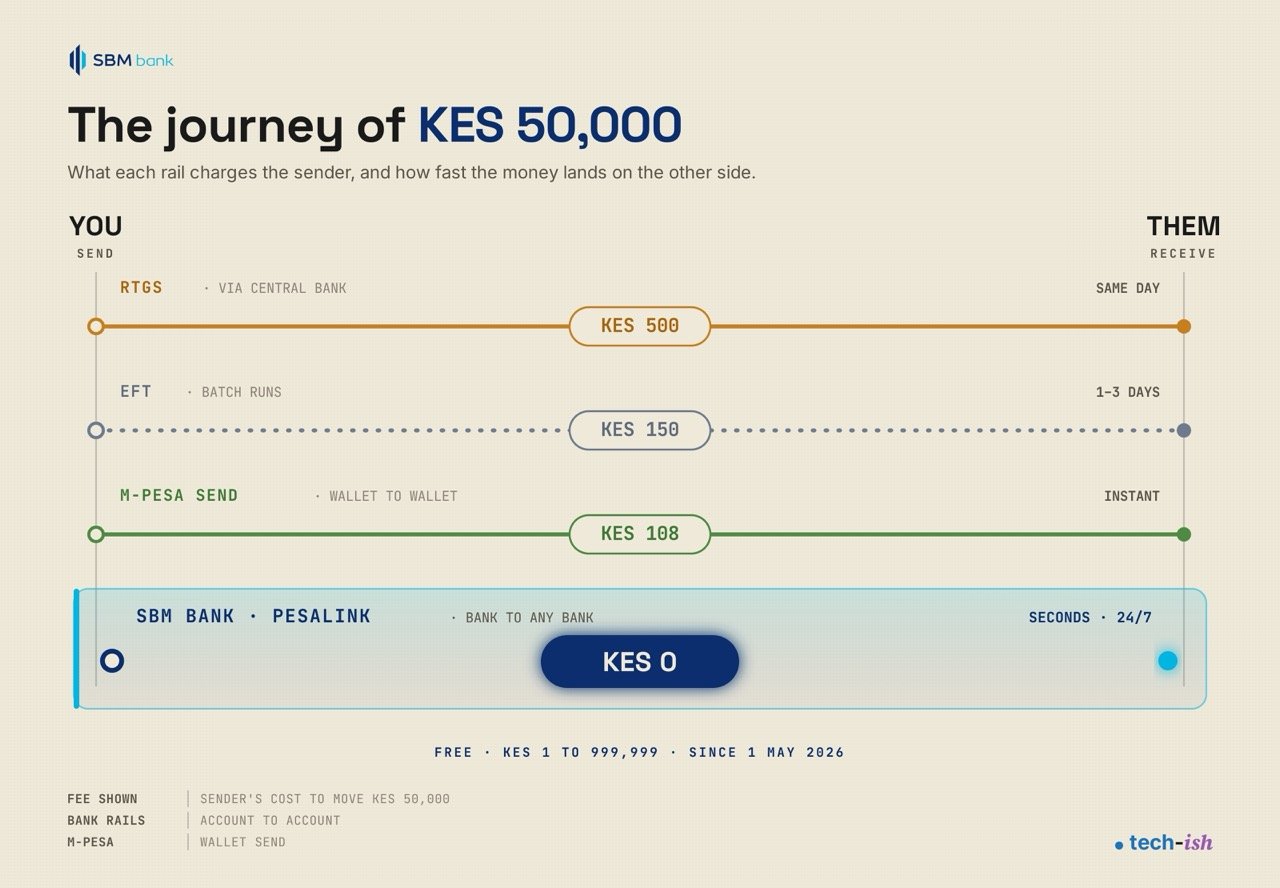
Before instant payment rails, sending money from one Kenyan bank to another meant one of two things. An EFT, a batch transfer processed in scheduled runs, could take one to three working days and typically costs around KES 150. An RTGS transfer, used for larger amounts, settles the same day through the Central Bank but costs in the region of KES 500. Both routes involve queues, cut-off times and back-office staff manually reconciling accounts. The fees paid for all of that overhead, plus a margin.
Then in 2017, the Kenya Bankers Association launched PesaLink, run by its subsidiary Integrated Payment Services Limited (IPSL). PesaLink is a switch: shared infrastructure that sits between the core banking systems of Kenyan banks. When you hit send, your bank instantly debits your account and fires a secure message through the switch to the recipient’s bank, which credits the recipient before the banks settle the difference between themselves behind the scenes. Because the message and the credit happen in seconds, the recipient gets usable money immediately, 24 hours a day, weekends and public holidays included. The banks square up later; you never notice.

Kenyans use it for serious money. In 2024 alone the network moved over KES 1.1 trillion across 8.2 million transactions, with an average transfer of about KES 135,000. That is rent, school fees, supplier payments and payroll, not lunch money.
Here is the part customers rarely see: once a switch exists, the marginal cost of one more transaction is tiny. The expensive bit was building and connecting the infrastructure, and that happened years ago. The fees banks kept charging, in some cases up to KES 250 per transfer, were pricing decisions, not technology costs. That is why fees have been collapsing across the industry. We already covered how KCB and other banks moved to a flat KES 20 under the industry’s “Tuma Direct na 20/-” campaign, which waives fees below KES 1,000 and charges KES 20 for everything up to KES 999,999.
Where SBM went further
SBM Bank Kenya moved first in that pricing wave, branding its rollout “Tuma na Mbao” in July 2025 with free transfers under KES 1,000 and a flat KES 20 above. Then it stopped charging altogether. From 1 May 2026, PesaLink transfers on the Mfukoni app and online banking are free for any amount from KES 1 to KES 999,999. Announcing the change alongside Q1 2026 results, CEO Bhartesh Shah described the thinking plainly: “When you win transactions, you win the relationship, and the economics follow.”
The numbers make the comparison easy. Sending KES 50,000 through M-Pesa costs KES 108, Safaricom’s capped fee for any send above KES 20,001. The same transfer from an SBM account to any other bank account via PesaLink now costs KES 0 for any amount below KES 1 million, and arrives instantly. Mobile money fees are meanwhile moving in the opposite direction; we recently caught Airtel Money quietly raising its transfer fees to match M-Pesa’s rates.
The zero-fee approach runs across SBM’s whole payment stack:
Free PesaLink transfers, for any amount from KES 1 to KES 999,999, on the Mfukoni app and online banking.
Free deposits, including from M-Pesa. SBM’s position is that all credits into an account are free on its side: incoming PesaLink, RTGS, EFTs, international transfers and M-Pesa deposits via paybill 552800. Safaricom’s own paybill charge on the M-Pesa side of the journey is separate from what the bank charges.
Free ATM withdrawals on the SBM debit card, both locally and abroad, at SBM ATMs, Kenswitch ATMs and Mastercard ATMs worldwide. This rides on SBM’s move to Mastercard announced in November 2025, which is migrating customers to Mastercard-branded cards with tap-to-pay and digital wallet support. Withdrawing without your own bank charging you, whether at home or overseas, is rare in Kenyan banking, where ATM withdrawals commonly carry a fee, and international ones can cost several hundred shillings. The ATM operator may add its own surcharge and currency conversion applies abroad, but the bank’s side of the fee is gone.
What this looks like in the app
The delivery mechanism for all of this is Mfukoni, SBM’s mobile and internet banking platform. You can self-register from the app, and the home screen puts the essentials one tap away: accounts, funds transfer, M-Pesa, bill payments and airtime.
A PesaLink transfer takes under a minute. Open Funds Transfer, choose PesaLink, pick the recipient’s bank, enter the account or phone number and the amount, confirm with a one-time password, and both sides get an SMS the moment it lands. The same app handles bills (DSTV, GoTV, Kenya Power, Zuku, KRA), airtime for all networks, moving money to and from M-Pesa, card management, and cheque deposits using your phone camera.
There is quieter engineering underneath. Recent Mfukoni updates added support for ISO 20022, the new global standard for payment messages that carries far richer data with every transaction, the same standard being adopted by central banks and the SWIFT network worldwide. It is invisible to users, and it is precisely the kind of plumbing that determines whether payments reconcile cleanly, fail less, and travel across borders without friction.
Why a bank gives payments away
Free payments are not charity. SBM is running a payments-led strategy: make everyday transactions free so customers route their financial lives through the bank, then earn from the deposits, lending and services that follow. The early evidence supports it. In Q1 2026 the bank posted a profit before tax of KES 246 million, up from KES 12 million a year earlier, with customer deposits up 23% to KES 89 billion.
Taken together, the free transfers, the M-Pesa integration, the Mastercard migration and the standards work add up to something bigger than a price cut: a bank rebuilding itself around payments, from the interbank switch at home to card networks that work anywhere in the world. What that full picture looks like, and how it compares to what a modern payments bank should offer, is a story of its own.
The practical takeaway is simple: transfer fees in Kenya are no longer a cost of technology, they are a choice made by your bank. PesaLink made instant, bank-grade transfers cheap to run years ago, and SBM has decided to pass that on completely. If you move money between banks regularly, check what your bank charges per transfer, multiply it by a month of your transactions, and you will know exactly what staying put costs you.






Join the discussion