

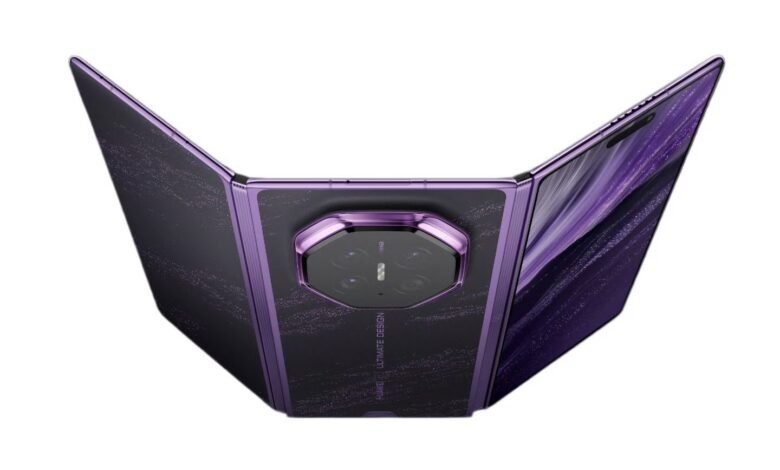
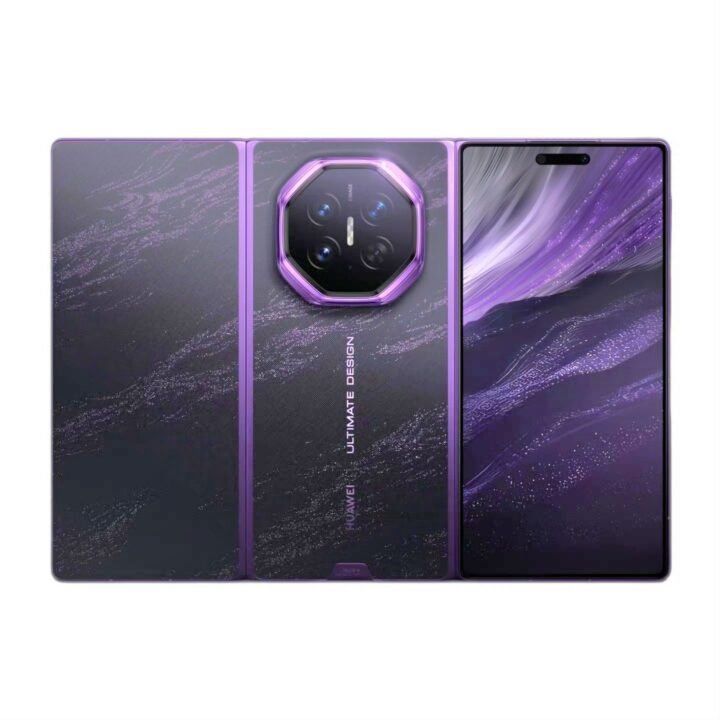
Huawei has confirmed 7 September for an event titled “HarmonyOS 7 | HUAWEI Mate XT 2 and All-Scenario New Product Launch”. It is a China only event. The tri-fold, Huawei Mate XT 2 is the main highlight of the event.
This time round, Huawei is shifting to an inward-folding phone with a cover screen. This makes it a U-shaped fold rather than the previous zig-zag Z-Shape. According to leaks, the new tri-fold will be powered by a Kirin 9050 Pro chipset. It’ll have over 6000mAh battery and be roughly 20% better in flatness when closed.
Huawei pioneered the trick-fold segment and is currently the only player. Early in January of 2026, Samsung put their own Galaxy Z Trifold in the market at a $2899 price tag. However, by March the company discontinued sales after only about 30,000 units being sold.
Huawei launched the first Mate XT in China in September 2024 at CNY 19,999, took it global from Kuala Lumpur in February 2025 at EUR 3,499, and passed 400,000 sales by April. Whatever the tri-fold market is, Huawei is nearly all of it.

The OS is the bigger announcement
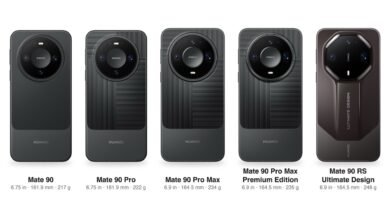
HarmonyOS 7 was announced on 12 June at Huawei’s developer conference with a developer beta the same day. This September is when it the stable version goes out. We’ll first see it preloaded on the tri-fold and, Huawei says, on the Mate 90 series later on.
The pitch with HarmonyOS 7 is an agent-centric operating system. Xiaoyi becomes a system-level agent with access to more than 2,100 system capabilities, running on Huawei’s Harmony Agent Framework 2.0, with long-term memory and the ability to reuse what it learns across tasks. The interface gets a spatial redesign, with 3D depth and lighting across wallpapers, buttons and sliders, that looks a great deal like Apple’s Liquid Glass. Huawei claims 15% better performance than HarmonyOS 6.1 and a task execution rate above 90%.
This matters because HarmonyOS is now the third largest mobile platform globally. Counterpoint Research put it at 5% of global smartphone sales in Q2 2026, behind Android on 75% and iOS on 20%, and at 24% inside China, ahead of iOS on 18%.





Can’t wait to have it. I love Huawei Mate XT 2