

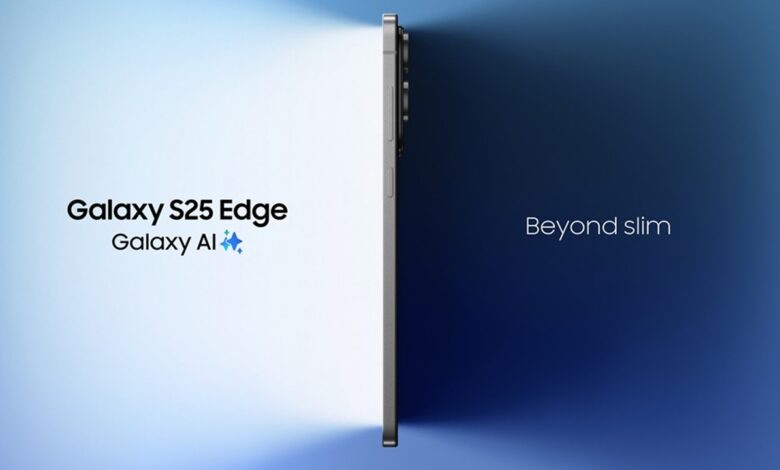
Samsung may be gearing up for a second swing at the ultra-thin smartphone market, but if this week’s leaks are anything to go by, the company’s roadmap is a closely guarded and contradictory secret.
On 2 September 2026, two leakers on X surfaced claims that a Galaxy S27 Edge is in development for 2027. This would be the return of a form factor Samsung abandoned after a single, commercially disastrous generation.
The leaks disagree on the fundamental architecture of the device:
- The compact version. @kro_roe describes a 5.8-inch display in a chassis in the “low 4-millimetre range”, with a 4,300mAh battery.
- The large version. Hours later, @SPYGO19726 countered, claiming the device is a 6.8-inch handset measuring 5.4mm thick.
Neither gave a source, and Samsung has announced nothing. What we do know is that the standard S27 lineup, which we have been tracking, is expected in January or February 2027 as the S27, S27+, S27 Pro and S27 Ultra. If the Edge exists as a fifth variant, one reading of the leak has it arriving later in the year, the way the Galaxy S25 Edge did in May 2025.

The ghost of the S25 Edge
To understand the scepticism around an S27 Edge, we have to look at why the S25 Edge was cancelled.
At 5.8mm thick and 163g, the $1,099 S25 Edge was an engineering achievement that failed as a daily driver. To hit that footprint, Samsung compromised heavily: it shipped a 3,900mAh battery, capped charging at 25W, and left out the telephoto lens entirely.
Galaxy S25 series shipments through August 2025, per Hana Investment & Securities figures in an October 2025 report:
| Model | Units shipped |
|---|---|
| S25 Edge | 1.31 million |
| S25 | 8.28 million |
| S25+ | 5.05 million |
| S25 Ultra | 12.18 million |
That same October report said Samsung had cancelled the S26 Edge, and the S26 duly launched as three phones. By April 2026, Samsung was describing the whole ultra-thin line as an “ongoing experiment”, as we reported when the S27 Pro rumour first surfaced.
Samsung was not alone. Apple’s 5.6mm iPhone Air, launched in September 2025, sold below Apple’s expectations, and by November Apple had reportedly cut production and pushed its second-generation Air to 2027.
The silicon-carbon solution
If Samsung is going to make an ultra-thin flagship work in 2027, it needs a battery chemistry the company has never shipped in a Galaxy S phone: silicon-carbon.
Conventional lithium-ion batteries use graphite anodes. Mixing silicon into the anode lets the battery hold far more lithium, so you get more capacity in the same physical volume. This is how the POCO F9 Ultra fits an 8,050mAh cell into a standard chassis.
A July 2026 leak from the tipster Lanzuk said Samsung plans to bring the chemistry to the S27 Pro and Ultra, for roughly 10% more capacity than their S26 equivalents. The report said Samsung was undecided on the base S27 because of cost, and it noted a second problem: silicon-carbon cells currently degrade faster than conventional lithium-ion, which matters on a phone people keep for years.
If @kro_roe’s leak is accurate, a 4,300mAh battery in a sub-4.5mm chassis would be Samsung’s most aggressive use of the chemistry to date.





Join the discussion