

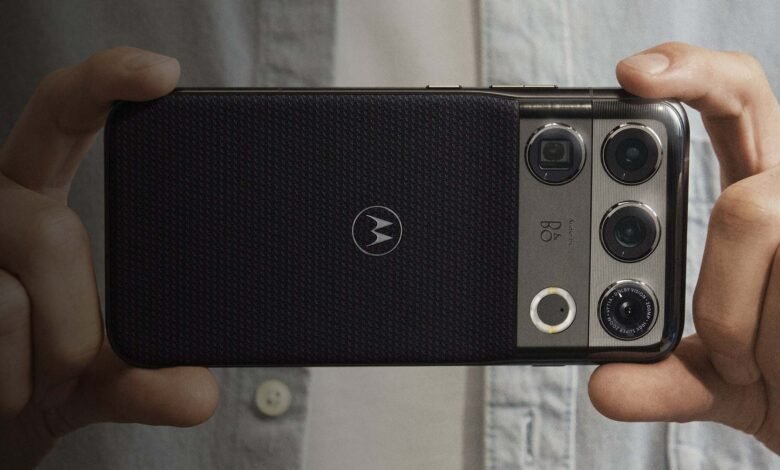
Motorola launched the Signature 27 on Thursday 5th November. It starts at USD 1,599. In Europe, the recommended price is EUR 1,899, or about KES 277,000. European prices include VAT and US prices don’t, which explains part of that gap.
The Signature is Motorola’s top range of non-folding phones. The first one launched in January at EUR 999. So 10 months later, the European price is nearly double what the first one started at.
When we first covered this phone in September, Motorola had given the chip and two of the cameras but no price, screen or battery. Now it has given all of them, so the question for anyone who looked at the first Signature is what the extra money buys.
Sales start in Europe, the Middle East and Africa on 16th November. Some retailers and partners in select countries are also expected to get it at EUR 1,399, but that’s unconfirmed and Motorola’s release doesn’t mention it. Germany only has “the coming weeks” so far. In the US, pre-orders open on 19th November and sales begin on 26th November through Motorola, Amazon and Best Buy. Motorola’s release itself only says “markets worldwide in the coming months”.

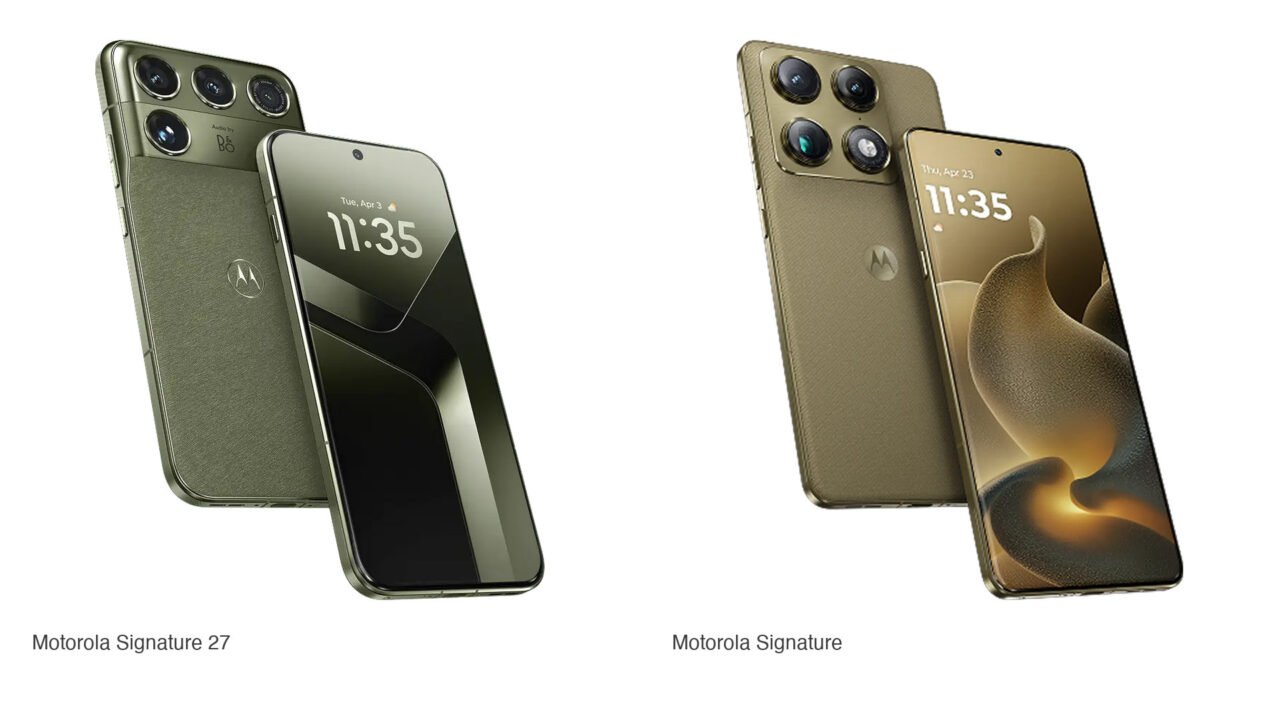
Comparing Specs: Motorola Signature 27 vs original Motorola Signature
| Motorola Signature 27 | Motorola Signature | |
|---|---|---|
| Launched | 5th November 2026 | January 2026 |
| Price | USD 1,599 | EUR 999 |
| Kenyan price | Not announced | KES 121,499 at Avechi (16GB and 512GB) |
| Chip | Snapdragon 8 Elite Extreme Gen 6 | Snapdragon 8 Gen 5 |
| Memory and storage | 12GB or 16GB, with 256GB or 512GB (12GB and 512GB only in the US) | Not stated in the launch release |
| Screen | 6.8-inch Extreme AMOLED Duo, 1.5K, 120Hz | 6.8-inch Extreme AMOLED, 165Hz |
| Peak brightness | 12,000 nits | 6,200 nits |
| Battery | 7,000mAh silicon-carbon (rated 6,790mAh) | 5,200mAh silicon-carbon (rated 5,100mAh) |
| Charging | 90W wired, 50W wireless | 90W wired, 50W wireless |
| Main camera | 50MP Sony LYTIA L910 | 50MP Sony LYTIA 828 |
| Zoom camera | 200MP periscope, 3x optical | 50MP periscope, 3x optical |
| Ultrawide camera | 50MP | 50MP |
| Action sensor | EVS | None |
| Selfie camera | 50MP | 50MP |
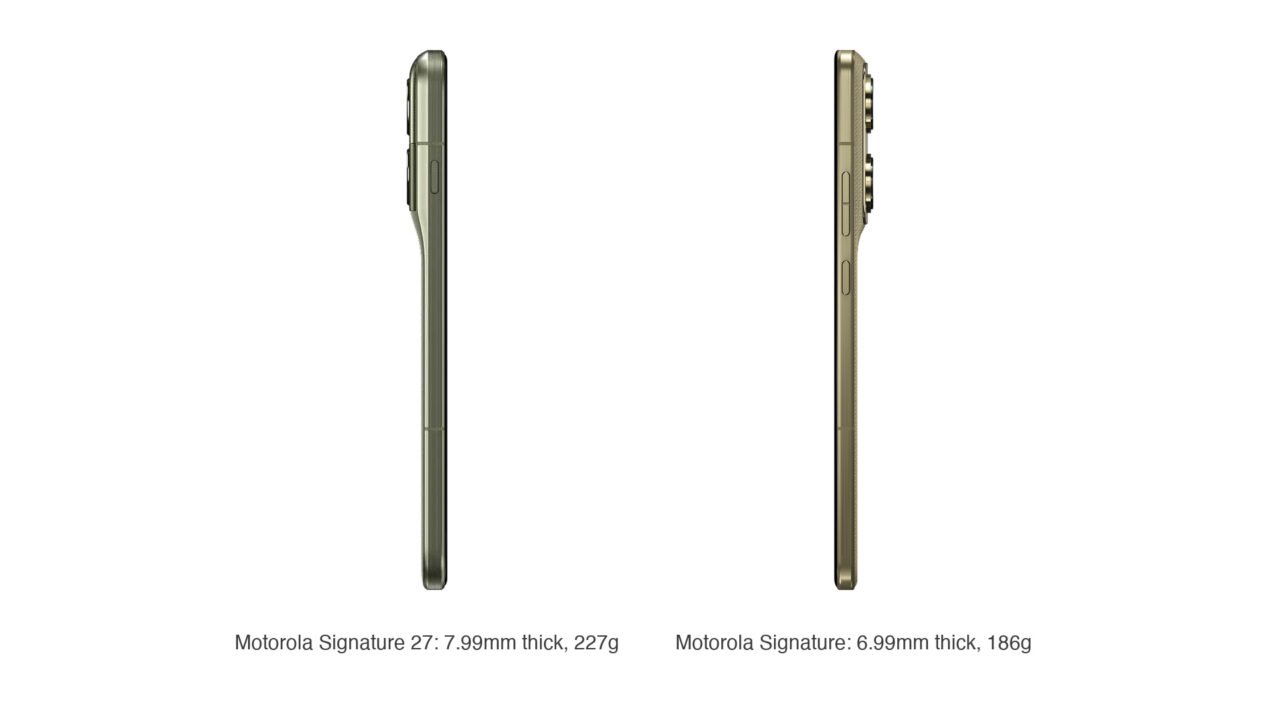
| Thickness and weight | 7.99mm, 227g | 6.99mm, 186g |
| Glass | Gorilla Glass Ceramic 3 | Gorilla Glass Victus 2 |
| Water and dust rating | IP68 and IP69 | IP68 and IP69 |
| Speakers | Audio by Bang & Olufsen | Sound by Bose |
| Updates | 7 OS upgrades, up to 7 years of security updates | 7 Android upgrades, up to 7 years of security updates |
| Colours | Pantone Coal Smoke, Pantone Capulet Olive | Pantone Carbon, Pantone Martini Olive |
A bigger battery in a thicker phone
The Signature 27 has a 7,000mAh battery, 35% bigger than the 5,200mAh one in the first Signature. Both use silicon-carbon cells, which pack more charge into the same space than the usual graphite ones. That helps, but an extra 1,800mAh still needs room. The phone went from 6.99mm to 7.99mm thick, and from 186g to 227g, and we think the battery accounts for a good part of that.
Motorola claims up to 77 hours of battery life, against the up to 52 hours it claimed for the first Signature. It also says 12 minutes on its 90W charger gives up to 12 hours of use. That charger is sold separately.
What 12,000 nits means
Nits measure how bright a screen gets. A normal phone screen of this type has one layer of material that makes light. The Signature 27’s Extreme AMOLED Duo stacks two, so it can get brighter, or use less power at the same brightness. That’s why Motorola also claims up to 34% better energy efficiency and up to 121% longer life than the first Signature’s panel.
The headline figure is 12,000 nits, nearly double the first Signature’s 6,200. But Motorola’s footnotes tie that number to a 1% average pixel level, which means only a tiny part of the screen is lit.
The refresh rate went down from 165Hz to 120Hz.
The cameras
There are four sensors on the back, but you shoot with three: a 50MP main camera, a 50MP ultrawide and a 200MP periscope with 3x optical zoom, meaning it reaches 3x with the lens alone. A periscope lens folds the light sideways inside the phone, which is how a long lens fits in a thin body.
The fourth is new. Motorola calls it the first dedicated EVS action sensor on a smartphone. EVS stands for event vision sensor. A normal camera sensor records the whole scene, frame by frame. This one only picks up pixels whose brightness changes, so it follows movement separately from the main cameras. Motorola says that helps its Action Shot feature freeze moving subjects while keeping as much light as possible. That’s the hard part on a phone, because in low light the shutter stays open longer and anything moving blurs. So if you shoot people moving indoors or at night, this is the feature to look out for in reviews.
Motorola also says DXOMARK, a French company that tests phone cameras, rates the phone the world’s best camera system launched in 2026. The date is the catch, and the claim only covers devices DXOMARK has tested. On DXOMARK’s ranking, the Signature 27 scores 173 and comes second overall, behind the 175 of the Huawei Pura 80 Ultra, a 2025 phone, and ahead of the iPhone 18 Pro on 172. Motorola says its engineers also spent weeks with DXOMARK’s teams in Paris and used its tools to fine-tune the camera. So this is a score from a company Motorola worked closely with, and we’d read it alongside other reviews.
DXOMARK’s test likes the portraits and the video. It also says motion blur in portraits is “more pronounced than on competing devices such as Vivo and Huawei”, and that “long-range zoom performance falls behind that of competing devices equipped with dedicated telephoto modules”, meaning phones with a separate longer zoom camera. So we think Motorola’s 100x Super Zoom shouldn’t be your reason to buy this phone.
Chip and software
The chip is the Snapdragon 8 Elite Extreme Gen 6, the faster of Qualcomm’s two top phone chips this year. The US gets one version with 12GB of memory and 512GB of storage, while Germany gets 16GB and 512GB.
It runs Android 17, with seven OS upgrades and up to seven years of security updates promised from the global launch date. Two software features aren’t ready yet. GrapheneOS, a privacy-focused system built on Android, will be supported for the first time on a Motorola phone, but Motorola hasn’t said when, and GrapheneOS’s developers have pointed to 2027. Google’s Gemini Intelligence features, where the phone handles multi-step tasks in apps for you, come “in the coming months”, in select countries and languages. Motorola doesn’t list those countries.
Will it come to Kenya?
Africa is in that 16th November sales date. Motorola hasn’t named the countries or given a Kenyan price, so we can’t say yet whether it’s coming here officially.
The first Signature did reach Kenyan shops. A Nairobi retailer sells it with 16GB and 512GB at KES 121,499. We know the Signature 27 will cost far more. The US price alone converts to about KES 86,000 above what the first Signature costs here today.
We think memory costs are part of the price jump, as they were on vivo’s X500 series, though Motorola hasn’t explained its price. The screen’s brightness, the battery life and the action sensor are still Motorola’s claims until independent reviews land. We’d wait for those before paying that much, especially with the first Signature still on sale for so much less.



Join the discussion