

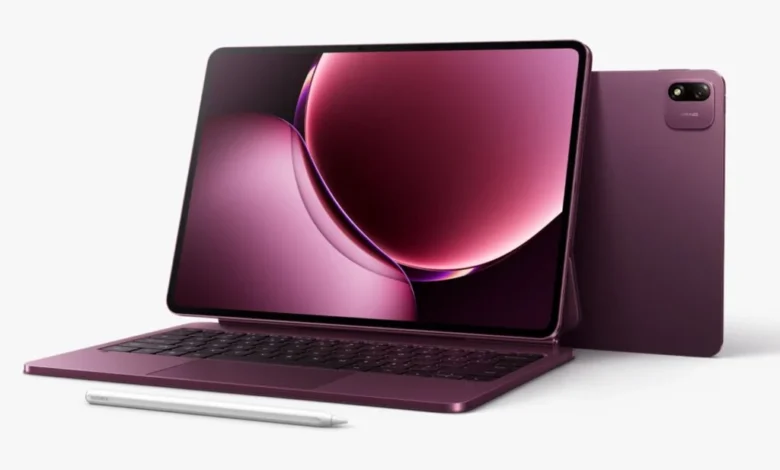
Carrying a dedicated portable monitor alongside your laptop has always been a clunky compromise. Xiaomi is aiming to eliminate that redundancy entirely with the upcoming Pad 9 Pro Max. According to teasers Xiaomi published on 5 September, ahead of the tablet’s 7 September launch in China, the device will feature native video input through its USB-C port. By connecting a computer, the tablet’s 13.3-inch display becomes a desktop monitor for that computer.
We have already covered the foundational specs, including the 7 September launch date, the expansive screen size, and Xiaomi’s custom in-house Xring O3 processor, but this new video input capability dramatically shifts how this tablet can fit into a professional workflow.
USB-C Output or Input
It is crucial to understand that simply having a USB-C port does not magically turn a tablet into a monitor.
Historically, tablets that support video output act as a one-way street. They push their own graphical interface to an external display using a standard called DisplayPort Alternate Mode, where the tablet’s internal processor runs the apps and the connected TV or monitor merely acts as a dumb screen.

Video input fundamentally reverses those roles. The connected computer does the heavy lifting, sending the picture down the cable, and the tablet acts as the receiver. This requires specialised internal hardware to accept and decode an incoming video signal: a capability most modern tablets simply lack.
While software workarounds exist, such as Samsung’s Second Screen, which relies on Windows wireless display protocols to bridge the gap, a direct, hardwired video connection takes an entirely different route. It avoids the compression and network variability of Wi-Fi, though Xiaomi has not published a latency figure for the wired mode.
According to Xiaomi’s teasers, this wired display mode is engineered for three distinct use cases:
- A traditional second screen for a computer.
- A dedicated pen display for digital artists.
- A larger, external display for a handheld games console.
For the handheld console route, Xiaomi specifies that DisplayPort 1.2 or newer is a strict requirement. The connection will also route audio directly through the tablet’s built-in speakers.
Drawing on the Tablet, Rendering on the PC
For creative professionals, the “pen display” functionality is perhaps the most exciting prospect. In this mode, the tablet serves purely as an interactive surface. You draw directly onto the 13.3-inch glass, but your demanding creative software (like Photoshop or Premiere) is actually running on the powerful computer tethered to it. Xiaomi has not said how pen strokes are sent back to that computer, whether a driver is needed, or which operating systems are supported.
Xiaomi’s teaser notes that this setup is designed to work in tandem with their proprietary Focus Pen Pro and a TourBox controller. TourBox Tech makes editing controllers loaded with programmable dials and buttons. This creates a highly efficient, two-handed workflow: one hand uses the Focus Pen Pro to draw, while the other rests on the TourBox to rapidly switch brush settings, undo strokes, or execute editing shortcuts.
Screen Geometry and HyperOS 4
The display on the Pad 9 Pro Max is built for this kind of intense productivity. It features a 13.3-inch panel with a 3:2 aspect ratio, a crisp 3.4K resolution, and a peak brightness of up to 1,000 nits.
Furthermore, teasers point to a claimed Delta E of approximately 0.47. In technical terms, Delta E measures the visual distance between a displayed colour and its true reference colour. A value below 1.0 is generally treated as accurate enough for colour-critical work, and if the claim holds this is a professional-grade panel. Xiaomi has not said which version of the Delta E calculation produced the figure.
The 3:2 aspect ratio is also a deliberate, work-focused choice. Compared to a standard 16:10 display of the same width, a 3:2 screen is noticeably taller. This provides significantly more vertical space for reading long documents, writing code, or browsing web pages; a productivity trade-off we recently discussed in our coverage of Huawei’s new tablet.
When untethered from a PC, the tablet runs on Xiaomi’s HyperOS 4. A separate teaser reported by IT Home highlights that this software can natively support up to six apps on screen simultaneously. It is important to note this is entirely separate from the wired monitor mode, where your connected computer’s operating system dictates how the desktop windows are arranged.
Video input is rare
Android tablets with hardwired video input are rare, but not unprecedented. Lenovo built a similar concept into the Yoga Tab 13 in 2021.
That device featured a built-in kickstand and could display a laptop’s output or a gaming console’s picture. However, it relied on a dedicated micro-HDMI input. As chronicled by Liliputing during its international announcement, the Yoga Tab 13 proved the concept worked. It cost CNY 3,299 in China and $680 in the United States. Xiaomi is taking a different route, using the USB-C port the tablet already has rather than adding a separate micro-HDMI connector.


Join the discussion