
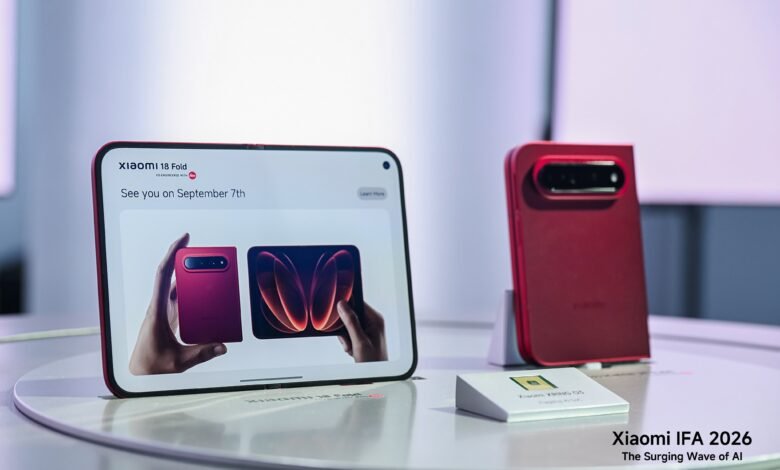
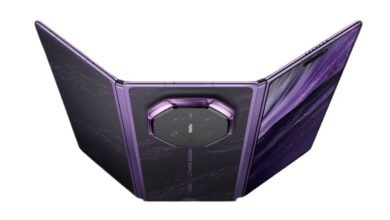
Xiaomi launched the Xiaomi 18 Fold in China on 7 September 2026, its first wide foldable, at exactly the same starting price as the Huawei Pura X Max that Huawei announced on 20 April. Both cost CNY 10,999, about USD 1,638, or roughly KES 212,000. We went through the 18 Fold’s pre-launch details last week; now that Xiaomi has published the finished specifications, here is the full comparison.
A wide foldable shuts into a squat rectangle roughly the size of a passport and opens into a screen shaped like a sheet of paper turned on its side, the opposite of the tall, narrow book foldables Samsung sold until this year. Xiaomi calls its version a “mid-fold” and says both screens sit at close to a square root of two to one ratio, the proportions of an A4 page. Huawei calls its own a “wide fold” and has been building them since the original Pura X in March 2025.
The full spec sheet
| Xiaomi 18 Fold | Huawei Pura X Max | |
|---|---|---|
| Announced | 7 September 2026 | 20 April 2026 |
| Inner screen | 7.58in LTPO AMOLED, 2364 x 1672, about 382 ppi | 7.7in foldable LTPO 2.0 OLED, 2584 x 1828, 412 ppi |
| Cover screen | 5.38in LTPO, 1712 x 1168, about 385 ppi | 5.4in LTPO 2.0 OLED, 1848 x 1264, 412 ppi |
| Refresh rate | 1 to 120Hz on both screens | 1 to 120Hz on both screens |
| Touch sampling | 240Hz inner, 300Hz cover | 240Hz inner, 300Hz cover |
| Peak brightness | 4,000 nits at 30% average picture level | Not published by Huawei |
| Colour and HDR | P3, Dolby Vision, HDR10+, DC dimming | P3, 1.07 billion colours, HDR Vivid, 1440Hz PWM dimming |
| Cover glass | Xiaomi Dragon Crystal Glass 3.0 | Kunlun Glass, second generation |
| Inner screen glass | Double-layer UTG | UTG |
| Chip | Xiaomi XRing O3, TSMC 3nm, 24 billion transistors | Kirin 9030 Pro, 6nm |
| CPU | 10 cores: 2 x 4.35GHz, 4 x 3.68GHz, 4 x 3.15GHz | 9 cores: 1 x 2.75GHz, 4 x 2.27GHz, 4 x 1.72GHz |
| GPU | 16-core, Xiaomi’s own | Maleoon 935 |
| NPU | 4-core, 200 TOPS tensor, 3.13 TFLOPS vector | Not published by Huawei |
| RAM | 12GB or 16GB, LPDDR5X, LPDDR6 on the 1TB models | 12GB or 16GB |
| Storage | 256GB, 512GB or 1TB, UFS 4.1 | 256GB, 512GB or 1TB, no card slot |
| Main camera | 200MP f/1.7, 1/1.56in Samsung ISOCELL HP5, OIS, Leica Summilux | 50MP f/1.4 to f/4.0 ten-stop variable aperture, 24mm, RYYB, OIS |
| Telephoto | 50MP f/2.8 periscope, 80mm, 3.5x optical, 160mm 7x in-sensor, OIS | 50MP f/2.2 periscope, 81mm, 3.5x optical, RYYB, OIS |
| Ultrawide | 50MP f/2.4, 17mm | 12.5MP f/2.2, 13mm, RYYB, autofocus |
| Extra sensor | None | Second-generation Red Maple colour spectrum sensor |
| Zoom claims | 3.5x optical, 7x optical quality | 3.5x optical, 7x optical quality, 100x digital |
| Selfie cameras | 16MP f/2.2 on both screens | 8MP f/2.2 inner, 8MP f/2.4 cover |
| Video | Up to 8K at 24fps, 1080p slow motion to 960fps | Up to 4K, HDR Vivid, Log |
| Battery | 6,000mAh Jinshajiang silicon carbon, 20% silicon, 920 Wh/L | 5,300mAh typical, 5,150mAh rated |
| Wired charging | 67W | 66W |
| Wireless charging | 50W | 50W |
| Reverse charging | Wireless supported | Wireless supported |
| Unfolded | 117.8 x 163.8 x 5.02mm | 120 x 166.5 x 5.2mm |
| Folded | 117.8 x 83.6 x 10.68mm | 120 x 85 x 11.2mm |
| Weight | 219g | 229g |
| Frame | 7-series aerospace aluminium | Aluminium |
| Hinge | Xiaomi Dragon Bone, three-link | Xuanwu waterdrop, rocket steel core parts |
| Drop rating | 1.2 metres | None published |
| Water and dust | IP58 and IP59 | IP58 and IP59, IP58 tested at 3 metres for 30 minutes |
| SIM | Dual nano-SIM | Dual nano-SIM plus two eSIM, two numbers active at once |
| Wi-Fi | Wi-Fi 7 | Wi-Fi 7, 2×2 MIMO, EHT160 |
| Bluetooth | 6.0 | 6.0 with LDAC and L2HC |
| Short range extras | UWB, infrared | NearLink E2.0, infrared |
| Satellite | None | Beidou messaging, Collector’s Edition only |
| USB | Type-C, USB 3.2 Gen 2 | Type-C, USB 3.1 Gen 1 |
| Fingerprint | Side-mounted in the power button | Side-mounted |
| Stylus | Not supported | HUAWEI M-Pen 3 Mini, sold separately |
| Audio | Stereo, Dolby Atmos, Hi-Res | Stereo, Huawei Histen |
| Cooling | Not published in detail | Large VC graphene chamber |
| Software | HyperOS 4 on Android 17 | HarmonyOS 6.1 |
| Colours | Black, Nishino Red, Warm Gold White, Ceramic | Seven, including Interstellar Blue, Olive Gold and Bordeaux Red |
| Starting price | About KES 212,000 | About KES 212,000 |
Form factor and build

The two phones are almost the same object. Both are roughly 120mm on the short edge, both open to about 165mm across, both sit near 5mm thick unfolded and 11mm folded.
Xiaomi wins the fine margins. The 18 Fold is 5.02mm open against Huawei’s 5.2mm, 10.68mm shut against 11.2mm, and 219g against 229g. Ten grams is not much on its own, but on a phone you hold open in two hands for long stretches it is the difference you notice first.
Xiaomi frames the 18 Fold in 7-series aerospace aluminium and uses a new three-link hinge it calls Dragon Bone. It says the phone survives a 1.2-metre drop, that the hinge went through 492 design revisions and 80,000 fold tests, and that the average crease measures under 30 micrometres. Huawei uses its Xuanwu waterdrop hinge with core parts made from rocket steel, and a composite laminated inner screen. Huawei publishes no drop-height figure.
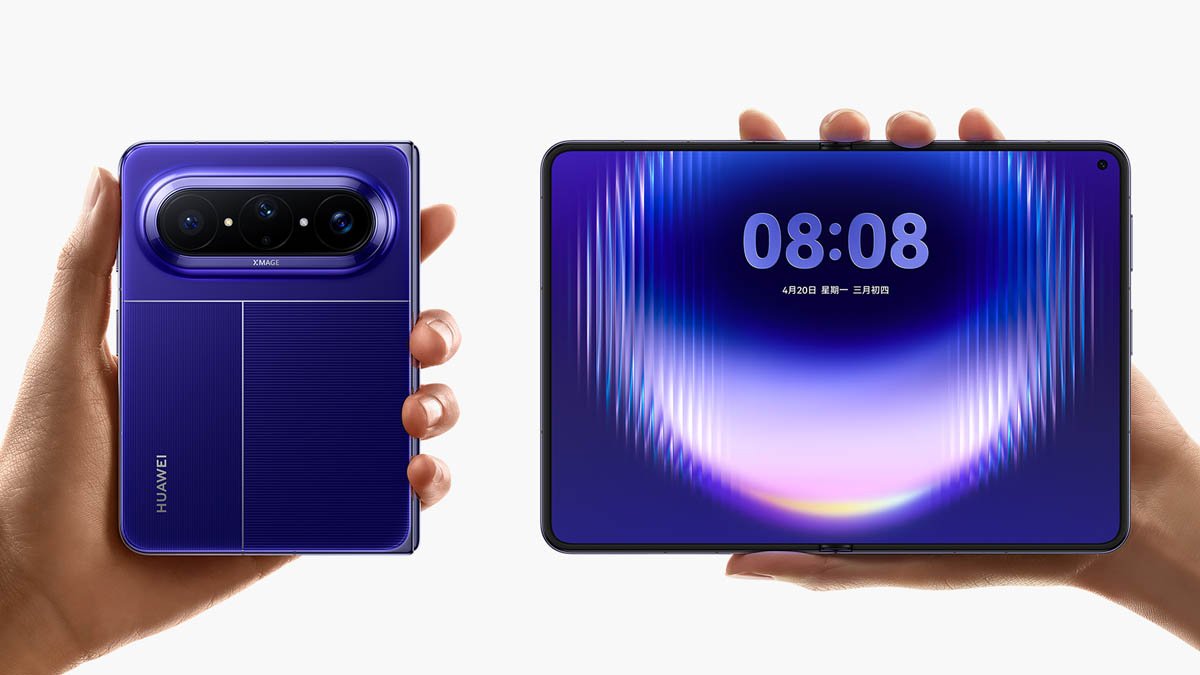
One design difference is visible from across a room. The 18 Fold’s cover screen is asymmetric: the corners on the hinge side are squared off while the outer corners are rounded. The Pura X Max keeps a conventional symmetrical outline.
The screens
Huawei has the bigger and sharper panel on both sides. The Pura X Max inner screen is 7.7 inches at 2584 x 1828, which works out to 412 pixels per inch, and its 5.4-inch cover screen matches that density. Xiaomi’s 7.58-inch inner panel runs 2364 x 1672, about 382 ppi, and the 5.38-inch cover screen about 385 ppi. In practice, 382 against 412 is a difference you would struggle to see at arm’s length, but it is a real gap on paper.

Xiaomi’s counter is brightness. Both 18 Fold panels peak at 4,000 nits, measured at 30% average picture level, which is the figure that matters in direct sun. Huawei publishes no peak brightness number for the Pura X Max anywhere on its own spec sheet, so there is nothing to compare it against.
The rest is close. Both run LTPO panels that drop to 1Hz to save power and climb to 120Hz for scrolling. Both hit 240Hz touch sampling inside and 300Hz on the cover. Xiaomi supports Dolby Vision and HDR10+, Huawei supports HDR Vivid, which is the Chinese HDR standard and is not the same thing. Huawei also runs 1440Hz high-frequency PWM dimming, which matters if flicker at low brightness gives you headaches.
The chips
The processors are not in the same class, and the reason is geopolitical rather than technical.
The XRing O3 is Xiaomi’s own design, built on TSMC’s 3nm process with 24 billion transistors. It has ten CPU cores topping out at 4.35GHz, a 16-core GPU, and a four-core NPU rated at 200 TOPS of tensor performance. Xiaomi puts it at 5,228,014 points in AnTuTu v11 and at 3,945 single-core and 15,221 multi-core in Geekbench 6.5, with multi-core performance up 52% on the previous XRing O1.
The Kirin 9030 Pro is a 6nm chip with nine cores and a peak clock of 2.75GHz, paired with Huawei’s Maleoon 935 graphics. Huawei publishes no benchmark figures at all. What it does claim is 30% better whole-device performance than the original Pura X, which ran the Kirin 9020 on HarmonyOS 5.0.1.
Huawei designs and fabricates without American tooling because it has had to since the 2019 United States sanctions, and 6nm is roughly where domestic Chinese fabrication currently sits. We wrote about what that has cost the company when the Pura 90s went global in July. Xiaomi has no such restriction and buys 3nm capacity from TSMC in Taiwan.
Memory and storage
Both phones offer 12GB and 16GB of RAM and 256GB, 512GB and 1TB of storage, and neither takes a memory card.
The 18 Fold is the first phone in the world to ship LPDDR6 memory from CXMT, the Chinese manufacturer that beat Samsung and SK Hynix into mass production. It is on the 1TB models only; everything below uses LPDDR5X. Storage across the range is UFS 4.1. Huawei publishes neither the memory generation nor the storage interface for the Pura X Max.
Cameras
This is where the two phones genuinely diverge.
Xiaomi went for sensor size and resolution. The main camera is 200MP on a 1/1.56-inch Samsung ISOCELL HP5 sensor at f/1.7, with a Leica Summilux lens. The ultrawide is 50MP at 17mm. The telephoto is a 50MP periscope at 80mm, giving 3.5x optical and a 160mm 7x crop Xiaomi calls optical quality. Video tops out at 8K at 24fps, with 1080p slow motion up to 960fps, and both selfie cameras are 16MP.
Huawei went for light control. Its main camera is 50MP at 24mm with a ten-stop physical variable aperture that moves between f/1.4 and f/4.0, which is unusual on any phone and lets you shape depth of field optically instead of in software. All three rear sensors use Huawei’s RYYB filter, which swaps green photosites for yellow to gather more light at the cost of colour accuracy, and a separate second-generation Red Maple colour spectrum sensor exists to correct for that. The ultrawide is 12.5MP at 13mm with autofocus, so it doubles as a macro camera, something the Xiaomi cannot do. The telephoto is 50MP at 81mm, effectively the same reach as Xiaomi’s.
Two hard limits separate them. The Pura X Max records 4K at most, while the 18 Fold records 8K. And Huawei’s selfie cameras are 8MP on both screens against Xiaomi’s 16MP, which is a large gap for anyone who shoots video calls or vlogs on the cover screen.

Battery and charging
Xiaomi carries 700mAh more in a lighter body. The 18 Fold has a 6,000mAh dual-layer silicon carbon cell Xiaomi calls Jinshajiang, with 20% silicon content and an energy density of 920 Wh/L. Silicon carbon chemistry is what lets a 6,000mAh cell fit in a 5mm chassis at all; conventional graphite would need more volume.
The Pura X Max has 5,300mAh typical, which Huawei notes is 5,150mAh rated. Wired charging is 67W against 66W, wireless is 50W on both, and both support reverse wireless charging. On paper Xiaomi should last meaningfully longer, though foldable battery life depends on how much time each screen spends lit, and neither claim has been tested independently yet.
Durability and water resistance
Both phones carry IP58 and IP59 ratings, which is the same pairing and unusually good for a folding device. IP59 covers high-pressure, high-temperature water jets. Huawei publishes its test conditions in full: IP58 was tested in still fresh water at 3 metres for 30 minutes, three times the 1 metre most IP68 phones are rated for, and IP59 was tested with 80 degree water at 15 litres a minute. Xiaomi does not publish equivalent test detail.
Xiaomi adds the 1.2-metre drop rating and the 80,000-cycle hinge test. Huawei does not publish a drop height.
Connectivity
Both run Wi-Fi 7 and Bluetooth 6.0, both have infrared blasters and side-mounted fingerprint readers, and both are 5G.
Huawei’s advantages here are eSIM and satellite. The Pura X Max stores two physical SIMs and two eSIM profiles, with any two active at once. That matters for a phone bought abroad. Xiaomi lists dual nano-SIM only. The Collector’s Edition also does Beidou satellite messaging, which works in mainland China alone; the standard model does not have it. Huawei also supports NearLink, its own short-range protocol, where Xiaomi uses UWB.
Xiaomi’s USB port is the faster of the two, USB 3.2 Gen 2 against Huawei’s USB 3.1 Gen 1. Huawei is the only one of the two that takes a stylus, the M-Pen 3 Mini, sold separately.
Software, and what actually runs

The 18 Fold runs HyperOS 4 on top of Android 17, with Xiaomi’s Super XiaoAi 2.0 assistant and its own MiMo on-device model. Multitasking runs up to six windows at once on the inner screen.
The Pura X Max runs HarmonyOS 6.1, which is not built on Android. Android apps run on it only inside Huawei’s compatibility containers.
Neither phone ships with Google services. On the Xiaomi that is a Chinese ROM problem: there is no Play Store, so apps install as APK files, which is tedious but workable, and the underlying system is still Android. On HarmonyOS the constraint is structural, because an Android app has to be wrapped before it runs at all. If you rely on Gmail, Google Maps, Google Pay or any banking app that checks Play Integrity, both phones will fight you, and the Huawei will fight harder.
The prices in full
Xiaomi, five configurations:
- 12GB and 256GB, CNY 10,999, about KES 212,000
- 12GB and 512GB, CNY 11,999, about KES 231,000
- 16GB and 512GB, CNY 12,999, about KES 251,000
- 16GB and 1TB, CNY 14,999, about KES 289,000
- Ceramic Special Edition, 16GB and 1TB, CNY 15,999, about KES 308,000, limited to 1,500 units

Huawei, four configurations:
- 12GB and 256GB, CNY 10,999, about KES 212,000
- 12GB and 512GB, CNY 11,999, about KES 231,000
- Collector’s Edition, 16GB and 512GB, CNY 12,999, about KES 251,000
- Collector’s Edition, 16GB and 1TB, CNY 13,999, about KES 270,000
The two ranges track each other exactly until the top, where Huawei’s 1TB model is CNY 1,000 cheaper than Xiaomi’s. Conversions use 129.4 shillings to the dollar on 8 September 2026 and will move with the rate.
Buying either one in Kenya
Neither is sold here, and Xiaomi has said it has no plans to sell the 18 Fold anywhere outside China. That is consistent: Xiaomi has never sold a foldable abroad, going back to the Mix Fold in 2021, and it said the same about the 15S Pro when that phone launched with the company’s first in-house chip.
Huawei does take phones global. The Pura 90s went international in July 2026, three months after its China launch, and the Pura X View may follow. But Huawei’s international units ship with EMUI on open-source Android rather than HarmonyOS, so a global Pura X Max, if one ever appears, would be a different software product from the one on sale in China today. A unit bought through an importer right now is a Chinese unit on HarmonyOS 6.1.
So the software question comes first, because it decides which apps you can run at all. The hardware question is narrower. Xiaomi gives you the faster chip, the bigger battery, 8K video, better selfie cameras and a lighter body. Huawei gives you a sharper screen, a variable aperture on the main camera, an autofocusing ultrawide, dual eSIM and stylus support. The prices are the same until the very top of the range, where Huawei is cheaper.
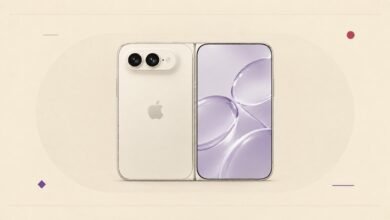
Xiaomi’s Chinese sale opens at 10am on 10 September. Apple shows its own wide foldable, the iPhone Ultra/Duo, on 9 September, and it will be the first of the three sold with Google services or an app store most Kenyan buyers can use.




Join the discussion