

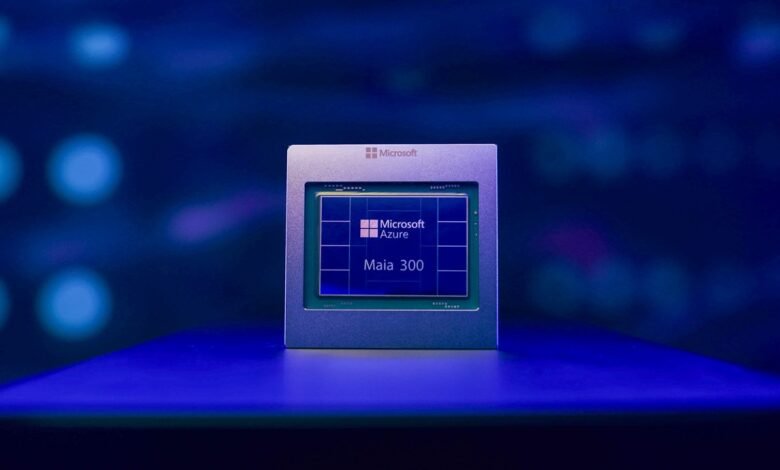
Microsoft is moving the AI behind Copilot, Teams and its other products onto chips it designs itself. From 2027, it’ll deploy its Maia chips in datacentres drawing several gigawatts of power, and Maia will become the main system that answers when you use a Microsoft AI feature. Chief executive Satya Nadella called it “our biggest bet yet on our own silicon” on Monday 12th October 2026, the day Microsoft laid out the plan and introduced Maia 300, the third generation of the chip.
Most AI today runs on GPUs, graphics processors that became the default AI hardware because they can do thousands of calculations at once. Microsoft buys them like everyone else. Maia is a chip it designs for inference, the work a model does every time you use it, reading your question and writing the answer. Training, the one-off process of building the model, needs different hardware, and we explained the difference in July when DeepSeek started designing its own inference chip. Inference runs every time someone asks Copilot something, so it’s the cost that keeps growing as more people use the product.
Why tokens per watt is the number Microsoft picked
AI models read and write text in tokens, small chunks of text a few characters long. Tokens per watt is how much text a chip produces for the electricity it uses. Microsoft leads with it because power now limits how much AI a datacentre can serve. Its Maia 300 technical paper says efficiency at datacentre scale comes down to how much useful equipment fits inside a fixed power and cooling budget. So a chip that writes 40% more text on the same power lets Microsoft serve more people from the same building.
That 40% is still a projection. Maia 300 doesn’t go into production until 2027, and Microsoft’s blog only says it expects the chip to beat “leading GPU-based systems” by that much, even though Nadella’s post says it “delivers” it.

A gigawatt is 1,000 megawatts, and Microsoft hasn’t given an exact figure beyond “multi-gigawatt”. To put that in Kenyan terms, the country’s whole interconnected grid had 3,192 MW installed as of June 2025, the figure we used in May when we explained why the 1 GW Microsoft and G42 datacentre planned for Olkaria stalled. So a multi-gigawatt Maia rollout puts power on the scale of Kenya’s entire grid behind Microsoft’s own chips.
Maia 200 is already running Copilot
Microsoft introduced Maia 200 in January, when it ran in a single datacentre region near Des Moines, Iowa, with one near Phoenix, Arizona, to follow. Today it’s going into datacentres across the US, Europe and Australia, and Microsoft says it gives up to 1.7 times the tokens per watt of leading GPU infrastructure for the built-in AI features in Teams and Copilot. The chip runs OpenAI’s models, Microsoft’s own MAI models and open-source models, and GitHub Copilot and Microsoft Foundry, the Azure service businesses use to run AI models, are due on it by the end of the year.
The pitch has changed since then. In January Microsoft sold Maia 200 on cost, saying it gave 30% better performance per dollar than the newest hardware in its fleet, while this week’s announcement leads with power.
What Maia 300 changes
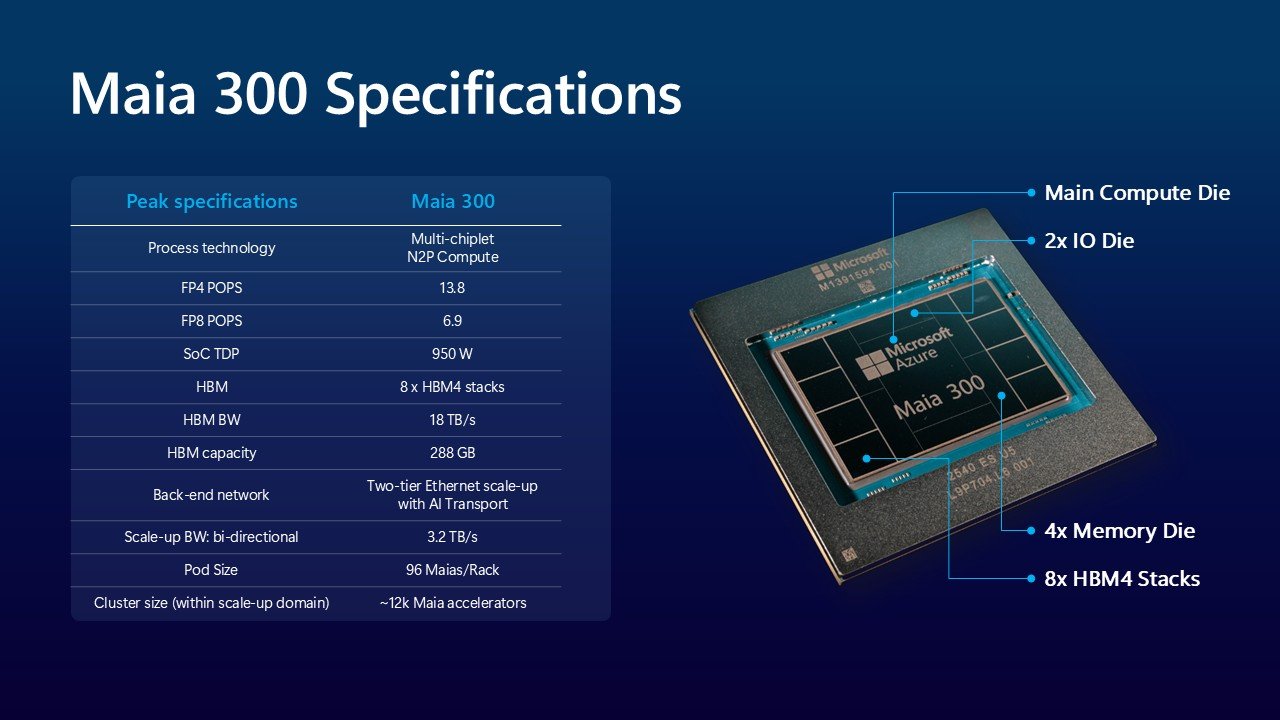
When a model writes a reply, the chip spends much of its time waiting for data to arrive from memory. Microsoft says moving data efficiently, “rather than raw compute power, is increasingly the bottleneck” in large inference systems. That’s why Maia 300 spends most of its upgrade on memory.
Each chip carries eight stacks of HBM4, high-bandwidth memory stacked right next to the processor. That gives 288 GB at 18 TB/s, which is 2.5 times Maia 200’s memory speed and 33% more capacity. Compute grows less, by 36%. The chip is now built from several smaller pieces called chiplets, with the compute parts made on TSMC’s N2P process and the memory and input-output circuits on chiplets of their own. It also draws more power, 950 W against Maia 200’s 750 W.
| Maia 200 | Maia 300 | |
|---|---|---|
| Made on | TSMC 3nm | TSMC N2P (compute chiplets) |
| FP4 compute | Over 10 petaFLOPS | 13.8 petaFLOPS |
| FP8 compute | Over 5 petaFLOPS | 6.9 petaFLOPS |
| Memory | 216 GB HBM3e | 288 GB HBM4 (eight stacks) |
| Memory bandwidth | 7 TB/s | 18 TB/s |
| Power per chip | 750 W | 950 W |
| Chips per rack | 48 | 96 |
| Largest linked cluster | 6,144 | 12,288 |
| In production | Now | 2027 |
A full Maia 300 rack holds 96 chips inside 167 kW, twice Maia 200’s density, and Microsoft says it gets up to seven times the token output of a Maia 200 rack. That number compares a full rack of each, so it includes having twice as many chips.
What Microsoft hasn’t said
- Microsoft doesn’t name the GPU systems behind the 40% and 1.7 times figures, or how it measured them.
- It hasn’t said how many gigawatts “multi-gigawatt” means,
- which datacentres in Europe and Australia have Maia 200,
- what the programme costs, or
- whether Azure customers will be able to rent Maia 300 directly the way they rent GPU servers today.
- None of the regions it named is in Africa.
Where this leaves GPUs and Copilot users
GPUs aren’t leaving Microsoft’s datacentres. Nadella’s post says Microsoft will keep working to “bring the latest innovations from across the ecosystem into our fleet”. The difference is the order: Microsoft’s own products go to Maia first. Google and Amazon already build their own AI chips, and in January Microsoft claimed Maia 200 had three times the FP4 compute of Amazon’s third-generation Trainium and more FP8 compute than Google’s seventh-generation TPU. This time Microsoft compares Maia 300 only with GPU systems and with Maia 200.
Copilot and Teams will look the same in Nairobi whichever chip does the work, so users won’t see the switch. The saving is in how much each answer costs Microsoft to produce, and it hasn’t said whether any of that saving reaches Copilot’s price or usage limits. Until it names the GPU it measured against, both efficiency figures remain Microsoft’s own claims. Microsoft says it’ll share more at Ignite, its conference for businesses and developers, in San Francisco from 17th to 20th November 2026.





Join the discussion