

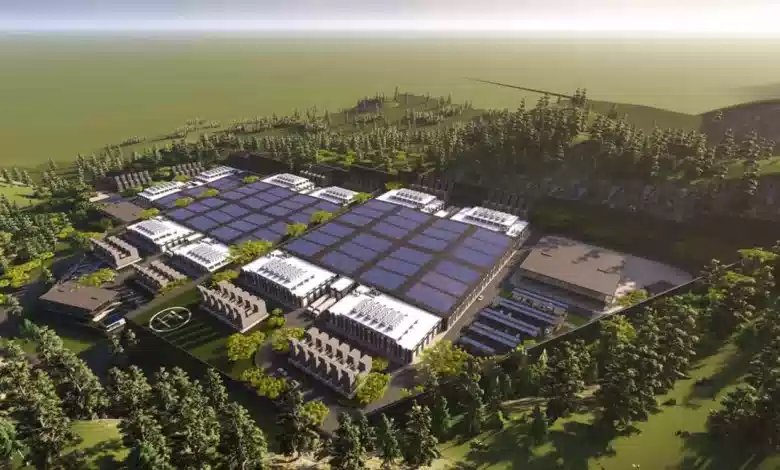
When President William Ruto stood next to American officials in Washington in May 2024 and announced a $1 billion (about KES 130 billion) data centre partnership with Microsoft and Abu Dhabi’s G42, the deal carried the polish of a turning-point moment. The facility, planned for Olkaria in Naivasha, was meant to run on Kenyan geothermal energy, host Microsoft’s first East African Azure cloud region, and confirm Kenya’s status as the continent’s serious destination for AI infrastructure. The press conference framed it as the largest single private-sector digital investment in Kenya’s history.
Two years on, the project is on pause. President Ruto, speaking in Nairobi this week, openly admitted the country’s electricity system cannot accommodate the proposed facility at full scale. His exact framing was striking: “To switch on that one data centre, we would need to shut off power for half the country. That’s when I knew there was a problem.” Neither Microsoft nor G42 has commented publicly on the collapse of the original timeline. According to reporting, a concept note was prepared by Kenya’s Ministry of ICT and submitted to the National Treasury for funding clearance, but the approval never came. By August 2025, internal meetings between Kenyan officials and Microsoft had effectively confirmed that the original May 2026 commissioning date was already gone.
So how did a deal announced with this much ceremony run into something as fundamental as a power shortfall? The answer is in the numbers, and they’re worth walking through carefully.
The grid arithmetic
Kenya’s grid-connected installed capacity, according to the Energy and Petroleum Regulatory Authority’s June 2025 statistics, stands at 3,192 MW. If you add captive generation and off-grid systems, the total figure rises to about 3,840 MW. Peak demand reached a record 2,444 MW in January 2026.

The Microsoft–G42 facility was designed to scale to a final capacity of 1 gigawatt (1,000 MW). Phase one alone was 100 MW. Even at phase one, the facility would have consumed roughly 4 percent of national peak demand. At full build-out, it would have demanded more electricity than half the country uses at the busiest moment of the day. To put that in plainer language: a single building outside Naivasha would have needed close to the same amount of power as Nairobi, Mombasa, Kisumu, and most of the rest of urban Kenya combined at peak hour.
Geothermal, the supposed selling point of the Olkaria site, doesn’t quite rescue the maths either. Olkaria’s geothermal complex generates roughly 950 MW today, with a national geothermal potential estimated at 10,000 MW. Even tapping every single available megawatt at Olkaria would not be enough to supply the full data centre while continuing to serve households and industries already drawing from those plants. The geothermal advantage was real, but it was an advantage of quality (clean, baseload, 24/7) rather than quantity.
Why this was always going to be hard
The deeper issue is that the deal was structured around an announcement, not a feasibility study. The Biden administration helped broker Microsoft’s $1.5 billion equity investment in G42 partly as a counterweight to China’s Digital Silk Road in Africa. Kenya was the showcase. The state-visit announcement in May 2024 set the political agenda, and the engineering work was meant to catch up. It didn’t.
Treasury’s reluctance to clear the concept note matters here. Hyperscale data centres of this size require sovereign-level guarantees on power purchase agreements, transmission upgrades, and water access. None of that came together fast enough. Kenya’s transmission network is also under strain. KenGen recently reported that lines like Muhoroni-Chemosit and Kisumu-Muhoroni already operate at over 120 percent of their design capacity. Adding a gigawatt-class load near Naivasha would require new transmission infrastructure that simply does not exist on the timeline the original deal assumed.
Ruto’s response is to widen the lens. The government is now targeting 10,000 MW of installed capacity by 2030, financed through a roughly $38 billion mix of public capital, asset sales, and private-sector participation. That’s a tripling of the current grid in under five years, and it’s a politically and financially aggressive target.
What’s actually happening on the ground
While the headline project stalled, Kenya’s data centre sector did not freeze. The smaller, modular, carrier-neutral model has quietly been delivering. iX Africa’s NBOX1 facility came online in early 2025 with 4.5 MW of IT power, with a much larger 18 MW phase planned. Oracle then picked iXAfrica to host its Nairobi cloud region, bringing AI-ready 50 kW per rack density to East Africa. We’ve covered both moments closely, and the pattern is clear: 4–20 MW carrier-neutral facilities are being absorbed by the grid without drama. Hyperscale sites that demand a third of the national supply are not.
Olkaria itself isn’t sitting idle either. The KenGen-led Olkaria EcoCloud project, which we wrote about when it broke ground in 2023, is still designed for a 60 MW campus run on geothermal. That’s a more realistic match for what Kenya’s grid can absorb without disruption.
What this means for the rest of us
For Kenyan businesses that were waiting for a local Azure region to handle compliance with the Data Protection Act, the pause is genuinely inconvenient. Microsoft’s nearest Azure region remains in South Africa. Latency, data residency, and cost will continue to push regulated industries (banks, insurers, government agencies) towards locally-hosted alternatives like Oracle on iXAfrica or Safaricom’s enterprise cloud, at least in the near term.
For Kenya’s broader story as Africa’s digital hub, the lesson is less flattering but more useful. Big diplomatic announcements do not, on their own, produce data centres. Power infrastructure does. So does transmission. So does Treasury approval. Without all three moving together, even the most attractive geothermal site on the continent ends up as a press release waiting for a grid.
The Microsoft–G42 project may yet revive in a smaller form, perhaps as a 100 MW phase-one facility that fits comfortably within the existing Olkaria geothermal supply. That would still be the largest single data centre Kenya has ever hosted. It would also be a quieter, more honest version of the original ambition. Sometimes the right project is the one you can actually plug in.








Join the discussion