

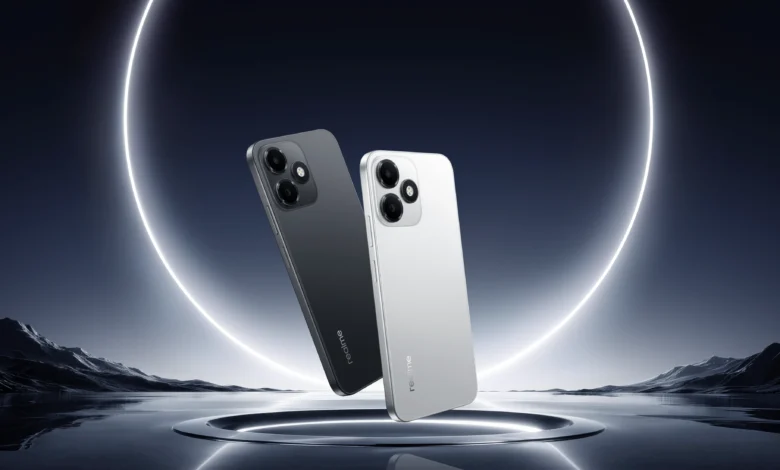
Realme’s India page for its new realme P4s Lite says the phone’s HI-RES camera mode lets you “capture ultra-detailed 50MP photos”. The camera on the back of the phone is 13MP. Further down the same page, a footnote explains the gap: those 50MP photos are “achieved through software upscaling algorithm”. Put simply, the camera hardware is 13MP, and software turns what it captures into a bigger, 50MP picture.
A megapixel is a million pixels, the tiny dots that make up a digital photo. So a 50MP photo has about 50 million dots and a 13MP photo about 13 million. You’d normally read 50MP as a description of the camera. On the P4s Lite, it only describes the size of the saved photo.
The P4s Lite is an India release. Realme’s India store listed its first sale for 8th October 2026. The version with 4GB of RAM, the phone’s working memory, and 64GB of storage was listed at INR 16,499. That’s about USD 170, or about KES 22,100. The dollar and shilling figures are straight currency conversions, not local prices.
Realme’s spec sheet lists a 13MP rear camera with autofocus, so it finds focus on its own. Photos save at 13MP by default. To get 50MP, you go to Camera, then More, then HI-RES. That changes how many pixels the saved photo has. The camera stays 13MP.

What upscaling does to a photo
The sensor is the part of the camera that catches light. It records the scene, and the phone then processes that recording into the photo you see in your gallery. Pixels can be added during that processing. So a saved photo can have more pixels than the sensor recorded.
That’s what upscaling does: it adds pixels to an image that already exists. The software looks at the pixels it has and works out what the new ones in between should be. Some methods give better-looking results than others. None of them can measure light the sensor never recorded. That’s why a bigger photo isn’t automatically a more detailed one. A larger file can help if you need a photo at a set size, but the pixel count alone can’t tell you how much real detail is in it.
On the P4s Lite, 50 divided by 13 is about 3.85. So HI-RES photos have almost four times as many pixels as the default ones. Nothing in Realme’s specs says they hold four times the detail.
Some phones go the other way and save photos with fewer megapixels than their sensors have. When we reviewed the Infinix Zero Ultra in 2022, we explained how its 200MP camera normally saved smaller photos through pixel binning. Binning combines information from neighbouring sensor pixels. Samsung’s 200MP HP1 sensor, for example, can combine 16 pixels into one. So a smaller saved photo doesn’t, on its own, prove a phone’s advertised sensor resolution is wrong.
That’s not what’s happening on the P4s Lite. Its default photos are 13MP, the same as its camera, and its 50MP mode is upscaled. When you compare it with other phones, treat it as a 13MP camera that can also save bigger files. We haven’t compared sample photos from the two modes, so we can’t say whether those bigger files are worth using.
A bigger battery, the same 15W charging
The battery has a similar catch. Capacity, measured in milliamp-hours (mAh), is how much charge the battery holds. Charging power, measured in watts (W), is how fast energy goes in. So a bigger battery can keep a phone going longer. But if charging power stays the same, filling that bigger battery takes longer, everything else being equal.
The P4s Lite’s battery is 7,000mAh typical, 6,820mAh rated, and it charges at up to 15W. It also supports USB Power Delivery at 15W. That’s a standard that lets the phone and charger agree on how much power to send over USB. Here’s how it compares with the older Realme P4 Lite:
| Specification | Realme P4 Lite | Realme P4s Lite |
|---|---|---|
| Rear camera | 13MP | 13MP, with software-upscaled 50MP mode |
| Typical battery capacity | 6,300mAh | 7,000mAh |
| Maximum charging power | 15W | 15W |
| Maximum screen refresh rate | 90Hz | 120Hz |
That’s about 11% more battery, with the same 15W charging. Don’t read it as 11% more battery life, though. How long a phone lasts also depends on how much power it uses. The screen can now refresh up to 120 times a second, up from 90. Realme notes the actual rate depends on the app and what you’re doing.
We’d expect this setup to suit you if you can leave the phone on the charger for a while. If you depend on quick top-ups, the unchanged 15W charging is less helpful. Realme’s product and spec pages don’t say how long a full charge takes. And 15W is the maximum. Phones don’t have to charge at their maximum the whole way.
Then there’s the six-year claim. Realme says the battery keeps more than 80% of its capacity after six years, but that comes from a lab simulation. It assumes one full charge and discharge every 1.3 days. Realme’s warranty also doesn’t cover the normal loss of capacity that comes with use. The page has a separate 36-month fluency test too, a lab test of how smoothly the phone keeps running. Neither is a promise of Android or security updates. The product and spec pages give no update period for this phone.
In short, the P4s Lite has a bigger battery than the P4 Lite but charges no faster, and its 50MP photos come from a 13MP camera. Realme does disclose both, though the camera one sits in a footnote under its “ultra-detailed” claim. What it hasn’t said on those pages is how long the phone will get updates. You’d want that answer before planning six years with it.








Join the discussion