
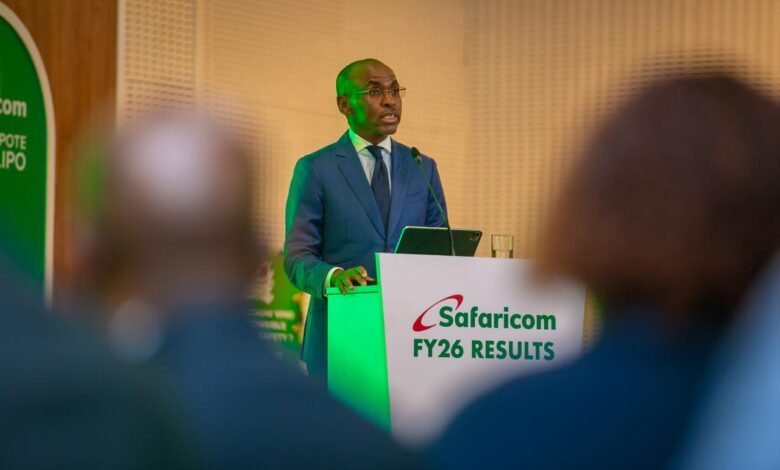
Safaricom, Kenya’s biggest mobile operator, made KES 58.2 billion in net profit in the six months to 30th September 2026. That’s up 35.9% from KES 42.8 billion a year earlier. The figure is the part of the profit that belongs to Safaricom’s own shareholders. The results are unaudited and came out on Thursday 5th November.
Two numbers passed KES 100 billion in a half-year for the first time. M-PESA, Safaricom’s mobile money service, brought in KES 100.1 billion in revenue. The Kenyan business made KES 101.8 billion in EBIT, which is operating profit before interest and tax.
Kenya didn’t grow 36%, though. Its net profit rose 13.8%, and most of the difference comes from Ethiopia.
Why the group grew faster than Kenya
The group is Kenya and Ethiopia together. Kenya made KES 66.3 billion in net profit. Ethiopia still loses money, and Safaricom’s share of that loss was KES 8.8 billion, down from KES 15.5 billion. So of the KES 15.4 billion rise in group profit, about KES 8 billion came from Kenya and about KES 6.7 billion came from losing less in Ethiopia. The other KES 0.7 billion or so appears to sit in the holding companies and adjustments between group companies.
Currency explains a big part of Ethiopia’s improvement. A year ago the birr, Ethiopia’s currency, fell 16.9% against the dollar in six months, and Safaricom Ethiopia booked KES 9.39 billion in foreign exchange losses in its operating costs. This time the birr fell 4.3%, and those losses came to KES 1.07 billion.
Ethiopia’s EBITDA loss fell from KES 12.56 billion to KES 434.4 million. EBITDA leaves out interest, tax and the cost of the network wearing out, and about 69% of the improvement there is the smaller currency hit. Convert both years at the same exchange rate and Safaricom puts its group profit growth at 30%. That figure still includes the smaller foreign exchange losses.
The Ethiopian business itself is growing too. Its service revenue, what customers pay for services without phone sales, rose 71.6% to KES 10.6 billion, and 15.4 million customers used the network in the last 90 days. Capital spending there, the money that goes into the network and IT systems, fell 47.2% to KES 5 billion.
Safaricom wants to break even at EBITDA by March 2027, the target we looked at in September, and at a KES 434.4 million loss it’s now close. How fast it gets there depends partly on pricing and exchange rates, Safaricom says. Ethiopia still lost KES 16.6 billion overall once you count network wear, interest and tax. Safaricom holds about 54% of the business, and KES 7.8 billion of that loss falls to its partners.
Where Kenya’s money came from
Kenya’s service revenue grew 11.3% to KES 216 billion.
| Kenya, six months to September | 2026 | 2025 | Change |
|---|---|---|---|
| M-PESA | KES 100.07bn | KES 88.06bn | +13.6% |
| Mobile data | KES 45.24bn | KES 40.32bn | +12.2% |
| Voice calls | KES 42.20bn | KES 39.72bn | +6.2% |
| Fixed internet and related services | KES 12.51bn | KES 9.96bn | +25.5% |
| Incoming calls and other | KES 10.94bn | KES 10.46bn | +4.6% |
| SMS | KES 5.01bn | KES 5.48bn | -8.6% |
| Total | KES 215.96bn | KES 194.00bn | +11.3% |
M-PESA is now 46.3% of that total. It handled 27.4 billion transactions, up 25.2%, and moved KES 23.56 trillion, up 16.6%. Revenue grew more slowly than both. Safaricom brought in KES 42 of every KES 10,000 that moved, down from KES 44, which works out to about KES 3.65 a transaction, down from about KES 4.03.
Free transactions made up 53% of the total, down from 60.3%. Financial services transactions rose 143% to 6.14 billion, about two-thirds of all the growth. That line includes Fuliza, the overdraft that lets a payment go through when your balance is short, and its average draw was just KES 192. Fuliza gave out KES 1.16 trillion in six months, up 84%, and Safaricom’s own revenue from it was KES 4.9 billion, up 86%.
Data keeps getting cheaper per GB, and people keep using more of it. Safaricom’s average rate works out to about KES 51.50 per GB, down from about KES 57.75. That’s an average across everything customers buy, so it won’t match any one bundle. The average paying customer used 5.31 GB a month, up from 4.85 GB, and there are 27.86 million of them, up 11.6%.
Safaricom has nearly stopped adding 5G sites. It had 1,880 in Kenya at the end of September, against 1,879 in March, and the results don’t say why. It added 532 4G sites in that time, and 5G devices on its network grew 51.9% in a year to 1.98 million.
Home and business internet customers rose 31.8% to 569,860, though the average home now pays KES 2,101 a month, down from KES 2,298. In September we wrote that Safaricom had raised Home Fibre speeds without raising prices, and that it now sells cheaper plans such as Fibre Lite.
What the results leave open
The results don’t announce an interim dividend, the mid-year payout to shareholders. Last year’s KES 0.85 a share was approved in February, so shareholders may have to wait until then.
Who controls Safaricom is still in court. In September the High Court voided the government’s sale of 15% of the company to Vodafone Kenya, owned by South Africa’s Vodacom. That sale took Vodafone Kenya from 40% to 55%. The results booklet only points to Vodacom’s 16th October update. That update says the Court of Appeal will fast-track the appeal, and Vodafone Kenya stays the registered holder of those shares until it’s heard.
Safaricom also doesn’t give the price of its 25-year spectrum renewal, which took effect on 1st July. Spectrum is the radio frequencies a network runs on. Safaricom is paying over several years, and the group’s lease and licence debts rose from KES 57.51 billion to KES 94.81 billion in the six months. About KES 27 billion of the September figure is licence payments still owed, and the rest is leases.
The full year, and what it means for you
For the full year, Safaricom kept its target of KES 180 billion to KES 187 billion in group EBIT. That target leaves out accounting charges left over from when Ethiopia counted as a high-inflation economy. Group EBIT for this half was KES 91.1 billion, or about KES 94.6 billion without those charges, a little over half the target.
August’s M-PESA fee cuts touched only two of these six months, and the cut on Pochi la Biashara, the business wallet on a trader’s M-PESA line, was only promised to 31st October. The full-year results in May 2027 will show more of what those cuts did to revenue.
If you’re a typical Safaricom customer, you’re using more data and moving more money through M-PESA, and Safaricom earns less on average per GB and per shilling moved. It took in about KES 890 a month from the average Kenyan customer active in the last 30 days, up from about KES 857. That, plus 7.1% more active customers, is how Kenya’s service revenue grew 11.3% while Safaricom earned less per unit.







Join the discussion