
Kenya’s mobile networks may not always deliver the internet speeds we want, but when it comes to reliable indoor signal, Nairobi is doing remarkably well. In fact, you are likely to enjoy stronger indoor mobile reception in the Kenyan capital than in some of the world’s most technologically advanced cities.
A new study by Ookla, the company behind Speedtest, analysed mobile signal measurements across more than 100 cities in 60 countries between September 2025 and August 2026. Nairobi emerged as the best-performing African city sampled for indoor 4G signal strength, beating the likes of Lagos, Cairo and Johannesburg.
What makes Nairobi’s performance particularly impressive is how it compares globally. With a median indoor signal strength of approximately -89 dBm, Nairobi is not far behind Dubai, Bangkok and Seoul, which recorded around -88 dBm. For context, numbers closer to zero indicate stronger reception.
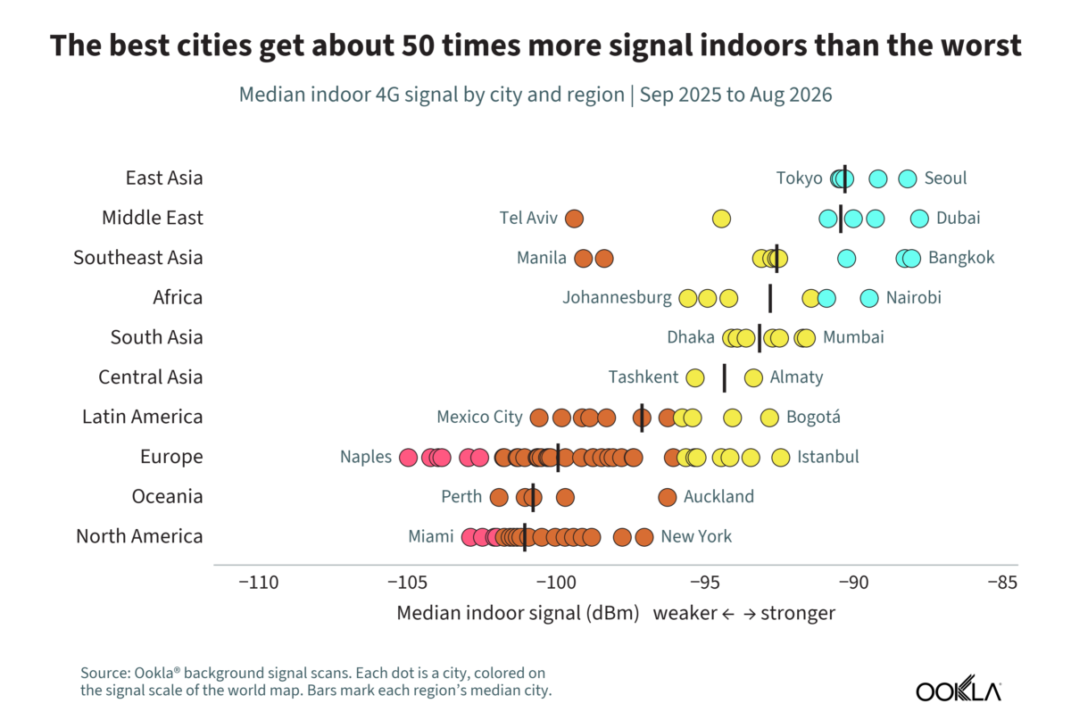
Meanwhile, cities across North America and Europe generally recorded much weaker signals. Around 34% of measured buildings in London, 25% in New York and 38% in Los Angeles had signal levels at which indoor 4G becomes unreliable.

Interestingly, Nairobi’s strong indoor reception could have a lot to do with the quality of its mobile networks outdoors. From our own experience, getting a strong mobile signal while out and about in Nairobi is rarely a problem, regardless of which network you’re using. And there may be a connection between that and the city’s impressive indoor performance. This corroborates Ookla.s report, which found that about 85% of the gap in indoor signal strength between cities comes down to their outdoor coverage. This means Nairobi’s generally strong outdoor reception could be giving the city a significant advantage over places like London and New York, even before factors such as building materials come into play.
That doesn’t mean Nairobi residents are immune to connectivity problems inside their apartments, offices or shopping malls. Concrete, steel and certain types of glass can weaken mobile signals, particularly in larger buildings. Ookla also found that weaker 4G signals can reduce download speeds by 65% and upload speeds by 87%, based on global Speedtest measurements.
For Kenyan operators like Safaricom and Airtel, the findings highlight the value of investing in dedicated cellular equipment inside large buildings, especially as Nairobi’s skyline continues to grow. However, Nairobi’s strong indoor performance, despite the apparent absence of specific indoor coverage requirements, suggests that investments in outdoor networks may already be paying off. Where installing dedicated equipment inside buildings proves difficult or costly, further strengthening outdoor coverage could be an equally worthwhile approach.
It’s also worth noting that stronger reception doesn’t automatically translate into faster internet speeds, and Ookla’s study doesn’t establish which Kenyan operator offers the best indoor coverage. Still, Nairobi’s performance offers a refreshing perspective on Kenya’s mobile infrastructure, particularly when compared with cities in significantly wealthier economies.







Join the discussion