
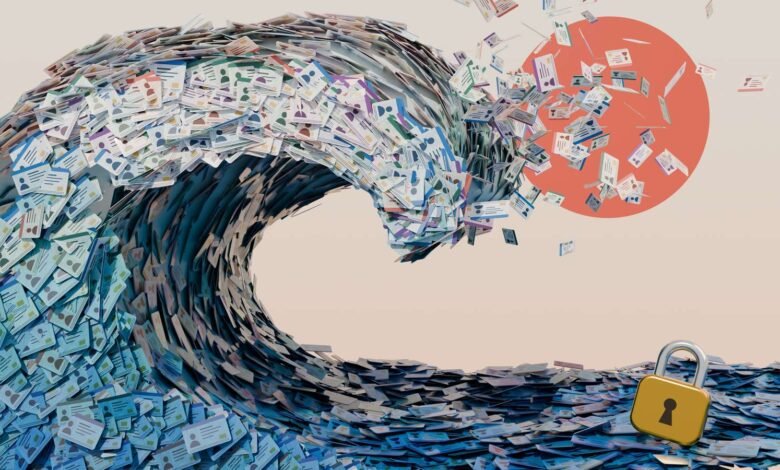
Earlier this week, we explained a hacker’s claim to have stolen 740GB of data from eCitizen. Now the hacker’s screenshots are public, and one appears to show a database table with an estimated 32 million records, each with a name, ID number and birth date.
The screenshots come from the hacker, who goes by ByteToBreach, so they could be staged and don’t prove a break-in. We’ve read them at full size in a security researcher’s write-up, and didn’t see payment or M-PESA details. We aren’t linking to the write-up because it leaves people’s names and ID numbers uncovered, along with what look like passwords and secret keys.
The government hasn’t confirmed or denied a break-in. On 24th November 2026, the State Department for Immigration and Citizen Services said its teams were investigating “to establish the extent of the incident” and that eCitizen was still available.
Who the 32 million could be
eCitizen had 13.5 million accounts at the end of 2024, so 32 million looks too many for a list of its users. But Kenya issued almost 35 million national IDs between 1995 and February 2026. The comparison is rough, since records can repeat and some people have died. The database’s name points to eKYC, which means checking electronically that people are who they say they are. For that, you need a list to check against. That’s why we think the table could cover most Kenyans with an ID, including those who’ve never opened an eCitizen account.

Signs of copied files and a delete command
The images appear to show the hacker looking at that table, and none shows the 32 million records being copied out. Other images do appear to show files leaving. Some files are named after individual fingers, which suggests fingerprints, and they’re being uploaded from what looks like eCitizen’s login server to storage outside. The folder, which holds other files too, had reached about 11.5GB with the upload tool still counting, and the full 740GB isn’t shown anywhere. In a separate image, a digital ID backup from February 2024 appears to have been uploaded.
That same image shows a command to delete everything in an eCitizen folder called barman, the name of a tool for backing up databases. We can’t tell what was lost, if anything. The hacker’s caption talks of making copies “before letting bytetocrypt loose”. Bytetocrypt is ransomware, a program that locks files until you pay, and Romania’s cybersecurity agency found it in July’s attack on the country’s land registry, where backups were deleted. No image shows it running on eCitizen.
What the images show of the way in
The images start in the early hours of 11th November, Kenyan time, on an eCitizen page that should only accept PDF and Word files. One shows it accepting a disguised file. The server adds a code containing the upload time to the file’s name. We decoded it, and the time matches the server’s clock in the same image to the second, though a careful forger could do that.
By 14th November, the images appear to show a different server, inside the network, with a hole called React2Shell. This flaw in React, a toolkit for building websites, lets a stranger run commands on a server without a password. The fix came out on 3rd December 2025. So if the image is real, that server was missing an 11-month-old update.
The government knew there were holes
On 9th June 2026, the ICT Authority invited firms to apply for the “immediate closure and remediation of vulnerabilities” found when it had eCitizen tested. The work includes installing security updates and putting walls between servers, so someone who gets into one can’t move to the next.
It’s expected to take up to six months, so a contract signed the day applications closed, 24th June, could run until 24th December. The World Bank is funding it and its listings show no award, while the ICT Authority’s awards list stops at July 2025. The test’s findings are classified, so we don’t know whether the holes in the images were among them, or how many had been closed by November.
What you can do
Change your eCitizen password, and change it anywhere else you’ve used the same one. You can’t change your ID number or birth date, so if a caller knows both, that doesn’t prove they’re genuine.
The government should tell us whether anyone got in and whether any passwords and keys in the images have been replaced. It should also say who was hired to close the holes.





Join the discussion