

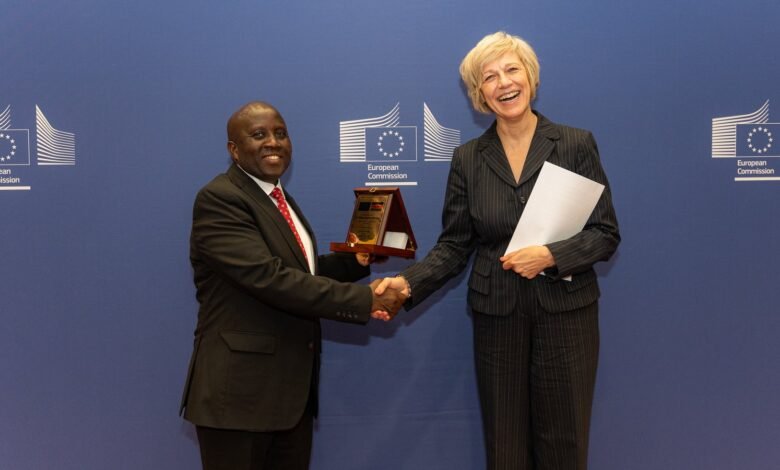
The EU and Kenya are a step closer to a deal that would let personal data move freely between them. Officials met in Brussels on 23rd and 24th November 2026 and said they’ll now start the formal process of adopting it. No African country has a deal like this with the EU.
At the same meeting, the two agreed to work together on artificial intelligence (AI) and discussed internet cables, digital identity and online safety. It was part of a Digital Dialogue, a series of policy talks that began in March. So what would the data deal change, and when?
Think of a customer in Europe who phones an online shop about a late parcel. The call may be answered in Nairobi, because the shop pays a company there to run its customer support. To help, the person answering has to see the customer’s name, address and order, so that data has gone from Europe to Kenya.
EU data law, known as the GDPR, restricts sending personal data to most countries outside the bloc. That’s why the shop normally needs safeguards first. The usual one is a set of contract terms the European Commission has already approved, plus an assessment of the other country’s laws.

The EU’s half of the deal is called an adequacy decision, and it takes those steps away. The Commission formally finds that a country protects personal data well enough, so data can go there with no further safeguard, as if it were moving between two EU countries. The shop could then hire the Nairobi company without the extra terms or the assessment. By our count, 16 countries and territories have a decision today, including Japan and Brazil. The deal works both ways, so Kenya’s Data Commissioner would issue a separate decision recognising the EU.
When the data deal could take effect
Talks on the data deal began in 2024, and both sides announced on 16th November that they’d finished. Next, the Commission publishes a draft decision. The European Data Protection Board, which brings together the EU’s data regulators, gives an opinion. Representatives of EU countries then have to approve it before the Commission adopts it.
No date has been announced. Japan took just over six months from the end of its talks in 2018 to adoption. South Korea took about eight and a half, from March to December 2021. On those timings, we think Kenya’s would come between late May and early August 2027.
The Commission reviews each decision at least every four years and can suspend or repeal it. We think that would give Kenya a reason to keep its data rules close to the EU’s.
AI, cables and digital ID
Kenya will partner with the EU’s AI Factories. An AI Factory brings a supercomputer, data and specialists together, so a European startup or researcher gets the machine and expert help. The joint work covers languages and agriculture.
Kenya and the EU also committed to improving access to compute, the processing power needed to train and run AI models. They’re exploring a shared centre in Kenya for startups, smaller companies and research institutes. John Tanui, Kenya’s Principal Secretary for ICT, says the AI Factories partnerships are backed by EUR 10 million. That’s about KES 1.4 billion (using KES 142.50 per EUR 1 on 25th November 2026). A new partnership will also help smaller tech companies on both sides find business with each other.
The two sides went over European-backed internet projects already planned, including 3,000 km of overhead fibre, Wi-Fi hotspots in 400 remote communities and internet for 3,000 schools, health centres and digital hubs in all. Then there’s Blue-Raman, an undersea cable designed to link Europe and India. Extending it to Kenya and Tanzania would give internet traffic another route. In June, Kenya’s President William Ruto welcomed EUR 37 million, or about KES 5.3 billion, in EU support for an extension. But the joint statement says one to Kenya and Tanzania “remains under discussion”.
Officials will work on making digital ID systems compatible, including with the EU’s digital wallet, a phone app for proving who you are. There’s no agreement to accept each other’s IDs. Last month, we covered a test of ID checks across three African countries that used made-up records. Online safety talks will look especially at protecting children.
A roadmap was launched too, but the joint statement doesn’t include it. It also doesn’t say how much money is going into AI, which European centres will be involved or how a startup would apply.
And until the EU adopts its half of the data deal, nothing changes for that online shop. It still needs those contract terms or another safeguard before its customers’ details can be handled in Nairobi.








Join the discussion