

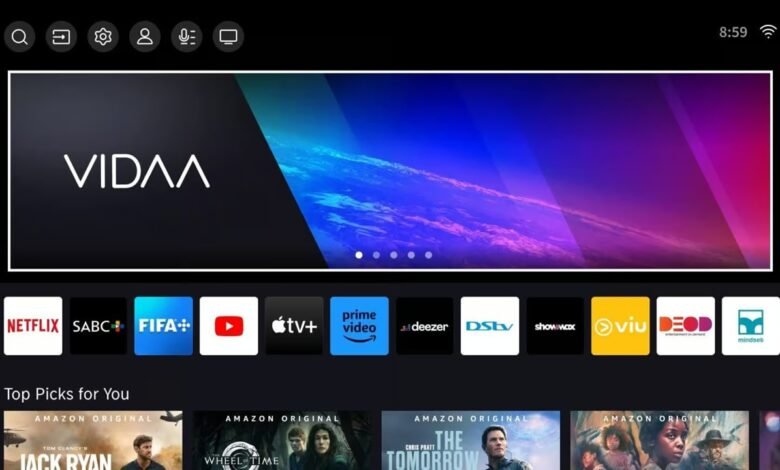
Gabriel Werneck had turned off Personalised Ads on his Hisense TV and thought that covered tracking. It didn’t. While there was sound, the TV kept sending a pattern made from it to Nexxen, an Israeli advertising company, about every 2.7 seconds. The connection closed after he unticked a different box, “Agree to Enhanced Viewing Service”.
His findings, published on 23rd November 2026, cover a UK 55U65QEVS. It runs VIDAA, TV software from a Hisense subsidiary now called V. So is the TV recording you? Going by his evidence, not this way.
If you’ve ever held up your phone so an app could name a song, you’ve seen the idea. Your phone needs its microphone for that, but a TV doesn’t, because the sound is already inside it. On Werneck’s TV, a background program copies the sound that goes to the speakers and leaves the microphone alone. A separate voice program kept the microphone open, but he saw nothing from it leave the TV.
About four times a second, the tracking program takes the last second of sound and splits it into 72 bands, from deep to high-pitched. Each band gets a yes-or-no mark: is it louder than the average of those below it? Those marks hold no sound, so you can’t play them back. But the same film gives nearly the same marks every time, so a company that already has them can line yours up and recognise it. That’s automatic content recognition, or ACR. In September, we covered LG’s version.

Each message carries ten sets of marks, the time, the app’s name, the input number and a device ID that never changed in his capture. The messages are encrypted, but he’d already taken control of the TV and read them on the way out. To check, he captured about a minute of Big Buck Bunny, a free film, and made his own marks from its soundtrack. They matched 88.5% of what the TV sent. Unrelated audio matches about 55%. Nexxen had no match for that film. Earlier that day, while he watched something else, the TV had saved a match with only the genre, Series and Documentary.
Turning off Personalised Ads didn’t help because it only decides whether ads are targeted with the TV’s advertising ID. ACR has its own consent, Enhanced Viewing, which had been on since setup day. He doesn’t say how it got ticked, though “Select All”, the first choice on the setup screen, ticks it.
VIDAA does disclose a lot of this. Its privacy policy says you have to opt in, that the service matches your TV’s sound, and that it helps Nexxen and its partners choose ads for the TV and other devices on its IP address. The service can also adjust picture and sound to what you’re watching. The TV lists that use first and Nexxen’s ad profile about you third.
Advertisers want to know who watches what, and Nexxen has put USD 60 million or about KES 7.8 billion (at KES 130 per USD 1 on 25th November 2026) into V, for about 6% of it. Nexxen also has exclusive access to the ACR data until at least the end of 2029.
Werneck didn’t capture what’s sent for HDMI inputs, but Nexxen says its ACR covers media players and gaming consoles. In October, Northeastern University researchers found HDMI tracked on another VIDAA TV, a Supersonic sold in the US, while the Netflix and YouTube apps weren’t. An open server also let them read results from more than a million TVs. It now needs a login, but that TV’s messages were still unencrypted.
How to turn it off
On Werneck’s TV (names vary by firmware):
- Settings > Support > Disclaimer and Privacy > Data Sharing, Privacy and EULA.
- Untick “Agree to Enhanced Viewing Service” and “Allow Data Sharing to see Ads relevant to you”. Leave the privacy policy and licence agreement ticked and press Agree.
- In Settings > System > Advanced Settings > Enhanced Viewing Settings, check that everything is off.
With the first box unticked, the tracking program sent nothing for a minute. But that was on a menu, and it sends nothing in silence anyway. He hasn’t yet checked during a video or after a reboot or update. The program also keeps reading the sound without connecting. On Northeastern’s VIDAA TV, opting out worked.
Werneck tested one UK TV, so yours may differ. We found no public reply from Hisense, V or Nexxen. We think a consent box that feeds an ad company should say so in its name. Untick it, and check again after a big update or factory reset.







Join the discussion