

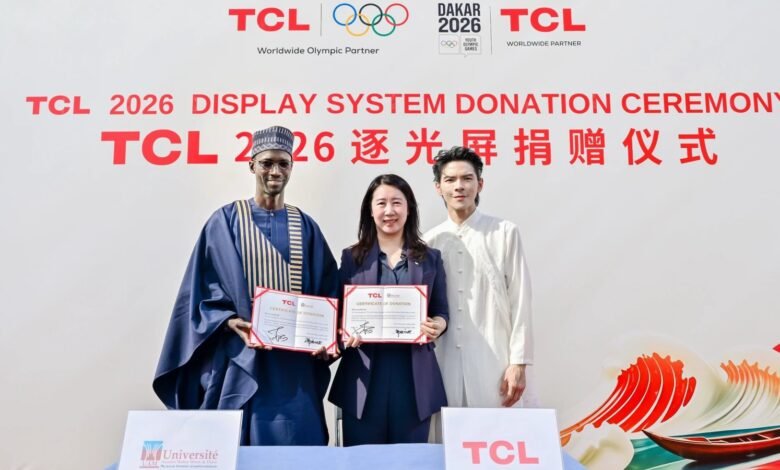
TCL has donated an ultra-low-power, solar-powered display system to Université Amadou Mahtar Mbow (UAM) in Senegal. The UAM campus will also serve as the Youth Olympic Village during the Dakar 2026 Youth Olympic Games, and the screen will work as an outdoor information hub on the campus.
TCL, a Worldwide Olympic and Paralympic Partner, handed over the system in Dakar on 30th October 2026. The ceremony was attended by IOC President Kirsty Coventry, UAM President Professor Mababa Diagne, Senegal’s Higher Education Minister Boubacar Camara, TCL Charity Ambassador Jacky Heung and Sunny Yang, General Manager of TCL Industries Middle East and Africa.
“Powered by TCL’s advanced display technology, this new display system will create new possibilities for our campus facilities and support development for both students and faculty,” said Professor Diagne.
Yang said TCL wants the donation to show how energy-efficient technology can support development in the communities it sells to. “At TCL, we believe that our growth in Africa must go hand in hand with our responsibility to the communities we are part of,” she said.

How the display stays bright on so little power
The donated system is built around a 75-inch high-brightness Field Sequential Color (FSC) panel from TCL CSOT, TCL’s display-making arm. It reaches 4,000 nits of brightness while drawing about 300W. For context, most TVs in a living room peak somewhere between a few hundred and around 1,000 nits.
A conventional LCD makes colour by shining a white backlight through a layer of red, green and blue colour filters, one for each sub-pixel. Those filters block most of the light that passes through them, so the backlight has to work harder, and use more power, to make the screen bright. An FSC display drops the colour filters entirely. Instead, the backlight switches rapidly between red, green and blue light, and the eye blends the flashes into a full-colour image.
Because less light is thrown away, more of it reaches the viewer. TCL puts the panel’s transmittance, the share of backlight that makes it through the screen, at over 15%. That is how the display delivers outdoor brightness at roughly half the power consumption of comparable displays, which in turn is what makes running it on solar power practical.
So for anyone walking across the UAM campus, the screen should stay clear and readable even in direct Dakar sunlight.
TCL says the technology is part of TCL CSOT’s push for better display performance and energy efficiency, and of the company’s wider Screen Universe vision of bringing advanced screens into everyday settings.
Murals and young artists in Dakar
Beyond the display, TCL is backing local culture in Dakar through TCLArt, its art-focused initiative. The company is taking part in Yeesal, an urban art project that works with Senegalese artists and communities to paint large public murals.
The project supports 43 artists, especially creators under 35, whose work draws on African athletes, cultural diversity and the hopes of young people. The murals will stay on as permanent parts of Dakar’s streets. TCL ties the project to TCLYoung, its programme for the next generation of creative talent.
TCL’s two decades in Africa
The donation and the Yeesal partnership build on more than 20 years of TCL in Africa. The company entered the African market in 2004, and its TVs and home appliances are now sold in nearly 50 African countries, backed by six sales subsidiaries and three regional business units.
TCL has also been building up its own retail presence on the continent. It opened its first brand experience store in Africa in Johannesburg, and it has set up its own retail and distribution channel in Kenya. The company says its local operations, combined with its global technology, are meant to bring it closer to African customers and to serve them better.
Founded in 1981, TCL now has 50 R&D centres and 47 manufacturing bases worldwide and operates in more than 160 countries and regions. It is an official Worldwide Olympic and Paralympic Partner in the Home Audiovisual Equipment and Home Appliances category.
More on TCL’s products in the region is on TCL East Africa’s website.








Join the discussion