
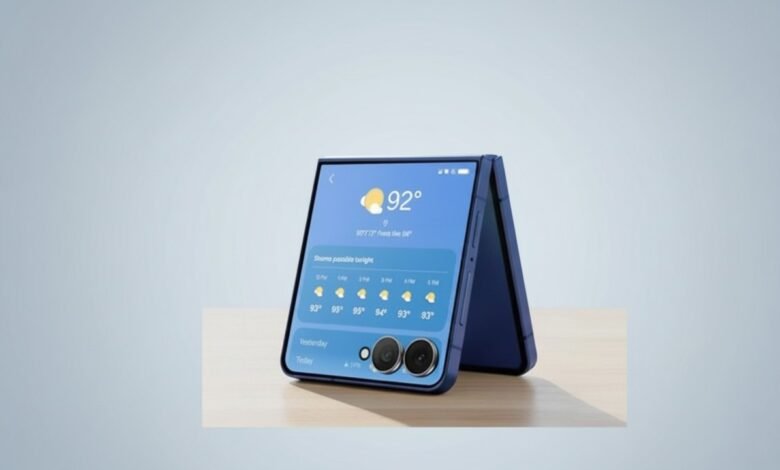
I’ve been using the Samsung Galaxy A56 for a bit now. It’s the first Samsung I’ve seriously used in years, and the second thing that immediately grabbed my attention after the heating up experience wasn’t the camera or display. It was the Samsung Weather app. Yes, the weather app. And not in a “wow, this is so cool” kind of way, but more of a “wait… why is this so different from Google’s?” moment.
Back in August, I published an article about how Google Search is quietly transforming how we check weather in Africa, thanks to its AI-powered hyperlocal forecasts. That upgrade has been a lifesaver for me as a farmer, especially in rural Western Kenya where rain plays games like Chelsea FC in a title race—exciting but unpredictable. Google’s weather system lets me check the conditions for my actual village. Not the location. Not the ward. My village.
And then I met Samsung Weather
Once I switched to the Galaxy A56, I naturally compared its default Samsung Weather app with Google’s. And right there was the problem—Samsung Weather doesn’t get that “where I am” can be very different from “around here.”
For context, my ward (Busali, Sabatia sub-county) covers roughly 24 square kilometers, according to the IEBC. In Western Kenya, that’s enough land for it to be raining here and completely sunny less than 2km away. That difference isn’t a minor inconvenience; it determines whether I’m heading to the farm or sheltering my seedlings.

Google gets this. Samsung doesn’t.
For reference, the screenshots below show Google Search weather forecast for two neighbouring villages that are just 2km apart.
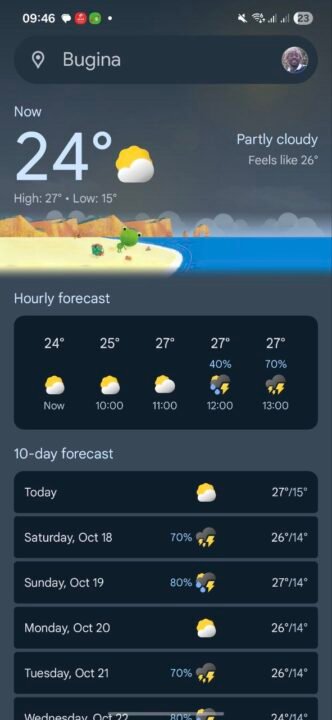
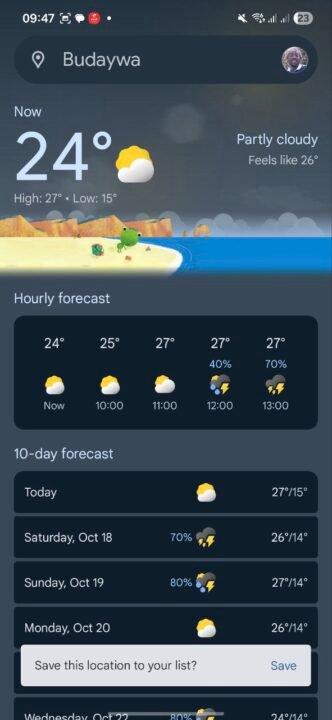
While Samsung Weather only gives me forecasts for the entire ward, Google lets me zoom right into my village and even other neighbouring villages, which technically represent sub-locations. That’s because of Google’s refined MetNet AI model, which quietly went live in Kenya and across Africa this year. The model can:
- Predict rain within a 5km radius
- Provide updates every 15 minutes
- Forecast up to 12 hours ahead
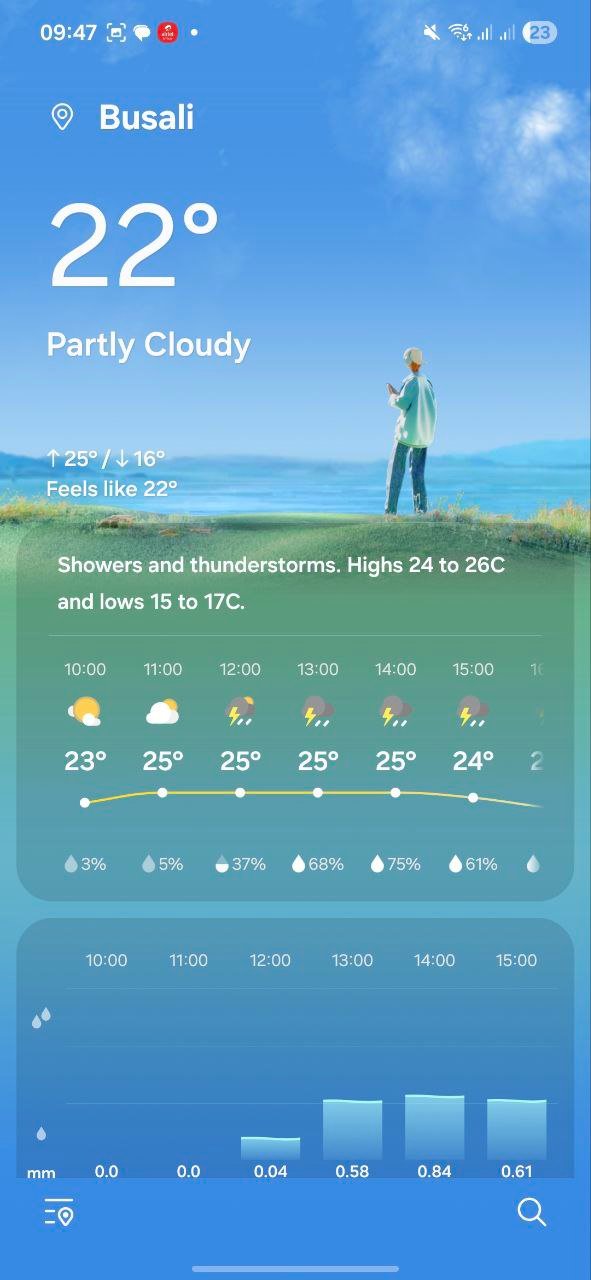
That’s why I can pull up Google Search and see rain warnings that apply to my actual shamba, not the general ward. Samsung Weather, meanwhile, throws me a blanket 24-square-kilometer forecast like “good luck, bro.” And as you can see in the screenshot below, the weather forecast for the entire ward isn’t the same with that of my local village (screenshot above for Bugina).
Samsung Weather isn’t all doom and clouds
In fact, I actually love what Samsung has done with the design of its new One UI 8 Weather app. Compared to the One UI 7 version, the refreshed app brings a fun animation that features a little character walking from the right side of your screen to the center, dressed according to the weather.
Hot and sunny? They’re in summer clothes and a cap. Rainy? Out comes the umbrella or raincoat. Cold? Boom—heavy layers. On top of that, Samsung packs a lot of helpful info in the app, including hourly temperature and precipitation, UV ray strength, sunrise and sunset times, pollen data, weather tips based on conditions, and even comparisons with yesterday’s weather. It also gives you an 8-day forecast starting from yesterday, with tiny cards that tell you what you might wear or exercises to do depending on the weather.
On the other hand, Google serves you the iconic frog mascot and a clean 10-day forecast with no animations, no outfit advice, no pollen charts. Samsung clearly wins on interface and feature richness.
But when it comes to precision, Google reigns
At the end of the day, I’d rather know if it’s going to rain on my side of the village than watch an animated person in a jacket that applies to someone 7km away.
Samsung Weather may look modern, feel lively, and offer more information on-screen. But all that style doesn’t beat the substance of Google’s precise, hyperlocal forecasts that cover the areas where actual life happens—farms, homesteads, and villages.
If Samsung could license Google’s hyperlocal data or offer location granularity that narrows forecasts down to the village level, it would be unbeatable. Until then, I’ll stick to using Google Search weather just to be sure I’m not planning a sunny day in a rainy corner of Vihiga.






Join the discussion