


Kenya’s persistently high mobile data and electricity prices are not primarily the result of technology limitations or lack of investment. They are the outcome of weak competition and regulatory failures.
That is the assessment of the World Bank’s Kenya Economic Update for November 2025, which identifies telecommunications and electricity as two sectors where legal and regulatory barriers are directly inflating costs for consumers and businesses.
In the telecoms sector, the report highlights the limited use of effective competition tools to address Safaricom’s market dominance and significant market power. According to the World Bank, Kenya has struggled to implement robust ex-ante and ex-post remedies that would constrain Safaricom and open space for other challengers.
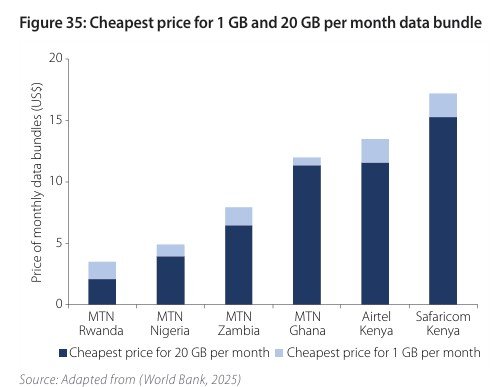
Spectrum allocation is another concern. The report notes that frequency management remains insufficiently market-based, limiting entry and innovation while entrenching existing operators. The result is data prices that remain high relative to income levels, slowing digital inclusion and internet usage.
Electricity shows similar structural problems. The World Bank highlights non-competitive power purchase agreements, limited third-party access to transmission infrastructure, and governance challenges within sector institutions. These issues have pushed Kenya’s electricity prices among the highest in the region, directly raising costs for data centres, ISPs, cloud providers, and startups.
The economic consequences are significant. According to the report, improving competition in foundational input sectors such as telecoms and electricity could increase Kenya’s GDP growth rate by 1.35 percentage points, while also lowering consumer prices and boosting productivity.
The takeaway is that high mobile data and electricity costs in Kenya are not an accident; they are the consequence of a regulatory environment that has failed to enforce competition, leaving consumers and startups footing the bill for sector inefficiency.