


There’s a peculiar thing about being born in early January in Kenya. By the time your birthday rolls around, the country is broke, WhatsApp groups are quiet, and everyone is busy figuring out how to survive Njaanuary after December’s sherehe.
My birthday falls on January 4 — right in that survival zone. Over the years, I’ve often found myself so deep in work or life that I’ve forgotten my own birthday altogether. And oddly enough, one of the few constants during those years was Safaricom.
For a long time, I could rely on waking up to a simple SMS from the telco giant: a happy birthday message, a reminder that I was a “valued customer,” and a complimentary 1GB data bundle valid until midnight. No effort required. No follow-ups. No verification hoops. It wasn’t much, but it felt thoughtful — especially on a day when you didn’t expect much else.
It became a ritual.
The birthday SMS that never came
This year, however, things played out very differently.
January 4 came and went quietly. No birthday SMS. No 1GB bundle. Nothing. Given that social media has recently been full of people asking whether Safaricom quietly killed the birthday data perk, I decided to wait it out — just in case the message was delayed.
It never came.
So I did what most Kenyans do when something Safaricom-related goes missing: I went to social media and reached out to customer care.
That’s when the experience took an unexpected turn.
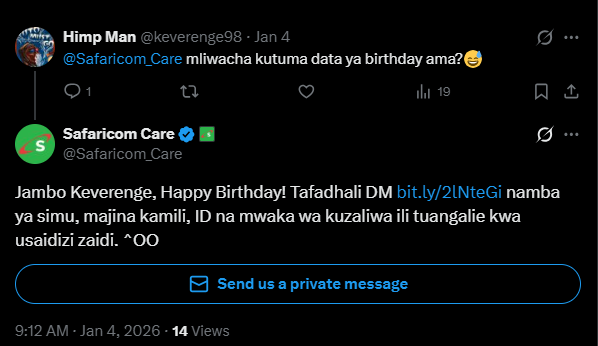
“Tafadhali DM ID na mwaka wa kuzaliwa”
Safaricom responded publicly, wished me a happy birthday, and asked me to DM my phone number, full names, ID number, and year of birth so they could “check and assist further.” This alone proved that Safaricom hadn’t ended the tradition as earlier feared. It just needs nudging to come through.
That was surprising.
For years, Safaricom never needed any of this to send a birthday SMS or data bundle. My SIM card is registered. My M-PESA account is verified. The company quite literally knows when I was born.
Still, I complied.
In the DM, I was told the bundles would be awarded before the end of the day and that I should stay patient. When I asked why these details were suddenly necessary now — when they never were before — the explanation was vague at best.
“A lot can change in the number and verification is required.”
That was it.
Six hours later, still nothing
Six hours passed. No SMS. No data. I followed up again.
This time, the issue was escalated into a ticket.
“Happy Birthday, Hillary. Please allow us 24 hours to follow this under ticket number 1-73WERTGQ.”
Twenty-four hours.
For a 1GB birthday bundle that used to arrive automatically — without a single message sent by the customer — that timeline felt absurd. When I protested, the response was polite but firm.
“Kindly allow us to follow up.”
At that point, it was no longer about the data.
A birthday wish… one day late
The next morning, Safaricom finally sent the birthday SMS along with the promised 1GB bundle, valid until midnight.
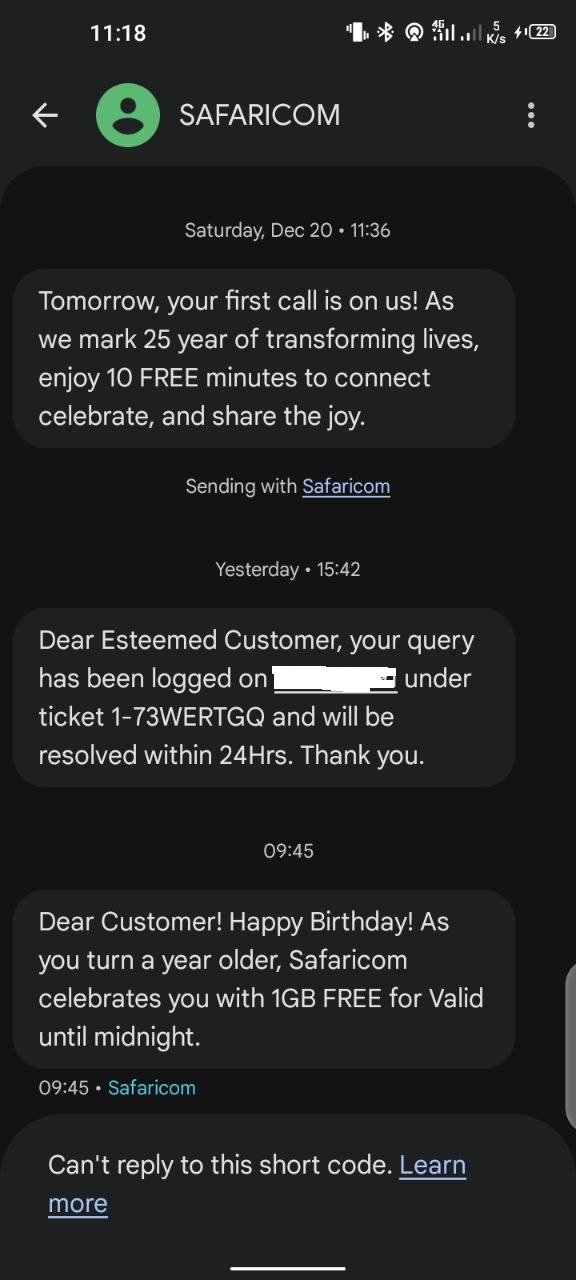
Technically, the issue was resolved.
But the timing was telling. The birthday wish came a full day late. For a company that holds customers’ birth dates through SIM registration and M-PESA KYC processes, the delay raises uncomfortable questions about internal systems, automation, and service consistency.
The data itself wasn’t the problem — it was still usable. What stood out was how much effort it now took to receive something that had once been effortless.
Is the hassle worth it?
That’s the bigger question here.
Does every Safaricom customer now need to follow up, DM personal details, wait hours, get assigned a ticket, and push customer care just to receive a birthday SMS and a small data bundle?
What about customers who don’t live on social media, aren’t comfortable pushing support agents, or simply assume the perk was discontinued?
Do they just miss out?
Safaricom’s birthday data wasn’t just a freebie. It was a subtle loyalty touchpoint. A small, automated gesture that made customers feel seen, even during financially dry months like January.
Turning that into a manual, ticket-based process strips it of its charm.
A small issue that reflects a bigger shift
On its own, this isn’t a major scandal. After all, it’s just 1GB of data and an SMS. But experiences like this add to a growing list of small service regressions that long-time Safaricom users have quietly noticed over the years.
Processes that were once smooth now require follow-ups. Things that used to “just work” now need verification, escalation, and patience.
And while I did eventually get the birthday wish and data, the experience left a lingering thought: this never used to be this hard.
For a company of Safaricom’s scale, and one that prides itself on customer experience, that should be worth reflecting on.