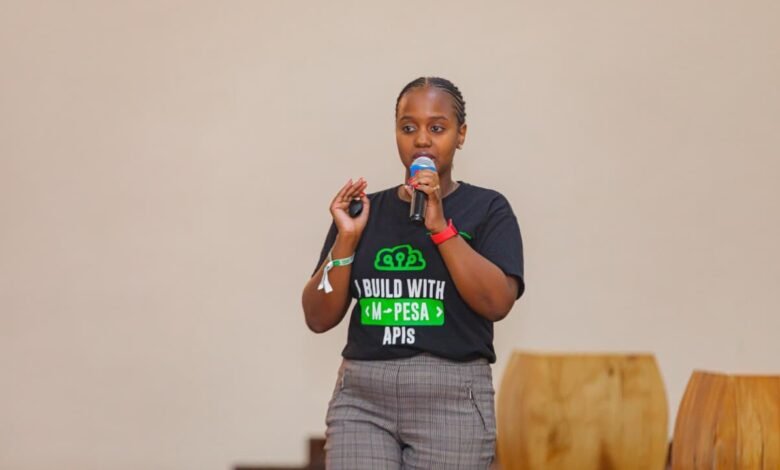

Safaricom unveiled Daraja 3.0 in November 2025, the latest iteration of its M-Pesa API platform. The launch was accompanied by a polished marketing campaign, complete with high-production video content touting a “cloud-native” architecture, enhanced security, and the ability to build directly within the M-Pesa Super App. On paper, it promised a revolution for fintech innovation in Kenya.
However, the reality for the developers actually tasked with integrating these systems has been starkly different. Faced with a testing environment described by the community as unstable and restrictive, one developer took the “if you want it done right, do it yourself” approach to the extreme.
Meet Pesa Playground, a locally hosted, open-source alternative that aims to do what the official Daraja sandbox reportedly cannot: behave like the real M-Pesa ecosystem.
The “happy path” problem
To understand why this tool exists, you have to look at the disconnect between Safaricom’s presentation and the developer experience. While the official promotional material highlights reliability, the developer community has painted a picture of a friction-heavy workflow.
A primary grievance with the official Daraja sandbox is its reliance on what is known in software testing as the “happy path.” In the official environment, API calls almost always succeed. While this sounds positive, it is a nightmare for developers who need to know how their app handles failure. If a sandbox cannot simulate an “insufficient funds” error or a “wrong PIN” entry, the developer has no way of knowing if their app will crash when those inevitably happen in the real world.
Furthermore, users have expressed frustration over unstable connections that drop every few minutes, and new security protocols that require Two-Factor Authentication (2FA) just to read the documentation. This has left many feeling that the new version is merely a cosmetic upgrade that ignores long-standing underlying issues.
Enter Pesa Playground
While most of us were preparing for Christmas, a developer identified as OmentaElvis released Pesa Playground to solve these exact headaches. Unlike the official solution which requires an internet connection and complex tunneling tools to expose a local computer to Safaricom’s servers, Pesa Playground runs entirely offline on the user’s machine.
The tool is not just a wrapper for the official API; it is a full simulation of the M-Pesa economy.
Key features and capabilities:
- Local-first architecture: It runs on
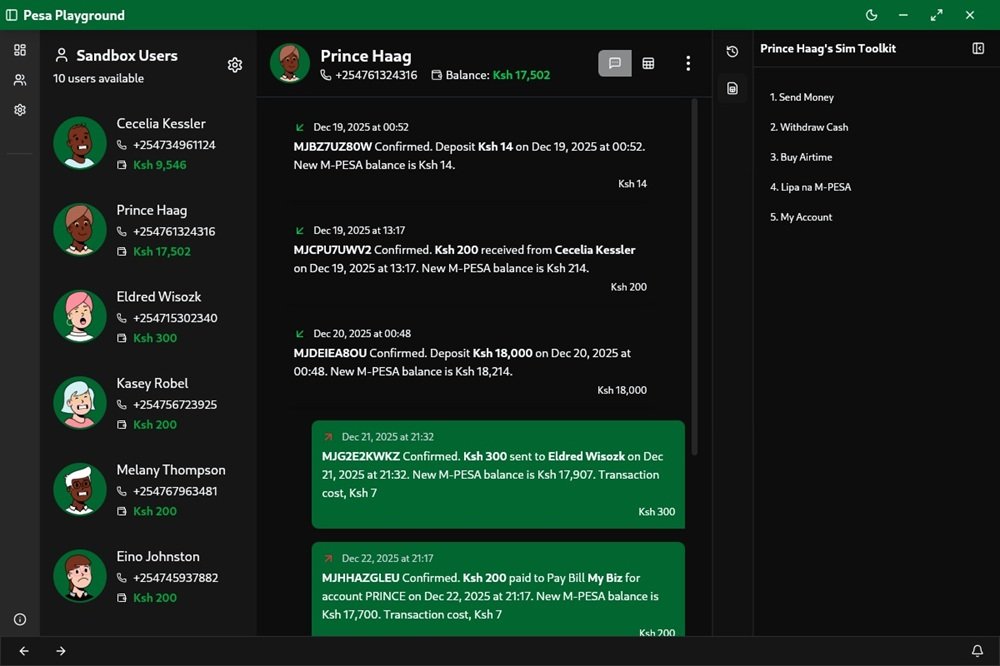
localhost(specifically referencing Docker ports like 3001 and 8001), eliminating the need for HTTP proxies or internet connectivity to test payment flows. - The “mini-economy”: The simulator maintains a real-time ledger. It creates simulated users with persistent balances. If User A sends money to User B, the specific amounts are deducted and credited instantly within the local database.
- Edge case testing: Perhaps most importantly, it allows developers to break things on purpose. Users can simulate timeouts, declined transactions, and canceled STK pushes to ensure their applications can handle rejection gracefully.
- Visual interaction: It includes a visual interface that mimics the phone’s SIM Toolkit menu, allowing developers to manually approve or reject a payment prompt on their screen to see how their backend code reacts.
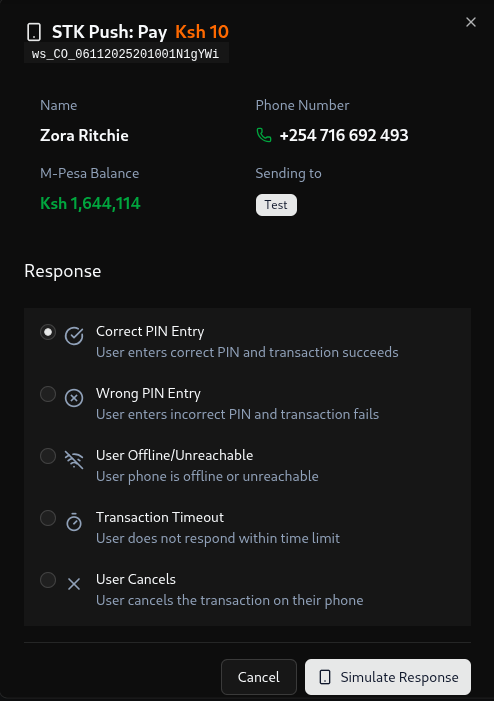
The speed at which this tool is evolving highlights the urgency of the community’s need. While Safaricom released Daraja 3.0 in November 2025, Pesa Playground hit its version 1.0.0 milestone on December 22, 2025.
Since then, the project has seen a flurry of updates:
- December 25, 2025 (v1.1.0 – v1.2.0): Added persistent backend settings and fixed race conditions in the UI.
- January 1, 2026 (v1.3.0 – v1.4.1): A massive update day that introduced self-diagnostics, database migration strategies, and critical fixes for currency unit mismatches that were causing user balances to generate with absurdly high values.
The project is built using Rust and Tauri, making it lightweight and cross-platform (Linux, Windows, and Docker), and operates under a Free and Open-Source Software (FOSS) license.
The reception to Pesa Playground suggests it is filling a significant void. While some techies have previously abandoned M-Pesa Daraja entirely in favour of aggregators like PesaPal due to integration difficulties, this new tool offers a way to stick with direct M-Pesa integration without the associated pain.
So, while the tech community waits for the official Daraja platform to become more “plug-and-play” and transparent, they now have a community-built engine that allows them to code, trigger, and respond without hitting a wall. As the developer noted in their documentation, the goal is to stop relying on support emails and start relying on code that actually works.